Exploring the Meaning of Malakos in Greek
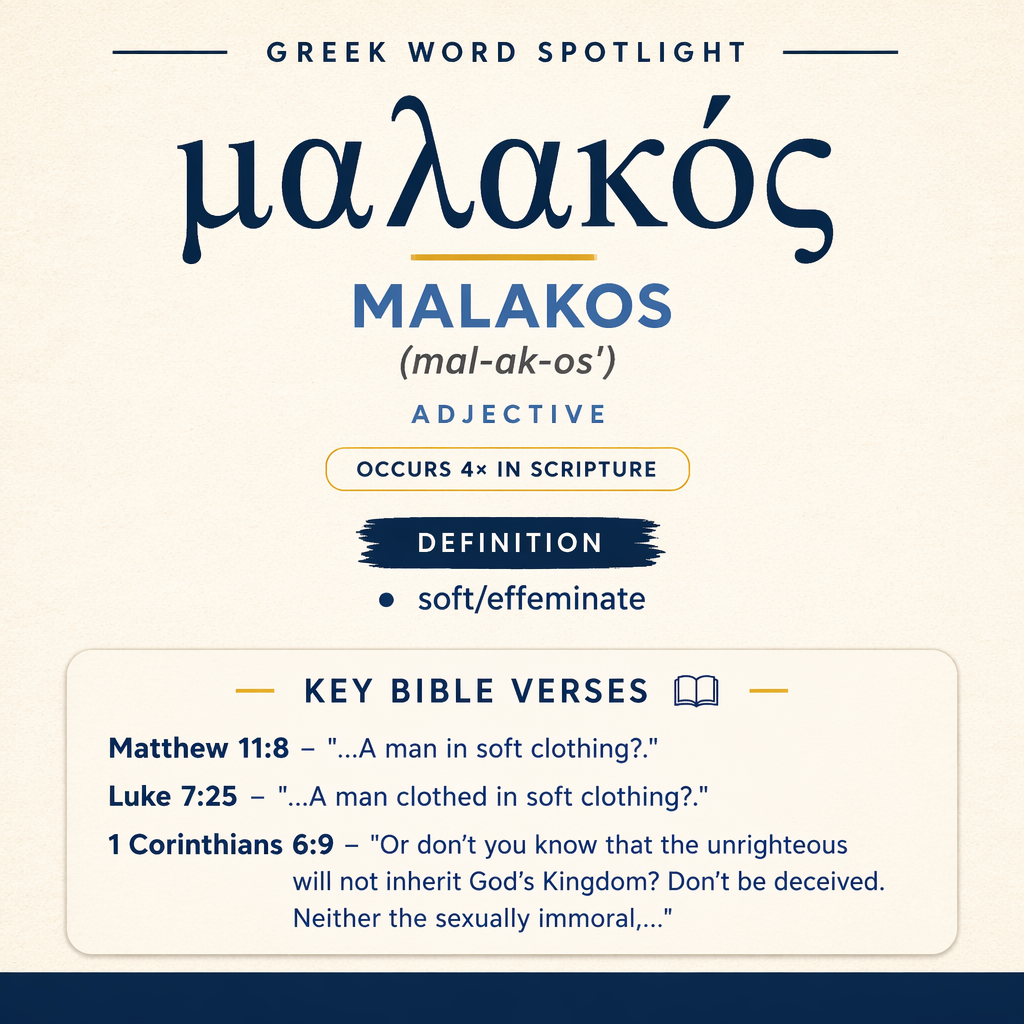
μαλακός means “soft/effeminate” and occurs 4 times in Scripture, including Matthew 11:8, Luke 7:25, and 1 Corinthians 6:9.
Pauline Occurrence
It appears in 1 Corinthians 6:9 within a warning that the unrighteous will not inherit God’s Kingdom.
Learn More →μαλακός describes what is “soft,” and it appears in sayings about “soft clothing” and in a moral warning that includes “effeminate” as a category. The passages place the word in settings that contrast outward refinement with the message being sought, and they also use it in a list that warns against being misled about who inherits God’s Kingdom.
Occurrences
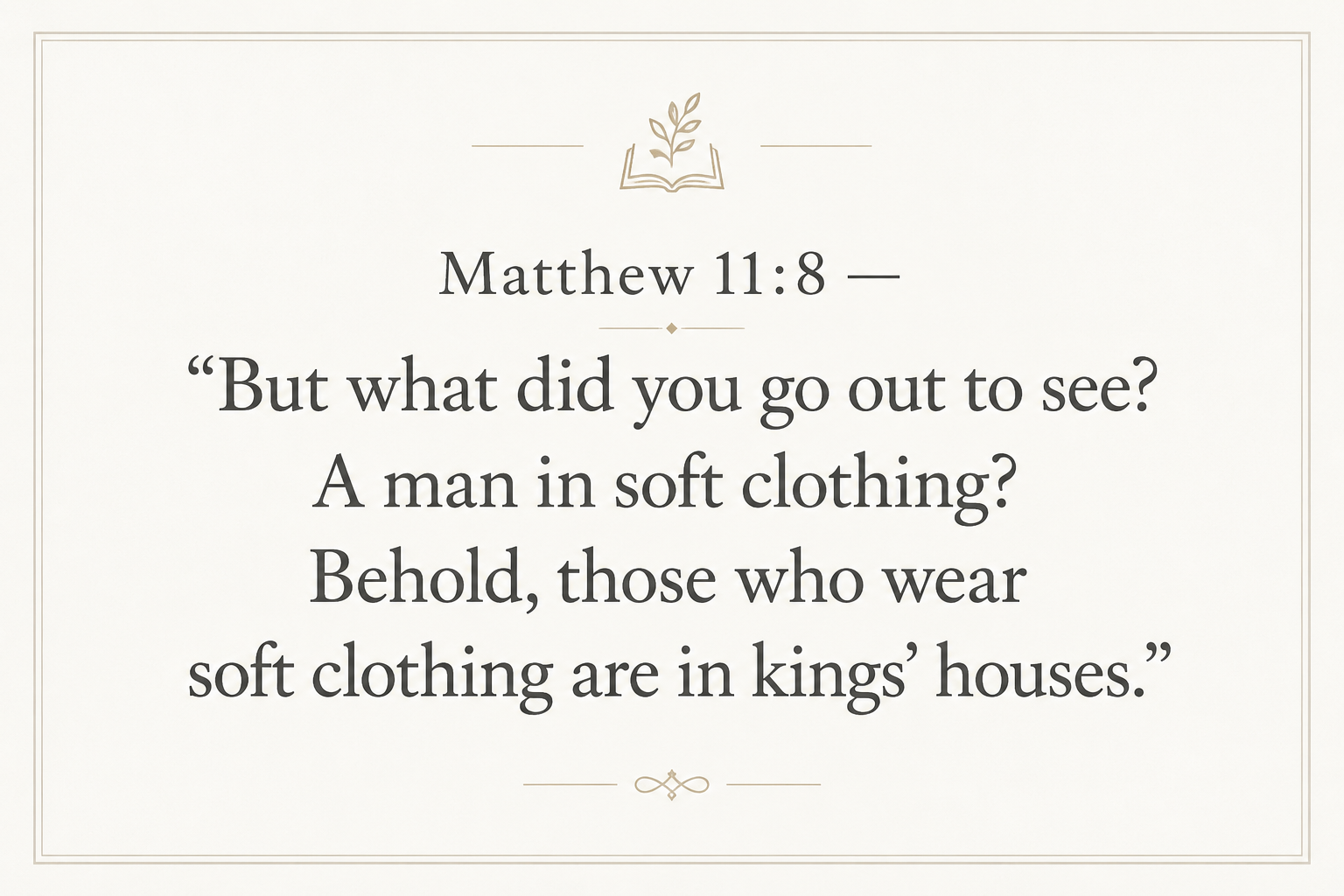
Matthew 11:8 — “But what did you go out to see? A man in soft clothing? Behold, those who wear soft clothing are in kings’ houses.”
Here μαλακός functions in a concrete, visible way: it qualifies “clothing” as “soft.” The question (“what did you go out to see?”) pushes the listener to examine expectations—what kind of figure they went out to encounter. “Soft clothing” becomes a marker of a particular social setting, since Jesus immediately locates it: “those who wear soft clothing are in kings’ houses.” The word therefore contributes to the contrast between a public search and royal comfort. In this scene, softness is not an abstract quality but an observable texture and style associated with courtly surroundings. The rhetorical force depends on the audience recognizing that “soft clothing” fits “kings’ houses,” not the place where they had “gone out” to see someone.
Luke 7:25 — “But what did you go out to see? A man clothed in soft clothing? Behold, those who are gorgeously dressed, and live delicately, are in kings’ courts.”
Luke’s parallel wording again uses μαλακός with “clothing,” but it expands the picture around it. The question “A man clothed in soft clothing?” is followed by a fuller description: “those who are gorgeously dressed, and live delicately, are in kings’ courts.” In this context, softness signals a whole mode of life characterized by luxury and careful living, paired with being “gorgeously dressed.” The placement “in kings’ courts” echoes Matthew’s “kings’ houses,” keeping the same social contrast: the softness of garments belongs to the sphere of royal privilege. Within the verse, μαλακός helps establish a recognizable image—fine apparel—as a foil for whatever kind of person the audience actually went out to see. The word’s contribution is therefore both sensory (softness of fabric) and social (softness as part of courtly presentation).
1 Corinthians 6:9 — “Or don’t you know that the unrighteous will not inherit God’s Kingdom? Don’t be deceived. Neither the sexually immoral, nor idolaters, nor adulterers, nor male prostitutes, nor homosexuals,”
In this verse, μαλακός is represented by the English gloss “male prostitutes,” placed among a series of descriptions under the heading “the unrighteous.” The framing statements (“will not inherit God’s Kingdom” and “Don’t be deceived”) show that Paul is not offering a neutral description but a warning meant to correct false confidence. In the flow of the list—“Neither the sexually immoral, nor idolaters, nor adulterers …”—the term functions as one item in a set of behaviors or identities used to characterize those who fall under the warning. The use of μαλακός in this list draws on the word’s sense “effeminate,” now applied not to fabric but to persons, and it is placed alongside other sexual terms, which situates the word’s moral force within the admonition of the passage.

Sense and Usage
The word’s two glosses, “soft” and “effeminate,” show a semantic movement from a physical property to a personal characterization. In Matthew 11:8 and Luke 7:25, softness is straightforwardly tied to material culture—“soft clothing”—and the sayings rely on that ordinary meaning to evoke a recognizable image of comfort and refinement. Both texts connect the soft garments to a specific location: “kings’ houses” (Matthew) and “kings’ courts” (Luke). In these scenes, softness is not presented as a virtue or vice by itself; instead it serves as a sign of setting, status, and the kind of spectacle someone might expect to find when looking for an important figure. The repeated structure (“what did you go out to see?”) turns μαλακός into a touchpoint for the hearer’s assumptions, contrasting a person in royal finery with the actual purpose of their search.
By contrast, in 1 Corinthians 6:9 the word is used with the sense “effeminate,” and the context is explicitly ethical and eschatological: “the unrighteous will not inherit God’s Kingdom.” Here μαλακός is not describing something worn but describing people in a way that belongs to a moral inventory. The rhetorical environment changes the feel of the term. In the Gospels, the word helps paint a scene and sharpen a contrast between royal luxury and the setting of the search; in Corinth, it becomes part of an urgent admonition—“Don’t be deceived”—and therefore carries the weight of warning rather than the weight of imagery. The shift in application (from clothing to persons) does not erase the basic idea expressed by the glosses; it shows how one adjective can operate in different domains: tactile softness in textiles, and “effeminate” as a descriptor of a person within a vice list.
Across the passages, μαλακός also helps organize social imagination. In Matthew and Luke, softness belongs to “kings’” environments—spaces where garments, presentation, and ways of living fit the expectations of power and wealth. Luke makes this especially clear by pairing “soft clothing” with “gorgeously dressed” and “live delicately,” linking softness to an entire lifestyle. The word therefore contributes to the depiction of what courtly life looks and feels like: fine dress and delicate living. This is not argued as doctrine; it is assumed as common knowledge used to make a point. Paul’s use, on the other hand, places the word inside a boundary-setting discourse (“will not inherit”), where the concern is not who belongs in royal courts but who will inherit God’s Kingdom. The settings differ, but both uses assume that μαλακός marks something recognizable—either the feel and look of clothing, or a recognizable category of persons for moral instruction.
Imagery
The Gospel scenes attach μαλακός to a vivid visual: a “man in soft clothing” whose proper place is “in kings’ houses” or “in kings’ courts.” Softness here evokes the textures of luxury and the polished world of royalty, setting a backdrop against which the hearer is invited to reconsider what they went out to seek. In 1 Corinthians 6:9, the imagery gives way to a sober warning, and the word stands not for textiles but for persons named within a list that begins with “Don’t be deceived.” The result is a word that can conjure either the feel of expensive garments in royal spaces or the gravity of a moral admonition about inheriting God’s Kingdom.
Sources: Lexical data from Strong’s Exhaustive Concordance and the Translators Brief Lexicon of Extended Strongs for Greek (STEPBible, CC BY). Occurrence data from the Translators Amalgamated Greek New Testament (STEPBible, CC BY). Scripture quotations from the World English Bible (public domain).