
Exploring the Meaning of Loidoros in Greek
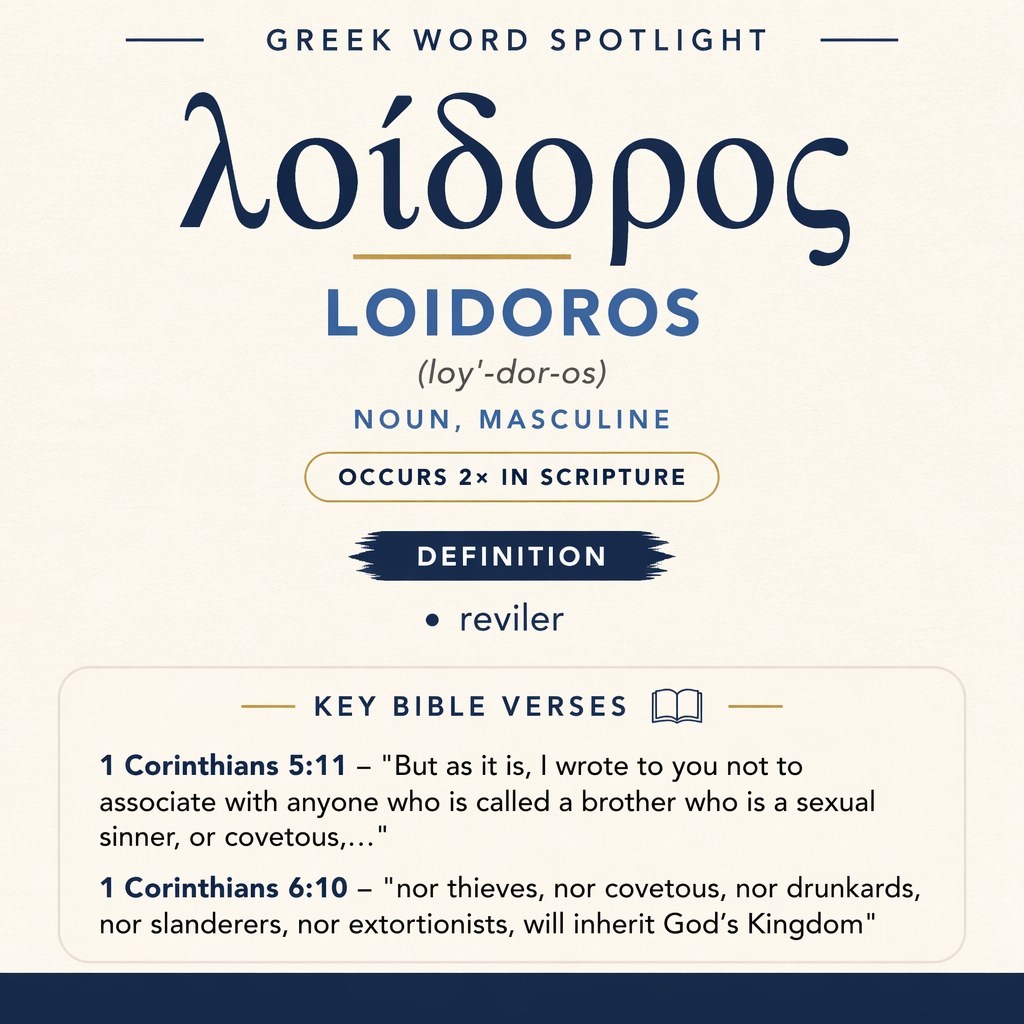
λοίδορος means “reviler” and occurs twice in Scripture, in 1 Corinthians 5:11 and 1 Corinthians 6:10.
Where It Appears
This word occurs 2 times in Scripture. Both occurrences are in 1 Corinthians.
Learn More →Context In Lists
In 1 Corinthians 5:11 and 6:10, it appears among lists of wrongful behaviors. In 6:10 it is translated “slanderers.”
Learn More →λοίδορος means “reviler” and is used in two closely connected warnings in 1 Corinthians. In both places it appears in lists that name kinds of people and behaviors that the church must treat with serious moral clarity.
Occurrences
“But as it is, I wrote to you not to associate with anyone who is called a brother who is a sexual sinner, or covetous, or an idolater, or a slanderer, or a drunkard, or an extortionist. Don’t even eat with such a person.” (1 Corinthians 5:11)
Here loίδορος (“reviler”) stands among several labels that mark a person’s public identity within the community: “anyone who is called a brother” and yet is also identified by a pattern of conduct. The verse frames the issue as one of association and table fellowship—“not to associate” and “Don’t even eat with such a person”—so “reviler” functions as a category serious enough to affect ordinary social and communal bonds. Within the list, the term is placed alongside actions and dispositions that disrupt faithfulness and communal integrity (“sexual sinner,” “covetous,” “idolater,” “drunkard,” “extortionist”). In that setting, “reviler” contributes the idea of a person whose defining trait includes harmful speech directed toward others, a pattern that is treated as incompatible with the obligations implied by being “called a brother.”
The wording also shows that the concern is not merely the presence of conflict or a single harsh moment; the verse speaks of “anyone” who bears these labels, indicating recognized character rather than an isolated lapse. The instruction is practical and relational: the community’s response to a reviler is to withhold a normal posture of association, even down to shared meals. In this scene, loίδορος marks a kind of person whose speech-driven harm is grave enough to trigger a boundary in fellowship.
“nor thieves, nor covetous, nor drunkards, nor slanderers, nor extortionists, will inherit God’s Kingdom.” (1 Corinthians 6:10)
In 1 Corinthians 6:10, loίδορος appears again in a list, but the focus shifts from immediate community practice (“not to associate… Don’t even eat”) to ultimate consequence: “will inherit God’s Kingdom.” The term is paired with other descriptors (“thieves,” “covetous,” “drunkards,” “extortionists”), and “slanderers” sits among them as one element in a broader moral inventory. In this verse, “reviler” functions as a recognized type whose life is characterized by conduct that excludes a person from the inheritance named here.
The placement of “slanderers” in the middle of the list matters for how the word is heard in context. It is not isolated as a minor interpersonal fault; it is set alongside acts commonly understood as destructive and unjust. The verse’s structure—repeated “nor… nor…” leading to a single verdict—presents reviling as part of a set of life-patterns that stand in direct tension with the Kingdom inheritance. In this scene, loίδορος points to the moral weight attached to speech that tears down others, treated with the same seriousness as other practices that exploit or degrade.

Sense and Usage
The definition “reviler” is consistently carried by both occurrences through list-style moral categorization. In each passage, the word is not used to describe a single utterance; it names a person in terms of a settled identity. The English rendering “slanderer” in both verses communicates the social shape of the term: reviling is speech that damages people, and the person characterized by it becomes a danger to the life of the community. That is why the term can serve as one member in a catalog of behaviors that demand either discipline in fellowship (chapter 5) or sober recognition of spiritual peril (chapter 6).
In 1 Corinthians 5:11, the category is applied to “anyone who is called a brother,” and that framing gives the word a specific ecclesial edge. The problem is internal: the person is publicly identified with the Christian community (“called a brother”) while also being publicly identified as a reviler. The response commanded is social and visible: the church is to withhold association and even the ordinary sign of shared meals. In that context, loίδορος names more than unpleasantness; it is a form of relational wrongdoing that distorts fellowship. Reviling is treated as something that, if embraced as a way of life, is incompatible with the mutual recognition and shared life implied by brotherhood.
In 1 Corinthians 6:10, the same term is placed within a warning about inheritance of “God’s Kingdom.” This use broadens the horizon: the community’s boundaries are not merely pragmatic but are tied to the moral reality of who belongs to the Kingdom as heirs. Here loίδορος functions as one example among several of identity-markers that, when they define a person, signal exclusion from that inheritance. The list’s logic treats reviling as part of a way of life, not an accidental misstep. The term therefore carries a steady ethical force: a reviler is someone whose speech-driven harm is not incidental but characteristic.
Together, the two occurrences show how the word works in communal discernment: it supplies a label for a recognizable pattern of speech that harms others and fractures relationships, and it is weighty enough to stand beside other categories that the passages treat as incompatible with Christian life and Kingdom inheritance. The verses also show that the church’s concern is not merely the private inner attitude behind speech but its public, relational effect—so significant that it can shape both the community’s immediate association and the warning about ultimate destiny.
Imagery in Context
Although loίδορος is a word about a person, the passages evoke concrete social scenes. In 1 Corinthians 5:11, the image is a table: ordinary shared eating is withheld—“Don’t even eat with such a person”—so the harm associated with the reviler is pictured as serious enough to interrupt daily fellowship. In 1 Corinthians 6:10, the imagery is legal and familial: an “inheritance” of “God’s Kingdom” is named, and the reviler is grouped with other wrongdoers who “will inherit” nothing there. Across both scenes, reviling is treated not as a small breach of manners but as a community-damaging, destiny-weighted identity.
Sources: Lexical data from Strong’s Exhaustive Concordance and the Translators Brief Lexicon of Extended Strongs for Greek (STEPBible, CC BY). Occurrence data from the Translators Amalgamated Greek New Testament (STEPBible, CC BY). Scripture quotations from the World English Bible (public domain).




