Exploring the Meaning of Logios in Greek
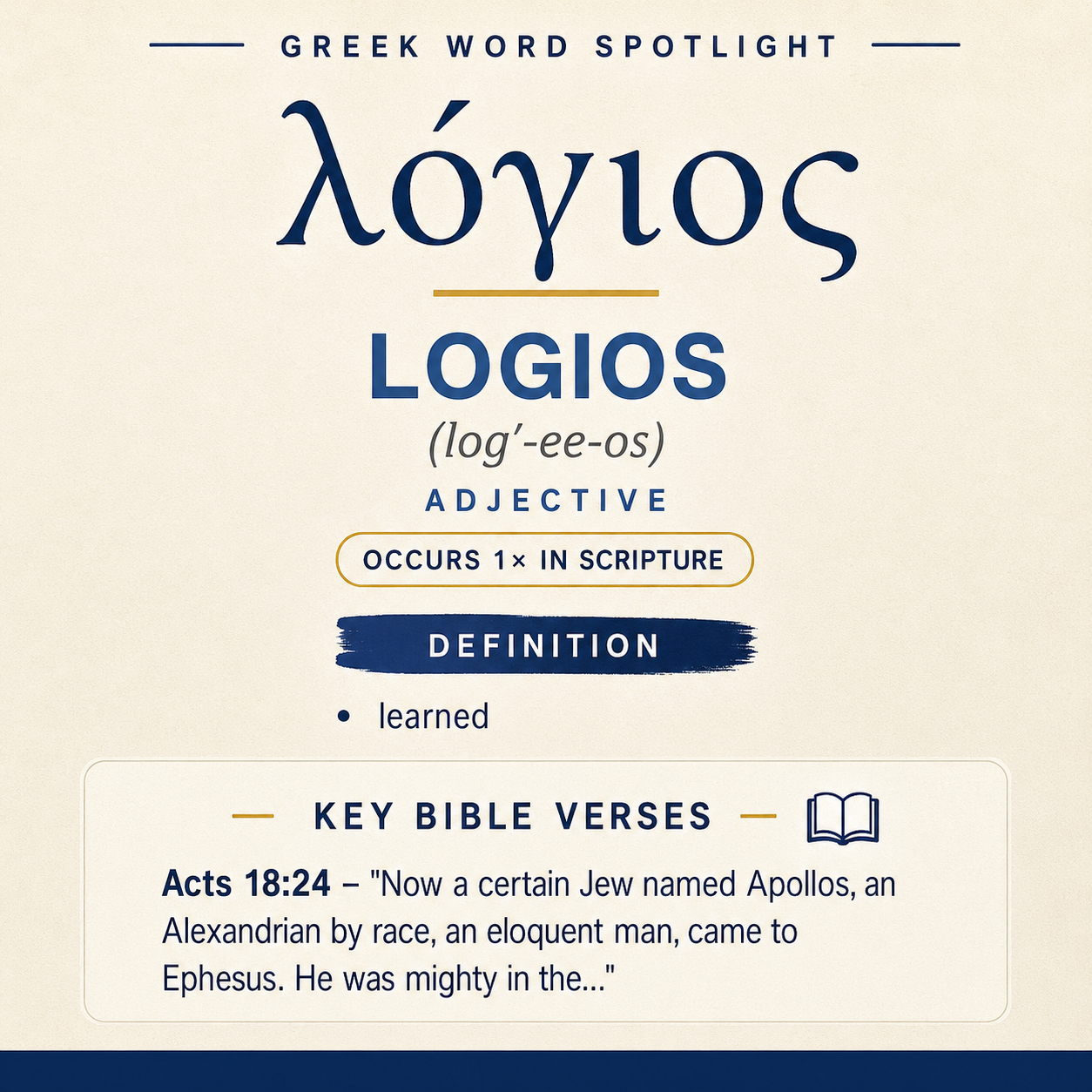
λόγιος means “learned” and appears once in Scripture, in Acts 18:24 describing Apollos.
Context in Acts
In Acts 18:24, it describes Apollos, a Jew from Alexandria who came to Ephesus.
Learn More →λόγιος means “learned” and appears once in the New Testament, describing Apollos in Acts 18:24. In that setting it helps characterize the kind of man he is as he arrives and begins to be known among believers.
Root and Related Words
λόγιος is related to logos (λόγος), “word” (Strong’s G3056). This relationship places λόγιος within a word-family associated with speech and expression, providing a natural linguistic backdrop for a description of someone marked by learning and cultivated ability.

Occurrences
“Now a certain Jew named Apollos, an Alexandrian by race, an eloquent man, came to Ephesus. He was mighty in the Scriptures.” (Acts 18:24)
In Acts 18:24, λόγιος functions as a descriptive label within a compact introduction of Apollos. The verse presents him with several identifying traits set side by side: his name (Apollos), his ethnicity (“a certain Jew”), his origin (“an Alexandrian by race”), his public capacity (“an eloquent man”), his movement (“came to Ephesus”), and his demonstrated competence (“mighty in the Scriptures”). Within this layered portrait, λόγιος contributes the idea of a person who is learned, giving a reasoned coherence to the surrounding descriptions.

The verse’s wording pairs the description “an eloquent man” with the later statement, “He was mighty in the Scriptures.” λόγιος fits this pairing by suggesting that Apollos’ eloquence is not merely a natural gift of speech but is connected to learning that can support and shape what he says. The passage does not present his eloquence as empty display; instead, it situates his speaking ability alongside strength in Israel’s sacred writings. λόγιος thus helps frame his eloquence as the expression of a mind trained and furnished by study, the sort of learning that can make a person effective when discussing weighty matters.
At the same time, Luke’s introduction in Acts 18:24 uses brief descriptive phrases as a narrative tool: before Apollos’ actions or teaching are narrated, the reader is given a sense of his capacity and credibility. Calling him λόγιος serves that narrative purpose. It prepares the audience to understand why his arrival matters and why his engagement with the Scriptures has force. In the flow of the verse, the description comes early, in the same breath as his background and his eloquence, so that “learned” becomes part of the first impression that governs how the rest of his depiction is heard.
Because the verse explicitly notes that he is “mighty in the Scriptures,” λόγιος also functions to connect learning with a particular domain of knowledge. The text does not speak of learning in a vague, generalized way; it immediately anchors the portrait in the realm of Scripture. The effect is to present Apollos as a person whose learning is relevant to the community he comes to, since the ability to handle the Scriptures is directly pertinent to instruction, explanation, and persuasion within the early Christian setting described in Acts.
Sense and Usage
The sense “learned” in Acts 18:24 operates as a character adjective, marking Apollos as someone formed by education and knowledge. In this context, learning is not portrayed as private accumulation of information; it is presented as a quality that shows itself in public competence—most visibly in eloquence and in strength with Scripture. The combination of these traits implies that learning can be both intellectual and practical: it shapes how one speaks and what one is able to do with authoritative texts.
As used here, “learned” functions evaluatively. The narrative does not introduce Apollos neutrally, as a mere traveler, but with language that establishes him as capable and impressive. “Eloquent” and “mighty in the Scriptures” are commendatory descriptions, and λόγιος stands comfortably among them as a commendatory marker of preparation and capacity. It signals to the reader that Apollos is not an amateur; his learning is part of what makes him significant upon his arrival in Ephesus.
The placement of λόγιος in an introduction also highlights how learning can be recognized socially. Acts 18:24 does not describe a hidden credential or a private claim; it presents learning as a discernible trait, something that can be attributed to Apollos as he comes into view. The verse does not explain the process by which he became learned, but it does show what that learning looks like from the outside: a man able to speak with skill and to engage deeply with the Scriptures.
In addition, the immediate linking of Apollos’ learning with the Scriptures gives the adjective a specific direction within this narrative world. Learning is valuable here because it contributes to understanding and handling sacred writings. The adjective therefore carries an implication of seriousness: it belongs to a setting where texts matter, where arguments and explanations are shaped by Scripture, and where the capacity to work with those writings is a major component of a teacher’s or speaker’s effectiveness.
Imagery
Acts 18:24 attaches λόγιος to a scene of arrival and recognition: a learned man comes into a city and is immediately described in terms of eloquence and scriptural strength. The imagery is not symbolic but concrete—movement into Ephesus, a reputation carried with him, and a mind furnished for speech and for Scripture. Within that brief introduction, “learned” is part of the verbal portrait that lets the reader “see” Apollos before hearing what he will say.
Sources: Lexical data from Strong’s Exhaustive Concordance and the Translators Brief Lexicon of Extended Strongs for Greek (STEPBible, CC BY). Occurrence data from the Translators Amalgamated Greek New Testament (STEPBible, CC BY). Scripture quotations from the World English Bible (public domain).