Exploring the Meaning of Kuriotes in Greek
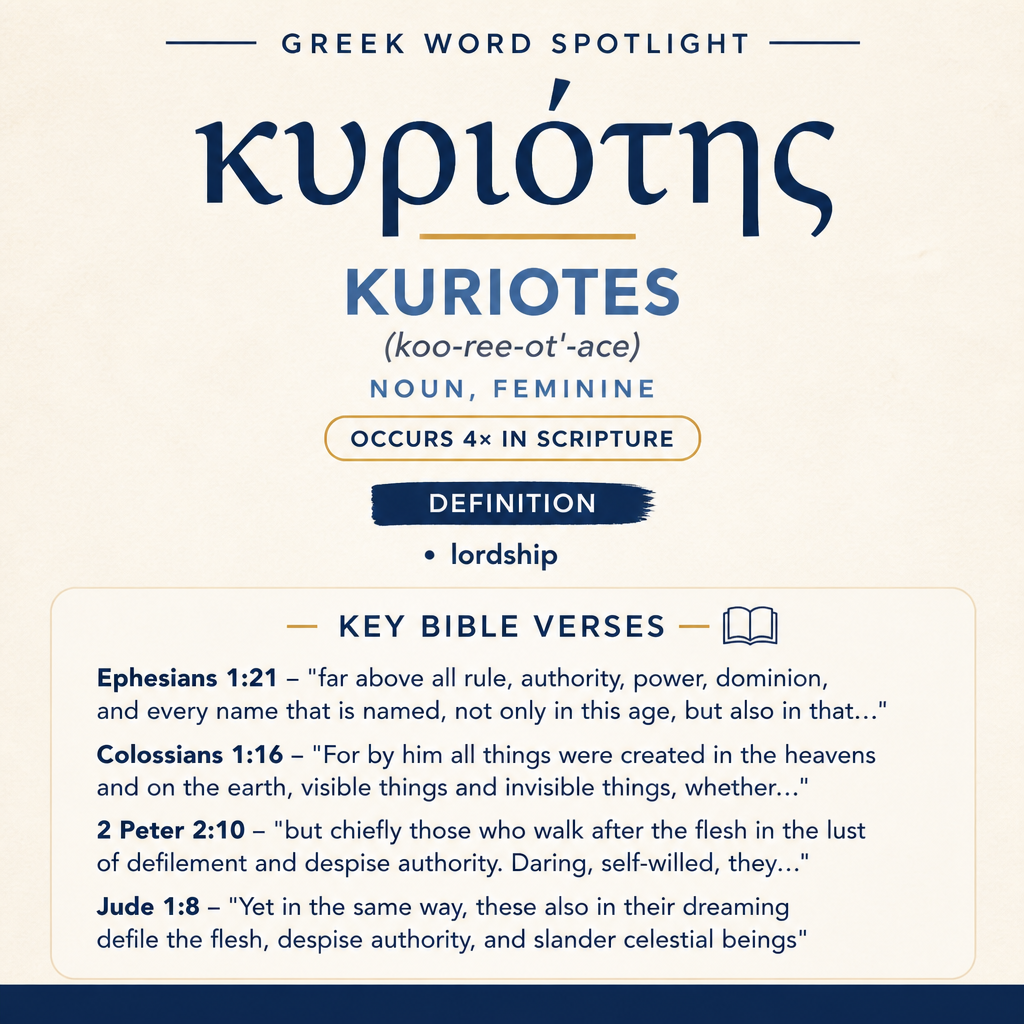
κυριότης means “lordship” and appears 4 times in Scripture: Ephesians 1:21, Colossians 1:16, 2 Peter 2:10, and Jude 1:8.
Scripture Occurrences
This word occurs 4 times in Scripture. It appears in Ephesians 1:21 and Colossians 1:16, and also in 2 Peter 2:10 and Jude 1:8.
Learn More →Context Snapshot
In Ephesians 1:21 it is listed among terms like rule, authority, power, and dominion. In 2 Peter 2:10 and Jude 1:8 it appears where authority is despised.
Learn More →κυριότης speaks of “lordship,” a term used in the New Testament to describe a kind of dominion or ruling status within ranked orders of authority. It appears in contexts that either place it among other exalted powers or condemn those who treat such authority with contempt.
Root and Related Words
κυριότης is related to kyrios (κύριος), “lord” (Strong’s G2962). This relationship places the word in the semantic orbit of recognized lordly status and the structures that express it.

Occurrences
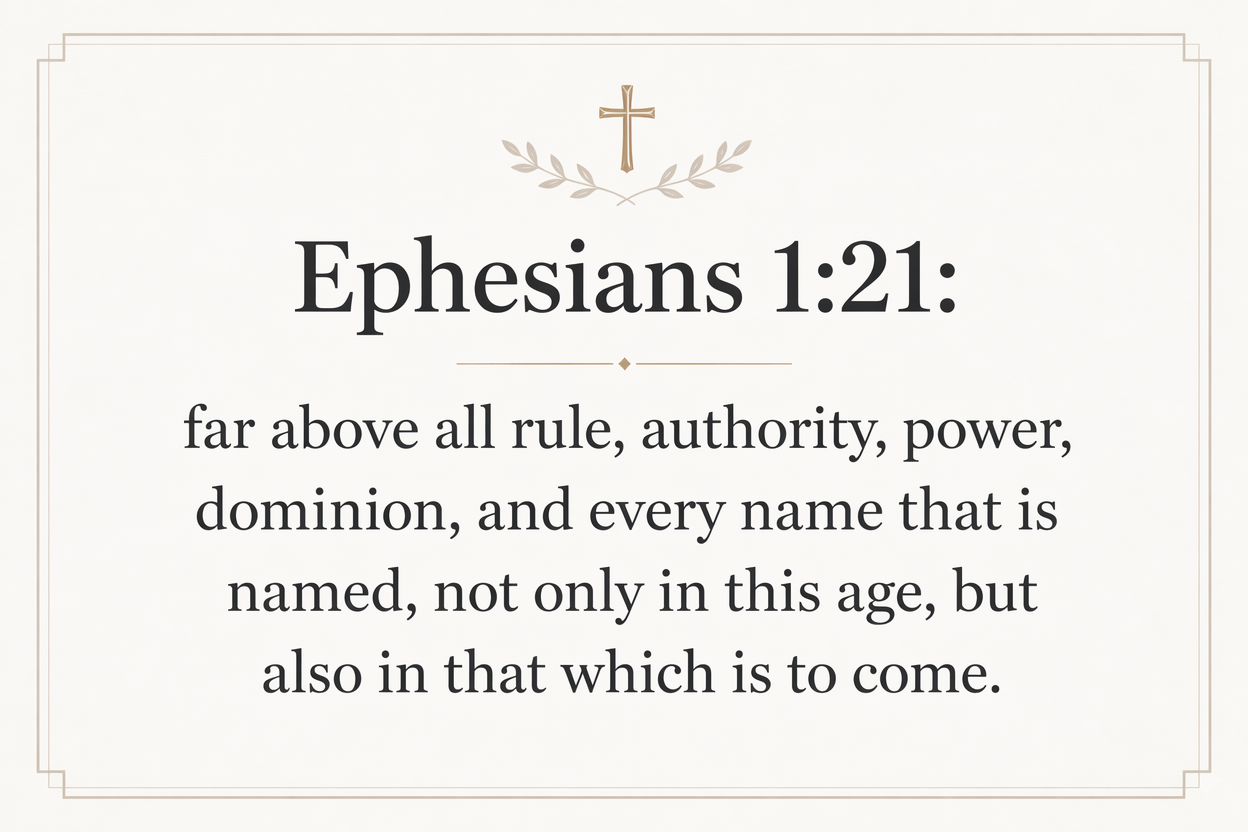
Ephesians 1:21: far above all rule, authority, power, dominion, and every name that is named, not only in this age, but also in that which is to come.
Here κυριότης stands in a catalog of ranked powers (“rule, authority, power, dominion”) that are placed beneath the exalted position being described. The verse’s argument works by accumulation: each term adds another layer to the idea of organized authority, and “dominion” contributes the notion of lordship as one of the heights within that hierarchy. The phrase “far above” frames κυριότης as something real and nameable within the created order of authority, yet surpassed; “every name that is named” reinforces that this lordship is the kind of thing that can be spoken of, identified, and ranked, whether “in this age” or “in that which is to come.” In this scene, κυριότης functions as a marker of status—one of the titles that can be possessed—while the verse emphasizes transcendence over it.
Colossians 1:16: For by him all things were created in the heavens and on the earth, visible things and invisible things, whether thrones or dominions or principalities or powers. All things have been created through him and for him.
In Colossians 1:16, κυριότης appears as “dominions” within a sweeping claim about creation (“all things were created… visible things and invisible things”). The verse does not treat lordship as an abstract idea detached from reality; it situates dominions among “thrones… principalities… powers,” categories that together suggest structured orders of rule. κυριότης here contributes to the portrayal of an ordered cosmos in which lordship exists among both “heavens” and “earth,” and among what can and cannot be seen. The verse further places such lordship under a comprehensive creative purpose: these dominions belong to the realm of “all things” that were created “through him and for him.” In this setting, κυριότης is part of the inventory of created authorities, included to show the breadth of what is encompassed by the act and purpose of creation.
2 Peter 2:10: but chiefly those who walk after the flesh in the lust of defilement and despise authority. Daring, self-willed, they are not afraid to speak evil of dignitaries;
In 2 Peter 2:10, κυριότης is rendered as “authority” and appears in a moral diagnosis: certain people “despise authority.” The word’s contribution is sharpened by the surrounding descriptors. Their conduct is characterized as “walk after the flesh in the lust of defilement,” and their inner posture is “daring, self-willed.” Against that backdrop, their stance toward lordship is not mere independence but contempt—an active rejection of a rightful ordering. The next clause (“they are not afraid to speak evil of dignitaries”) shows how despising κυριότης expresses itself in speech: lordly or dignitary status becomes an object of slander rather than respect. In this scene, κυριότης functions as the specific kind of authority they scorn, and the verse depicts that scorn as part of a larger pattern of defilement and arrogance.
Jude 1:8: Yet in the same way, these also in their dreaming defile the flesh, despise authority, and slander celestial beings.
Jude 1:8 uses κυριότης in the same moral profile, again as “authority,” but with a slightly different set of accompanying actions. The persons described “in their dreaming” commit a triad of offenses: “defile the flesh, despise authority, and slander celestial beings.” Within that triad, κυριότης names the authority they reject, set between bodily corruption and verbal assault. The placement suggests that contempt for lordship belongs alongside moral disorder and reckless speech; rejecting rightful dominion is presented as a symptom of a deeper distortion. The mention of “celestial beings” heightens the sense that their disdain reaches beyond ordinary social disrespect; it becomes a posture that treats even exalted beings as fair targets for slander. Here κυριότης contributes the idea that there is an order of lordship that should not be treated with contempt, and Jude portrays the rejection of that order as a hallmark of the intruders’ behavior.
Sense and Usage
Across these passages, κυριότης consistently functions as a label for lordly dominion within a structured world of authority. In Ephesians and Colossians, it appears among plural terms (“rule… authority… power… dominion”; “thrones… dominions… principalities… powers”), which presents lordship as one class within a broader taxonomy of powers. The rhetorical effect of these lists is to convey scale and organization: authority is not a single undifferentiated reality but is spoken of in multiple categories, and κυριότης names one such category of dominion or lordship.
Those same two passages also locate κυριότης in relation to ultimate supremacy and comprehensive creation. In Ephesians 1:21, lordship is something over which the exalted one is “far above,” and it is included in “every name that is named,” emphasizing that lordship belongs to the sphere of recognized, nameable powers. In Colossians 1:16, lordship is part of “all things” created in every realm—“in the heavens and on the earth,” “visible things and invisible things”—so that dominions are neither ultimate nor outside the scope of creation’s purpose (“through him and for him”). In both, κυριότης helps articulate that there are genuine dominions, yet they are subordinated within a larger, ordered reality.
In 2 Peter and Jude, the focus shifts from mapping the cosmos to exposing rebellion against rightful order. κυριότης becomes the object of contempt: “despise authority.” In both letters, this contempt is not neutral skepticism but a moral act paired with defilement and verbal aggression. In 2 Peter 2:10, contempt for authority is linked to walking “after the flesh” and to being “daring, self-willed,” culminating in fearlessness in “speak[ing] evil of dignitaries.” In Jude 1:8, despising authority sits beside “defile the flesh” and “slander celestial beings.” In these settings, κυριότης marks an established lordly status that can be rejected in practice—by attitudes, behavior, and speech—making the word a touchstone for the writers’ critique of arrogant lawlessness.
Taken together, the four occurrences show κυριότης operating in two complementary ways: (1) as one of the named dominions within a structured order of powers, and (2) as a standard of rightful authority that can be despised. The term therefore carries both a classificatory force (a kind of dominion among other powers) and an ethical force (a locus of rebellion when treated with contempt), while remaining anchored in the concrete notion of lordship.
Imagery
The imagery attached to κυριότης in these passages is the imagery of rank and rule: lists of authorities arranged as a hierarchy, “thrones” paired with “dominions,” and “dignitaries” and “celestial beings” treated as figures associated with exalted status. Even where no throne-room scene is narrated, the word evokes an ordered realm in which lordship is real, nameable, and consequential—either acknowledged as part of creation’s structure or rejected in arrogant speech and conduct.
Sources: Lexical data from Strong’s Exhaustive Concordance and the Translators Brief Lexicon of Extended Strongs for Greek (STEPBible, CC BY). Occurrence data from the Translators Amalgamated Greek New Testament (STEPBible, CC BY). Scripture quotations from the World English Bible (public domain).