
Exploring the Meaning of Kulioo in Greek
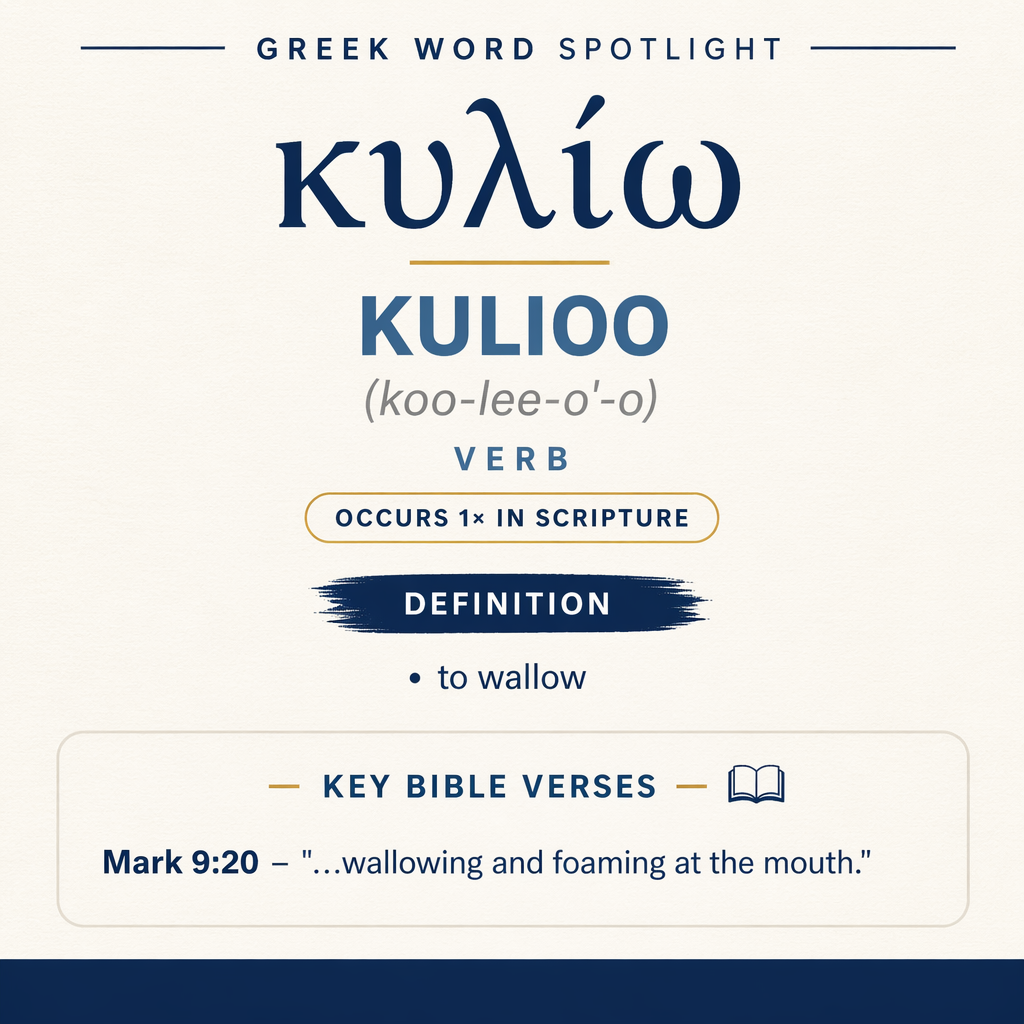
κυλίω means “to wallow” and appears once in Scripture, in Mark 9:20.
Biblical Occurrence
This verb occurs 1 time in Scripture. Its single occurrence is in Mark 9:20.
Learn More →κυλίω means “to wallow,” and it appears once in the New Testament, in Mark’s account of a violent demonic convulsion. The verb gives the scene a graphic, bodily realism by describing the afflicted boy’s movement on the ground during the seizure.
Root and Related Words
κυλίω is related (as a derivation) to the noun kyma (κῦμα), “a wave” (Strong’s G2949). The association with a “wave” coheres with motion that is forceful and turbulent, a helpful backdrop for hearing the physical energy carried by κυλίω in its lone narrative setting.

Occurrences
“They brought him to him, and when he saw him, immediately the spirit convulsed him, and he fell on the ground, wallowing and foaming at the mouth.” (Mark 9:20)
In Mark 9:20, κυλίω is embedded in a rapid chain of actions: the boy is brought forward; upon seeing Jesus, “immediately the spirit convulsed him”; he “fell on the ground”; then he is described as “wallowing and foaming at the mouth.” Within that sequence, the verb locates the convulsion’s effects not only in a momentary spasm but in an ongoing bodily agitation after he hits the ground. The fall places him prone and exposed, and κυλίω depicts what happens next: his body does not lie still but moves about on the ground in a distressing way.
The surrounding verbs help define the contribution of κυλίω without needing extra explanation. “Convulsed” already indicates involuntary muscular violence; “foaming at the mouth” adds visible evidence of the crisis. Between those two, “wallowing” communicates the seized body’s contact with the earth and its restless, rolling movement across it. The word therefore intensifies the physicality of the episode: the demon’s assault is not abstract or merely internal; it throws the boy down and keeps him churning on the ground.
The grammar of the clause also matters for how the reader experiences the scene. Mark strings the actions together with a plain, observational cadence, and κυλίω functions as one of the culminating descriptions after the decisive fall. It paints the aftermath of impact—the continued motion—so the reader can picture the boy’s condition at the moment he is brought near to Jesus. The verb’s placement alongside “foaming” makes the description concrete: the boy’s body is in chaotic movement, and his mouth shows the physical symptoms of the fit.
Sense and Usage
The definition “to wallow” is a vivid choice in English because it implies more than a simple “fall” or “lie” on the ground. In Mark 9:20 the boy’s wallowing is not presented as a voluntary posture but as the observable expression of the convulsion that has seized him. The narrative explicitly attributes the initiating force to “the spirit,” and the immediate result is a loss of bodily control: convulsion, collapse, and then wallowing. κυλίω thus carries the sense of bodily motion that is low to the ground, messy, and uncontrolled—movement that a bystander could not easily mistake for ordinary behavior.
Because this verb appears only in this single scene, its usage is best read with close attention to the details Mark supplies. The story does not treat wallowing as the central problem in itself; it is one element among several symptoms that together display the severity of the oppression. The order is significant: the spirit’s reaction happens “immediately” upon the boy seeing Jesus, and the wallowing follows as part of the immediate crisis. That makes κυλίω a narrative tool for heightening tension at the moment of confrontation. The scene is not calm or staged; it erupts, and the boy’s body becomes the arena in which the conflict is made visible.
κυλίω also contributes to the reader’s perspective on the boy’s vulnerability. Falling “on the ground” is already a sign of helplessness, but “wallowing” prolongs that helplessness: it describes a continued state rather than a brief incident. Paired with “foaming at the mouth,” the verb shows a loss of dignity and safety. The ground becomes the surface on which the suffering is displayed, and the movement suggested by wallowing indicates that the boy is being driven about rather than resting. In this way the verb supports the episode’s portrayal of the spirit’s harsh effect on the person it afflicts.
Finally, in a tightly written narrative, a rare verb can act like a spotlight: it draws the eye to what is happening at the most basic physical level. Mark 9:20 could have stopped at “fell on the ground,” but it goes on to specify how he is on the ground. That extra detail is what κυλίω provides. It invites the reader to picture the scene with immediacy and to feel the urgency of what Jesus is about to address.
Imagery
The imagery of κυλίω in Mark 9:20 is earthbound and turbulent. The boy is driven from standing presence (“They brought him”) to sudden collapse (“he fell on the ground”) and then to agitated movement (“wallowing”), with “foaming at the mouth” adding a stark, visible sign of distress. The word therefore evokes a body swept into motion along the ground, like a surface-level surge—an image that matches the scene’s abrupt violence and the boy’s utter inability to steady himself.
That concrete picture serves Mark’s larger depiction of the moment: when the boy sees Jesus, the spirit’s response is immediate and disruptive. κυλίω helps the reader see the disruption not as an invisible spiritual matter alone but as a violent physical episode unfolding in plain view.
Sources: Lexical data from Strong’s Exhaustive Concordance and the Translators Brief Lexicon of Extended Strongs for Greek (STEPBible, CC BY). Occurrence data from the Translators Amalgamated Greek New Testament (STEPBible, CC BY). Scripture quotations from the World English Bible (public domain).




