Exploring the Meaning of Kolazo in Greek
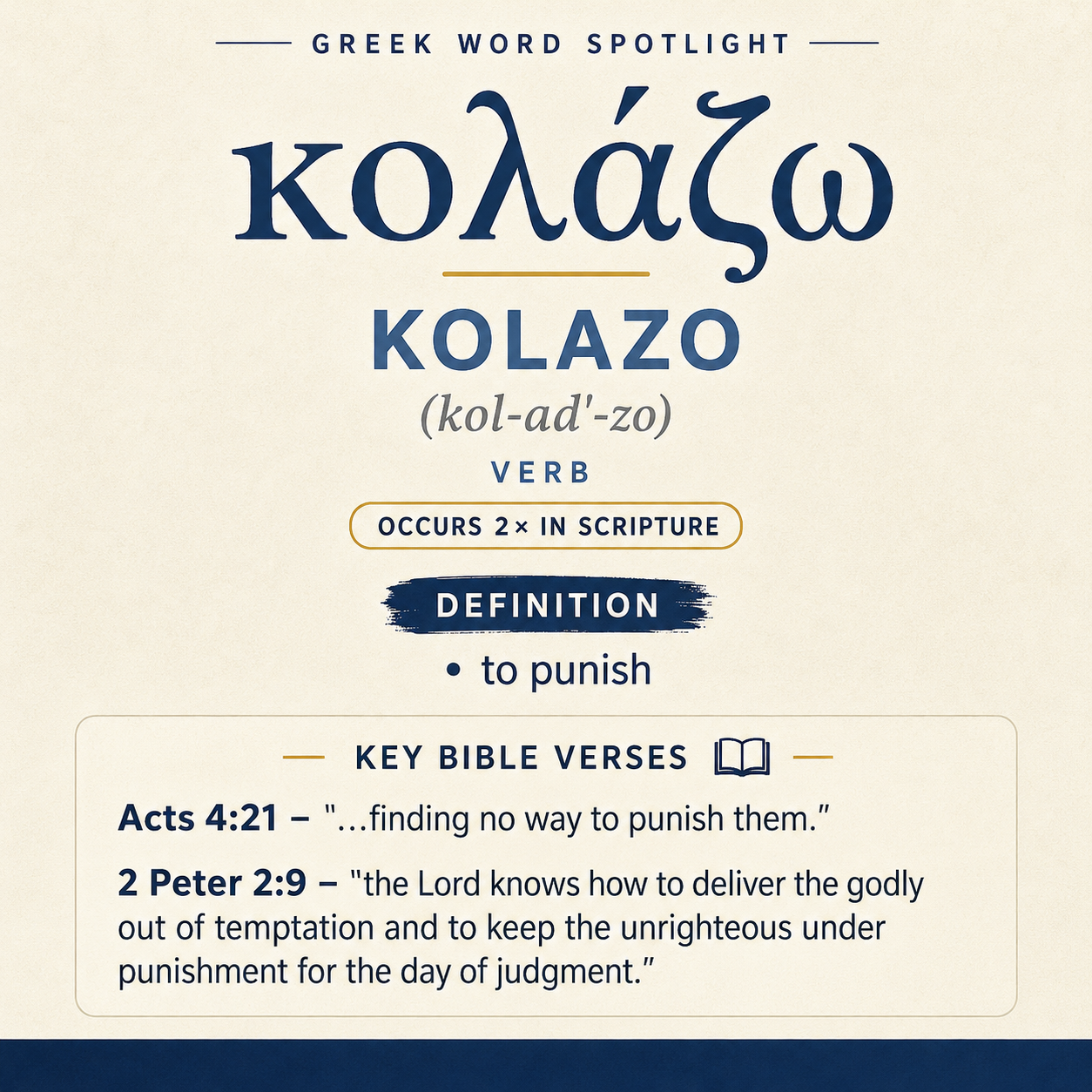
κολάζω means “to punish” and appears twice in Scripture: Acts 4:21 and 2 Peter 2:9.
Scripture Occurrences
This verb occurs 2 times in Scripture. It appears in Acts 4:21 and 2 Peter 2:9.
Learn More →Usage in Context
In Acts 4:21, authorities find no way to punish them because of the people. In 2 Peter 2:9, the unrighteous are kept under punishment for the day of judgment.
Learn More →κολάζω means “to punish.” In the New Testament it appears in two distinct settings: a public dispute over what to do with the apostles, and a doctrinal statement about God’s ability to hold the unrighteous in a state of punishment in view of judgment.
Occurrences
“When they had further threatened them, they let them go, finding no way to punish them, because of the people; for everyone glorified God for that which was done.” (Acts 4:21)
Here κολάζω is framed as an action the authorities want to carry out but cannot. The verse places it after “further threatened them,” so punishment is presented as the next step the officials consider once intimidation has been applied. Yet the narrative stresses restraint: “they let them go,” and the reason given is practical and social—“because of the people; for everyone glorified God for that which was done.” The word therefore functions as the concrete outcome the authorities seek (a punitive measure), but it is blocked by public sentiment. Punishment in this scene is not theoretical or future; it is an immediate possibility debated in real time, constrained by the surrounding crowd’s reaction and praise to God.
The phrasing “finding no way to punish them” highlights the lack of an acceptable avenue rather than a lack of desire. κολάζω, in this context, sits within a power dynamic: those who threaten possess authority, but their authority is checked by the social consequence of punishing men whom “everyone” associates with something that led them to glorify God. The verb thus marks the boundary between what the officials want to do and what they judge they can do without provoking the populace.
“the Lord knows how to deliver the godly out of temptation and to keep the unrighteous under punishment for the day of judgment,” (2 Peter 2:9)
In 2 Peter 2:9 κολάζω appears in a different grammatical environment: the Lord “knows how” to do two coordinated things—“deliver the godly out of temptation” and “keep the unrighteous under punishment for the day of judgment.” Punishment here is not a threatened action that may or may not be carried out; it is a condition in which the unrighteous are “kept.” The wording “under punishment” portrays punishment as something that can be ongoing and encompassing, rather than merely an isolated act.
The verse also gives punishment a temporal orientation: it is tied to “the day of judgment.” The line does not depict punishment as replacing judgment but as connected to it—punishment is the present or continuing state (“keep…under punishment”) that stands in relation to a future, climactic evaluation. κολάζω thus contributes to a moral contrast: as God rescues the godly from temptation, so he also maintains the unrighteous in a punitive holding-pattern that is directed toward judgment.

Sense and Usage
Across these two passages, κολάζω consistently belongs to the sphere of punitive action, but the two scenes illuminate different aspects of how punishment is conceived and spoken about. In Acts 4:21, punishment is discussed as a contemplated response by human authorities to a public event. The officials have already “threatened” the apostles, and punishment represents the stronger enforcement action they cannot find a viable way to administer. The word therefore carries the feel of concrete sanctions—something recognizable as “punish[ment]” that can be carried out, justified, and witnessed, and that would have social repercussions.
In 2 Peter 2:9, by contrast, punishment is not negotiated within a human court of opinion. The subject is “the Lord,” and punishment is presented as something he can administer and maintain without impediment: he knows how “to keep the unrighteous under punishment.” This construction presents punishment as a state or condition that can persist. The verb’s sense is expressed not merely as a moment of retribution but as an ongoing punitive custody, consistent with the verse’s pairing of present moral realities (“temptation,” “unrighteous”) with a future horizon (“the day of judgment”).
Put together, these occurrences show κολάζω operating in both immediate and eschatological frames. In Acts it is a near-term decision that is blocked by fear of public reaction; in 2 Peter it is a divine capacity that is assured and purposeful. Yet both uses keep punishment closely tied to accountability: in Acts, accountability is pressured by the crowd’s glorifying response to “that which was done,” making punishment difficult to justify; in 2 Peter, accountability is secured by the Lord’s ability to preserve an ordered moral outcome leading up to judgment.
These contexts also show how punishment relates to other actions in the same sentence. In Acts 4:21, punishment is paired with threatening: the threat is spoken, the punishment would be enacted. The inability “to punish them” marks a limit on what threats can accomplish when no acceptable punitive course is available. In 2 Peter 2:9, punishment is paired with deliverance: the Lord’s knowledge is displayed both in rescuing and in restraining. The same divine competence that frees the godly also holds the unrighteous in a punitive condition, creating a balanced statement of moral governance.
Finally, the two settings highlight differing “audiences” that shape the mention of punishment. Acts 4:21 is sensitive to “the people” and what “everyone” is doing; punishment is constrained by communal perception. 2 Peter 2:9 speaks without reference to social approval; it locates punishment within the Lord’s purposeful management of the unrighteous in view of judgment. κολάζω thus contributes, in these passages, to portrayals of punishment as both a contested instrument of human authority and an assured instrument of divine order.
Imagery
Acts 4:21 gives κολάζω the atmosphere of a tense public release: threats have been issued, but the would-be punishers step back because the surrounding crowd is actively “glorif[ying] God.” 2 Peter 2:9, by contrast, places the word in the imagery of custody—being “kept…under punishment”—with the calendar of accountability moving toward “the day of judgment.” Together, these verses let the word carry both the immediacy of a punishment withheld and the sobriety of punishment maintained under divine oversight.
Sources: Lexical data from Strong’s Exhaustive Concordance and the Translators Brief Lexicon of Extended Strongs for Greek (STEPBible, CC BY). Occurrence data from the Translators Amalgamated Greek New Testament (STEPBible, CC BY). Scripture quotations from the World English Bible (public domain).