
Exploring the Meaning of Koinonikos in Greek
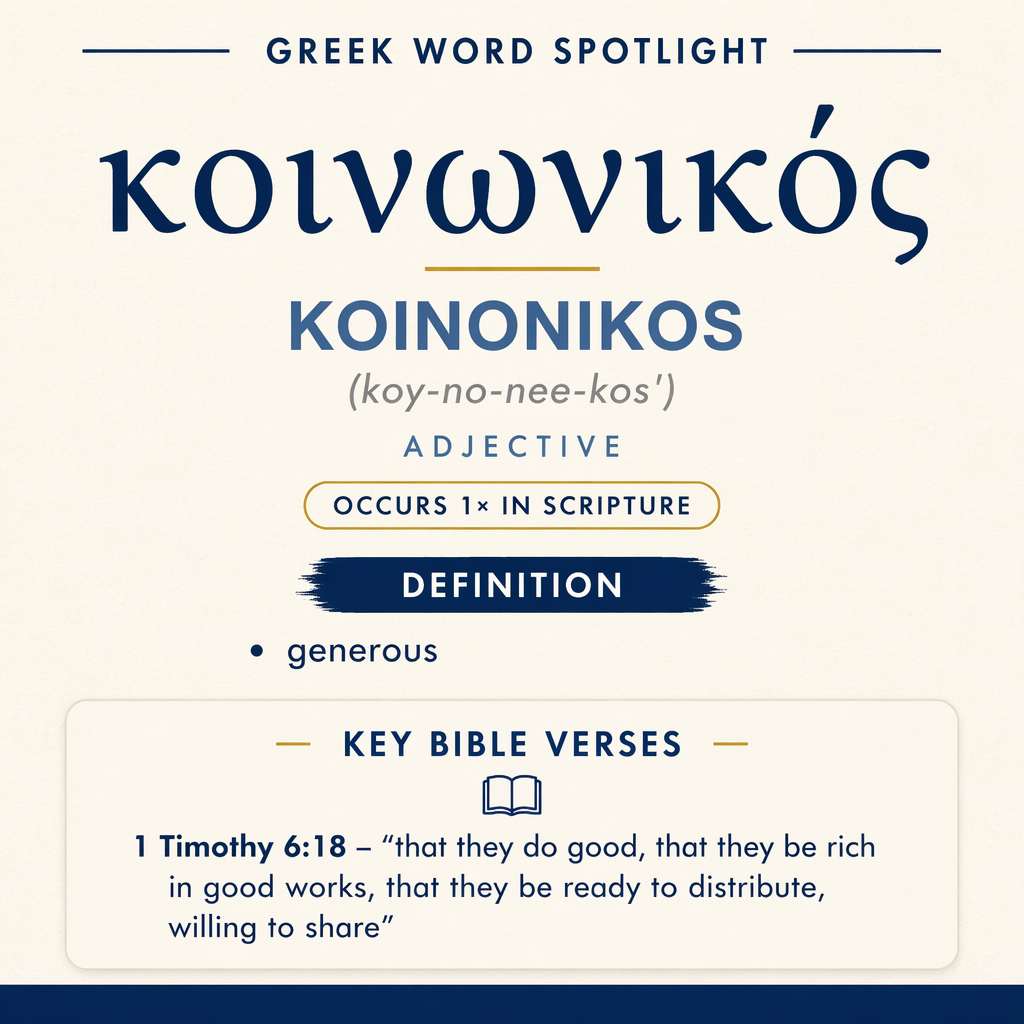
κοινωνικός means “generous” and appears once in Scripture, in 1 Timothy 6:18.
Scripture Occurrence
It occurs 1 time in Scripture. The single occurrence is in 1 Timothy 6:18.
Learn More →Verse Context
In 1 Timothy 6:18, it appears with exhortations to do good, be rich in good works, be ready to distribute, and be willing to share.
Learn More →κοινωνικός expresses the quality of being generous, and it appears in a single New Testament exhortation about wealth and conduct. In its lone setting, it belongs to a cluster of phrases that press generosity into visible, practical action.
Root and Related Words
κοινωνικός is related to koinonos (κοινωνός), “participant” (Strong’s G2844). The relationship links the adjective to the idea of participation: the disposition described by κοινωνικός fits a life that does not treat possessions and opportunities as sealed off from others, but as something that can be shared in.

Occurrences
“that they do good, that they be rich in good works, that they be ready to distribute, willing to share;” (1 Timothy 6:18)
In 1 Timothy 6:18, κοινωνικός stands at the end of a rising sequence of moral directions. The line begins broadly—“that they do good”—then sharpens into a description of what “rich” should look like: not merely wealthy, but “rich in good works.” From there it moves from general moral posture to readiness and habit: “ready to distribute,” and then, with κοινωνικός, “willing to share.”

The placement matters. The earlier clauses can be heard as describing a pattern of life (“do good,” “be rich in good works”), and then two paired expressions focus on the handling of resources: one stresses preparedness to give (“ready to distribute”), while κοινωνικός adds an inward posture of openness (“willing to share”). In this immediate context, generosity is not framed as an occasional act forced by circumstances; it is presented as a settled willingness that accompanies the outward act of distributing. κοινωνικός therefore marks generosity as a readiness of mind and heart that meets the needs of others through concrete sharing.
The verse’s string of infinitive-like directives also suggests that this willingness is meant to be consistent with the other commands. The generosity described by κοινωνικός is not isolated from “good” and “good works” but belongs to them: it is one of the ways good becomes tangible. The word contributes a social direction to the whole line—generosity as an orientation toward others that results in sharing.
Sense and Usage
The sense “generous” in κοινωνικός is shaped here by paired expressions that clarify what generosity looks like when applied to possessions and opportunities. The verse does not define generosity in abstract terms; it frames it with two adjacent actions and dispositions. First, the generous person is “ready to distribute,” which implies availability and promptness rather than reluctance or delay. Second, the generous person is “willing to share,” where κοινωνικός belongs: generosity is not merely the external transfer of goods, but the internal willingness that makes such transfer fitting and repeatable.
This combination gives κοινωνικός a practical, relational feel. Generosity is presented as a posture toward other people—an openness that treats one’s goods as shareable rather than guarded. The word thus fits naturally alongside “good works”: it is a kind of goodness that takes shape in what one releases, gives, or shares. It also shows that generosity is not only measured by the size of a gift but by the readiness and willingness behind it. The verse presses beyond minimal compliance; it aims at a generous character that is prepared and inclined to share.
Because κοινωνικός is placed after “ready to distribute,” it also helps distinguish two aspects of generosity without splitting them apart. “Ready to distribute” can emphasize the ability and preparedness to give when a need arises; “willing to share” stresses the generous attitude that makes giving natural rather than strained. Together they depict generosity as both capability put into action and a cooperative spirit that does not resist participation in another’s need.
The relationship to koinonos (κοινωνός), “participant,” reinforces this direction. Even without expanding the definition beyond “generous,” the connection suggests that generosity carries an element of shared participation: sharing is not merely handing something over, but entering into a common situation where another’s lack is met through what one has. In this verse, the generous person does not stand apart from others; generosity moves the person toward others through sharing.
Imagery
The imagery implied by 1 Timothy 6:18 is simple and concrete: goodness is pictured as something that can be “distributed” and “shared.” κοινωνικός contributes the picture of open hands and an open will—generosity that is prepared to give and glad to share, turning “good works” into practical help for others.
Sources: Lexical data from Strong’s Exhaustive Concordance and the Translators Brief Lexicon of Extended Strongs for Greek (STEPBible, CC BY). Occurrence data from the Translators Amalgamated Greek New Testament (STEPBible, CC BY). Scripture quotations from the World English Bible (public domain).





