
Exploring the Meaning of Koinos in Greek
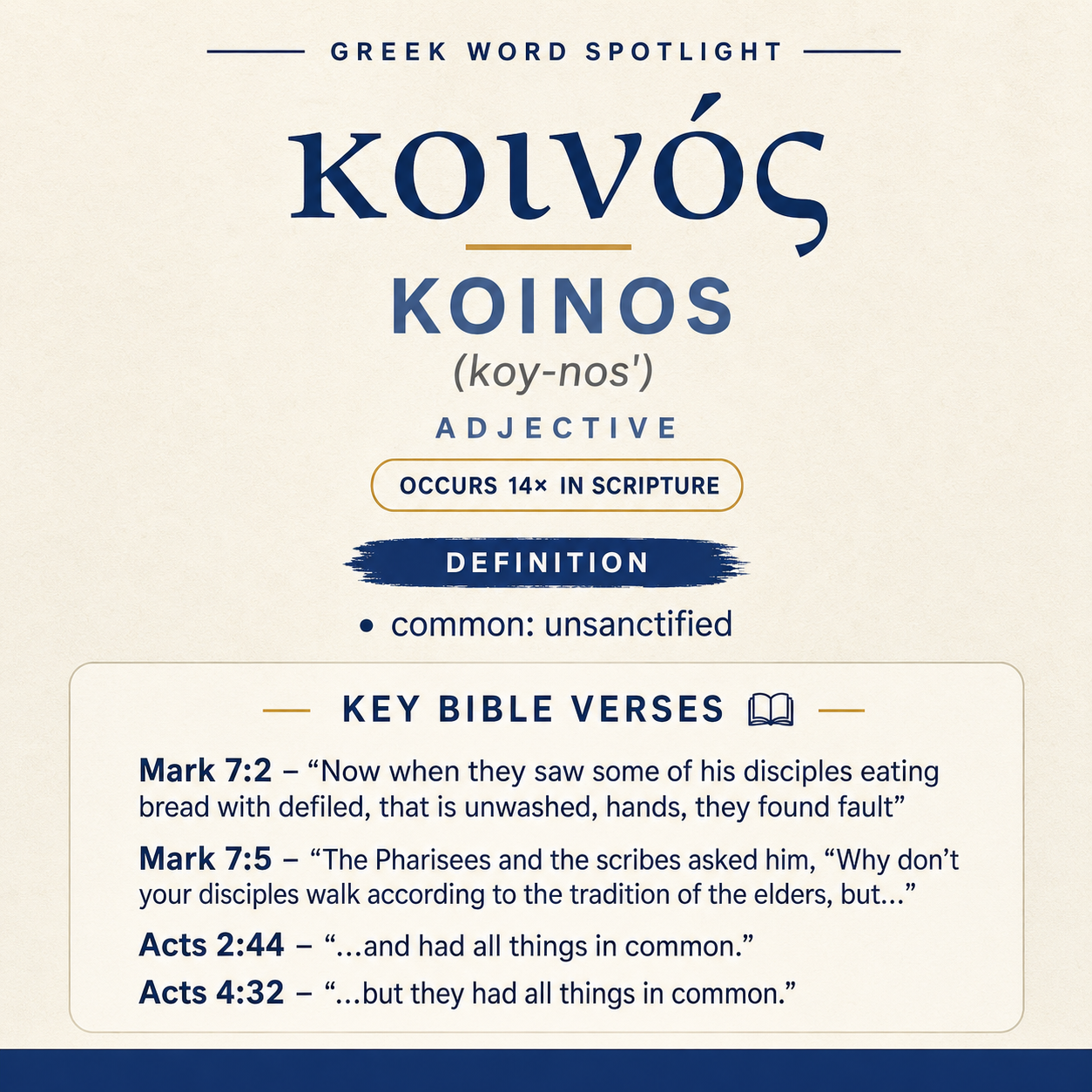
κοινός (Koinos) means “common; unsanctified” and occurs 14 times in Scripture, including Mark 7, Acts 2–4, Acts 10–11, and Romans 14.
Core Meaning
κοινός means “common: unsanctified.” In the listed passages it is used in contrasts involving what is common or defiled/unclean.
Learn More →Gospel Context
In Mark 7:2 and 7:5, the word appears in discussion of eating bread with defiled (unwashed) hands. The Pharisees and scribes challenge the disciples’ practice.
Learn More →Acts & Romans
In Acts 2:44 and 4:32, it describes believers having “all things in common.” In Acts 10:14, 10:28, 11:8 and Romans 14:14 it appears in statements about what is common/unclean.
Learn More →κοινός describes what is “common: unsanctified,” and it appears in scenes ranging from disputes about defilement to the shared life of the early believers. Across its occurrences, the adjective marks what is treated as ordinary rather than set apart, whether in ritual evaluation, moral judgment, or communal identity.
Occurrences
Mark 7:2 — “Now when they saw some of his disciples eating bread with defiled, that is unwashed, hands, they found fault.”
In this scene, κοινός colors the observers’ judgment of the disciples’ eating. The focus is not the bread itself but the condition of the hands—“defiled, that is unwashed.” The word supplies the evaluative label that turns a simple meal into a fault worthy of accusation, framing the act as unsanctified because it is associated with what they regard as defilement.
Mark 7:5 — “The Pharisees and the scribes asked him, “Why don’t your disciples walk according to the tradition of the elders, but eat their bread with unwashed hands?””
Here the charge is stated as a question, but the same concern drives it: eating “with unwashed hands.” Within the complaint, κοινός belongs to the sphere of “tradition of the elders,” where ordinary contact and ordinary hands are treated as a source of religious compromise. The word underwrites the assumption that failure to follow established washing practice renders the eating unsanctified.
Acts 2:44 — “All who believed were together, and had all things in common.”
In Acts, κοινός moves from ritual evaluation to communal life. “All things in common” portrays shared possession and shared use among those “who believed.” The adjective indicates that what belongs to individuals is treated as ordinary property available to the group, reshaping the boundary between “mine” and “ours” inside the gathered community.
Acts 4:32 — “The multitude of those who believed were of one heart and soul. Not one of them claimed that anything of the things which he possessed was his own, but they had all things in common.”
This occurrence expands the earlier picture: unity of “heart and soul” is expressed materially by refusing exclusive claims—“Not one of them claimed…was his own.” κοινός functions as the final summary of that stance. What is “possessed” remains real possession, yet it is treated as common rather than reserved, matching communal solidarity with economic practice.
Acts 10:14 — “But Peter said, “Not so, Lord; for I have never eaten anything that is common or unclean.””
Peter pairs “common” with “unclean,” presenting both as categories that exclude food from his diet. κοινός here marks a kind of unsanctified status that is sufficient to refuse eating, even before the additional label “unclean.” The word contributes a boundary term: certain things are avoided because they are not regarded as set apart for consumption.
Acts 10:28 — “He said to them, “You yourselves know how it is an unlawful thing for a man who is a Jew to join himself or come to one of another nation, but God has shown me that I shouldn’t call any man unholy or unclean.””
In this speech, the same evaluative categories are transferred from food to people: “any man.” κοινός shapes how Peter speaks about social contact—joining oneself to someone “of another nation” has been treated as “unlawful,” but he has been shown not to label a person “unholy or unclean.” The word thus bears on how one is permitted to classify others, and it is rejected as a way of naming human beings.
Acts 11:8 — “But I said, ‘Not so, Lord, for nothing unholy or unclean has ever entered into my mouth.’”
Retelling the earlier moment, Peter again uses the paired categories for what may enter his mouth. κοινός functions as part of the moral-ritual rationale for refusal—his past practice is defined by exclusion of what is considered unsanctified. The emphasis falls on lifelong consistency (“has ever entered”), showing how deeply the category is ingrained in personal conduct.
Romans 14:14 — “I know, and am persuaded in the Lord Jesus, that nothing is unclean of itself; except that to him who considers anything to be unclean, to him it is unclean.”
In Romans, κοινός appears in reflection on how “unclean” status is assigned. The statement distinguishes what something “is…of itself” from what it becomes within a person’s conscience: “to him who considers anything to be unclean, to him it is unclean.” The adjective helps articulate a tension between objective status and perceived status, showing how the label “unclean/unsanctified” can operate through personal evaluation and thereby govern behavior.
Titus 1:4 — “to Titus, my true child according to a common faith: Grace, mercy, and peace from God the Father and the Lord Jesus Christ our Savior.”
Here κοινός modifies “faith,” and the sense is relational rather than defiling. “Common faith” describes what is held together between writer and recipient—something shared as a basis for address (“my true child according to a common faith”). The word contributes the idea of mutual possession: faith is not private property but a shared ground that connects persons.
Hebrews 10:29 — “How much worse punishment do you think he will be judged worthy of who has trodden under foot the Son of God, and has counted the blood of the covenant with which he was sanctified an unholy thing, and has insulted the Spirit of grace?”
In Hebrews, κοινός is explicitly set against sanctification in the same sentence: “the blood of the covenant with which he was sanctified” is “counted…an unholy thing.” The adjective conveys a chilling reclassification—what is bound up with being “sanctified” is treated as ordinary and unsanctified. The word’s force lies in the evaluative act (“has counted”), highlighting not merely status but the deliberate regard that strips what is sacred of its sanctified treatment.
Jude 1:3 — “Beloved, while I was very eager to write to you about our common salvation, I was constrained to write to you exhorting you to contend earnestly for the faith which was once for all delivered to the saints.”
κοινός again expresses shared possession: “our common salvation.” The adjective draws the readers and writer into a single sphere of benefit and identity. In the same breath, the letter moves to urgent exhortation (“contend earnestly”), and “common” gives weight to that urgency: what is shared is worth guarding, because it belongs to the community as a whole.
Revelation 21:27 — “There will in no way enter into it anything profane, or one who causes an abomination or a lie, but only those who are written in the Lamb’s book of life.”
In Revelation’s vision of entry, κοινός appears as “profane,” naming what is barred from the city. The word establishes a purity boundary: anything unsanctified is excluded, along with those characterized by “abomination or a lie.” κοινός thus functions in an ultimate gatekeeping scene, where access is determined by whether something (or someone) belongs to what is set apart or to what is profane.

Sense and Usage
Across these passages, κοινός works as an adjective of classification. It labels something as “common” in the sense of not being set apart—an evaluative tag that can be applied to practices, objects, persons, and even central religious realities. In Mark 7, it belongs to disputes about how ordinary contact (unwashed hands) is thought to render an action religiously compromised; the word supports fault-finding by making the meal’s manner a matter of sanctity. In Acts 10–11, the same category governs what may be eaten, and then it is challenged when applied to people: the word’s reach into social relations is explicitly confronted (“I shouldn’t call any man unholy or unclean”). Romans 14:14 shows how this kind of label can operate within conscience, taking on practical force when a person “considers” something to be unclean. Hebrews 10:29 uses κοινός for a grave inversion, where what is associated with being sanctified is treated as unsanctified through contemptuous regard. Alongside these boundary-making uses, Acts 2:44 and 4:32, Titus 1:4, and Jude 1:3 display a communal sense of “common” as shared possession: goods, faith, and salvation are held together, not parceled into private claims.
Imagery
The passages cluster around two strong images. One is the table: bread eaten with “unwashed hands” (Mark 7:2, 7:5) and the refusal to eat what is “common or unclean” (Acts 10:14; Acts 11:8), where κοινός stands at the point of contact between the ordinary world and what one treats as set apart. The other is the boundary of belonging: a community that has “all things in common” (Acts 2:44; Acts 4:32), a shared “common faith” and “common salvation” (Titus 1:4; Jude 1:3), and finally a city into which nothing “profane” may enter (Revelation 21:27). In each case, κοινός marks where the line is drawn—either to exclude what is unsanctified or to bind together what is shared.
Sources: Lexical data from Strong’s Exhaustive Concordance and the Translators Brief Lexicon of Extended Strongs for Greek (STEPBible, CC BY). Occurrence data from the Translators Amalgamated Greek New Testament (STEPBible, CC BY). Scripture quotations from the World English Bible (public domain).




