Exploring the Meaning of Kleronomeo in Greek
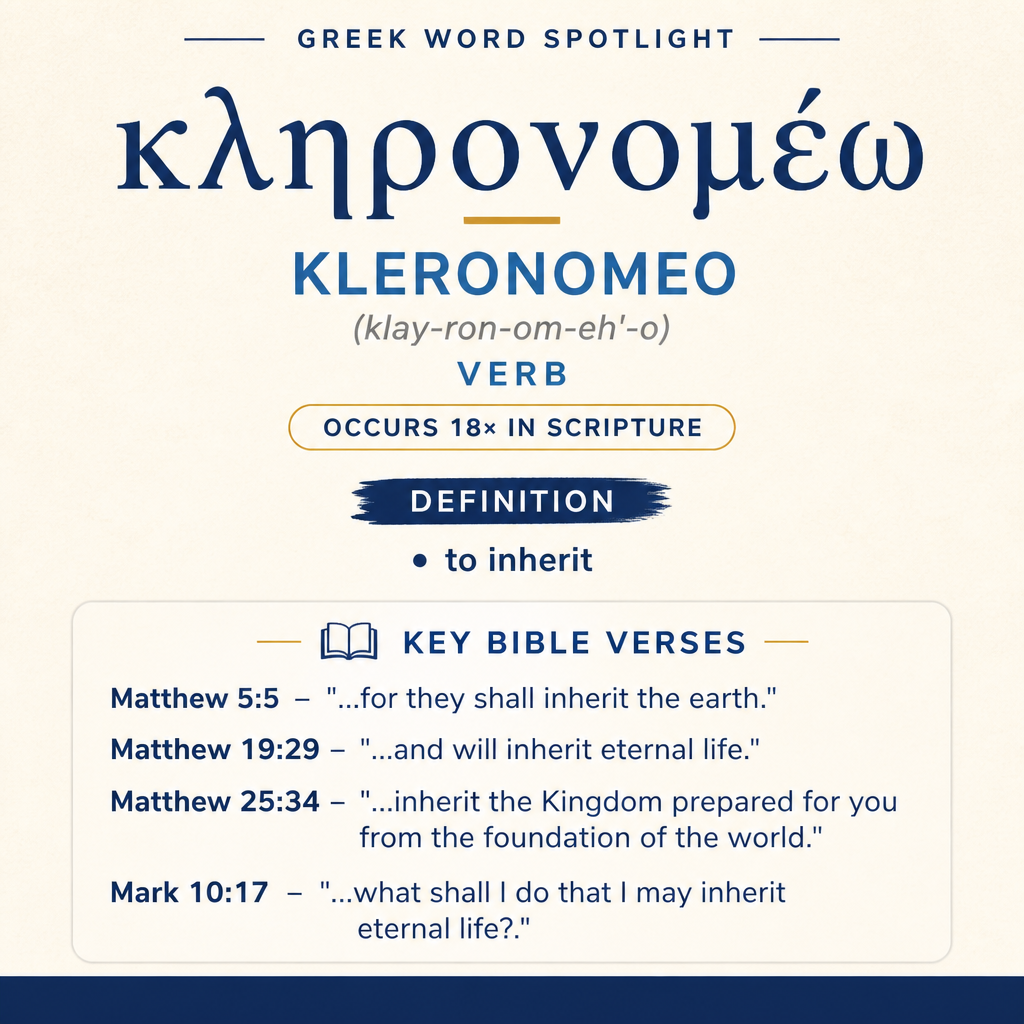
κληρονομέω means “to inherit” and occurs 18 times in Scripture, including Matthew 5:5 and 1 Corinthians 6:9–10.
Core Meaning
κληρονομέω is defined as “to inherit.” In the Gospels it appears in sayings about inheriting the earth, eternal life, and the kingdom.
Learn More →Gospel Scenes
It is used in Matthew 5:5 and Matthew 25:34, and in questions such as Luke 10:25 and Luke 18:18 about inheriting eternal life.
Learn More →Kingdom Warnings
In 1 Corinthians 6:9–10, it is used to say the unrighteous will not inherit God’s Kingdom.
Learn More →κληρονομέω expresses the act of receiving an inheritance, and in the New Testament it is repeatedly used for receiving the earth, eternal life, and God’s Kingdom, as well as for inheriting a name. In the passages below it appears in Jesus’ teaching, in questions addressed to him, and in apostolic warnings and explanations about who can inherit.
Occurrences
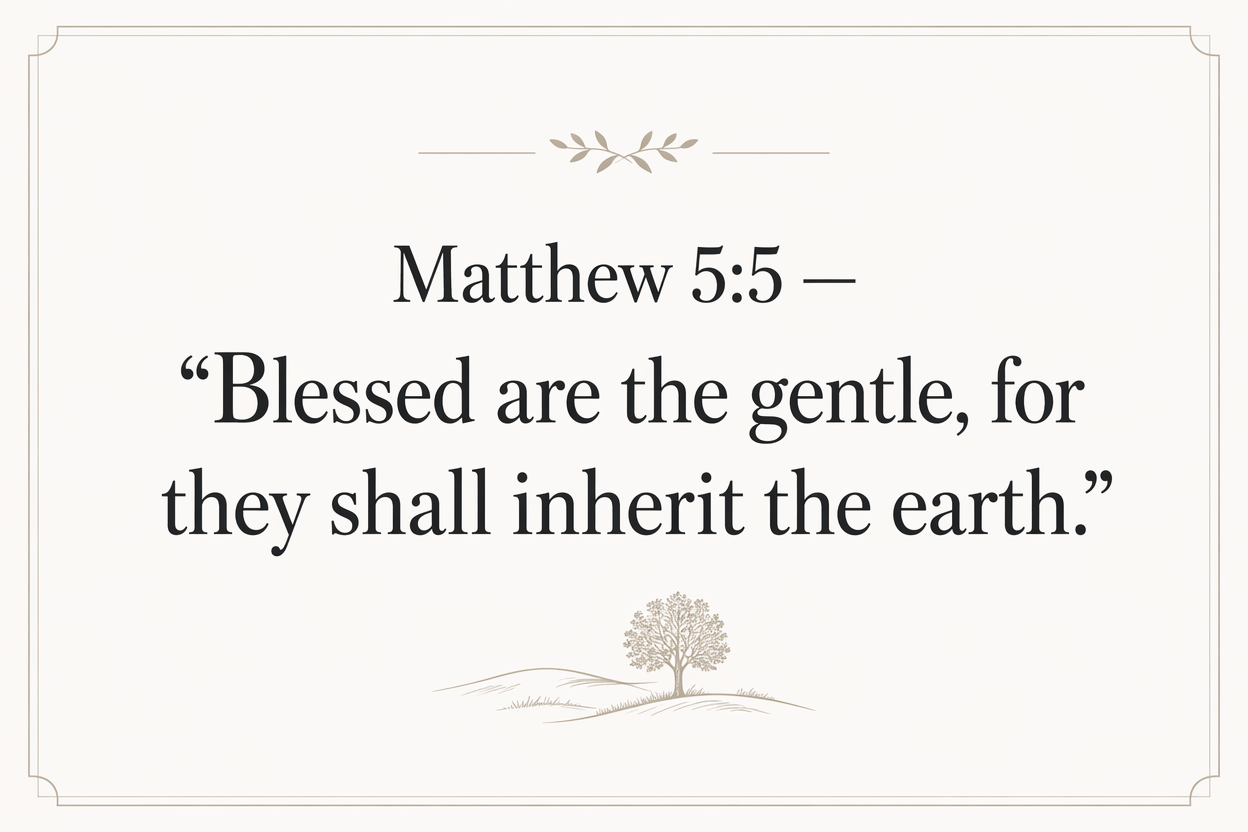
Matthew 5:5 — “Blessed are the gentle, for they shall inherit the earth.”
Here the verb frames “the earth” as something received rather than seized. The recipients are identified not by status or power but by being “the gentle,” and the future tense (“shall inherit”) places the inheritance ahead of them as a promised outcome.
Matthew 19:29 — “Everyone who has left houses, or brothers, or sisters, or father, or mother, or wife, or children, or lands, for my name’s sake, will receive one hundred times, and will inherit eternal life.”
The verb is paired with sacrifice and recompense. The saying connects leaving tangible social and economic securities (“houses… lands”) “for my name’s sake” with a twofold result: abundant “receive” in the present frame of the promise, and “inherit eternal life” as the culminating benefit. The inheritance here is explicitly “eternal life,” placed alongside other forms of reward without being reduced to them.
Matthew 25:34 — “Then the King will tell those on his right hand, ‘Come, blessed of my Father, inherit the Kingdom prepared for you from the foundation of the world;”
The verb functions as a royal summons. The addressees are “those on his right hand,” and the command “inherit” treats “the Kingdom” as something granted by the King to those named “blessed of my Father.” The line “prepared for you from the foundation of the world” gives the inheritance the feel of an arranged gift awaiting its recipients, rather than a prize improvised at the last moment.
Mark 10:17 — “As he was going out into the way, one ran to him, knelt before him, and asked him, “Good Teacher, what shall I do that I may inherit eternal life?””
The verb appears inside an earnest question shaped by personal urgency and reverence (“ran… knelt”). The speaker’s phrasing—“what shall I do… that I may inherit”—casts the desired inheritance (“eternal life”) as something to be received, yet the question focuses on the speaker’s action as the path to it.
Luke 10:25 — “Behold, a certain lawyer stood up and tested him, saying, “Teacher, what shall I do to inherit eternal life?””
In this scene the same core question is asked, but the narrative frames it as a test. The verb therefore sits at the intersection of inquiry and challenge: “inherit eternal life” names the goal, while the question “what shall I do” becomes a probing attempt to draw out Jesus’ teaching in a disputational setting.
Luke 18:18 — “A certain ruler asked him, saying, “Good Teacher, what shall I do to inherit eternal life?””
This occurrence again links the verb with the human desire to secure “eternal life” and with the language of personal performance (“what shall I do”). The question is straightforward, but the title “Good Teacher” and the social identity “ruler” give the scene a public weight: the inheritance sought is ultimate, and the questioner approaches as someone accustomed to decision and responsibility.
1 Corinthians 6:9 — “Or don’t you know that the unrighteous will not inherit God’s Kingdom? Don’t be deceived. Neither the sexually immoral, nor idolaters, nor adulterers, nor male prostitutes, nor homosexuals,”
Here the verb is negated and placed in a warning. “Will not inherit God’s Kingdom” establishes inheritance as an excluding boundary: some are barred from receiving it. The question “don’t you know” and the command “Don’t be deceived” make the statement corrective, and the list that follows begins to specify patterns of life that stand in the way of inheriting.
1 Corinthians 6:10 — “nor thieves, nor covetous, nor drunkards, nor slanderers, nor extortionists, will inherit God’s Kingdom.”
This continues and completes the warning by finishing the list and repeating the conclusion: such persons “will inherit” nothing of “God’s Kingdom.” The verb’s force is judicial in effect: it defines a future outcome—no inheritance—for those characterized by these behaviors.
1 Corinthians 15:50 — “Now I say this, brothers, that flesh and blood can’t inherit God’s Kingdom; neither does the perishable inherit imperishable.”
The verb is used twice to draw an analogy: “flesh and blood” is to “God’s Kingdom” as “the perishable” is to “imperishable.” Inheritance is presented as incompatible with certain conditions; the issue is not merely who receives, but what kind of existence can receive. The parallel clauses sharpen the point by restating it in different terms, with “perishable” and “imperishable” describing the mismatch.
Galatians 4:30 — “However what does the Scripture say? “Throw out the servant and her son, for the son of the servant will not inherit with the son of the free woman.””
The verb appears within a quoted line about inheritance shared—or refused—between two sons. “Will not inherit with” introduces the idea of co-inheritance: to inherit alongside someone is to belong to the same household line of receiving. The exclusion (“will not inherit with”) makes inheritance a marker of status and belonging, distinguishing “the son of the servant” from “the son of the free woman.”
Galatians 5:21 — “envy, murders, drunkenness, orgies, and things like these; of which I forewarn you, even as I also forewarned you, that those who practice such things will not inherit God’s Kingdom.”
As in 1 Corinthians 6, the verb is negated as a moral warning, but here it is tied to habitual action: “those who practice such things.” The repeated “forewarn” highlights the seriousness and clarity of the admonition. Inheriting “God’s Kingdom” is again cast as a future receipt that can be forfeited by persisting in these practices.
Hebrews 1:4 — “having become as much better than the angels as the more excellent name he has inherited is better than theirs.”
In this sentence inheritance is applied not to “life” or “kingdom” but to “the more excellent name.” The verb makes the “name” something received, and the comparison turns on rank: the inherited name is “better than theirs,” supporting the claim that he has become “as much better than the angels.” Inheritance here functions as an explanation of superiority within the comparison.

Sense and Usage
Across these passages, “to inherit” regularly points to receiving something of lasting and defining value—“the earth,” “eternal life,” “the Kingdom,” and “a… name.” The word consistently treats the object as a possession granted to the recipient rather than manufactured by the recipient. Even when speakers ask, “what shall I do,” the verb itself keeps the desired end framed as an inheritance: something entered into and received.
The verb also works well in settings that stress future certainty. In the beatitude (“they shall inherit”), in the King’s summons (“inherit the Kingdom prepared for you”), and in the apostolic warnings (“will not inherit God’s Kingdom”), inheritance language draws a clear line between promise and exclusion. It can therefore carry either comfort or alarm depending on whether the statement is positive or negated.
Several occurrences show that the verb can be used for different kinds of objects without changing its core idea. “Inherit eternal life” and “inherit God’s Kingdom” are closely related in how they function: they name the final good sought and received. “Inherit the earth” presents inheritance in more spatial and tangible terms. “He has inherited… name” applies inheritance to honor and identity; the “name” becomes a received distinction that establishes comparative greatness (“better than theirs”).
Finally, the passages use inheritance language to speak about compatibility and belonging. “Flesh and blood can’t inherit God’s Kingdom” and “neither does the perishable inherit imperishable” make inheritance depend on fitness for what is inherited. “Will not inherit with” in Galatians frames inheritance as shared participation in a household’s portion; exclusion from co-inheritance signals exclusion from the relevant standing and share.
Imagery
The imagery that gathers around κληρονομέω in these texts is domestic and royal at once: a share received, a kingdom granted, a status conferred by an inherited name. Whether it is the gentle inheriting “the earth” (Matthew 5:5) or the King calling the blessed to “inherit the Kingdom” (Matthew 25:34), the verb evokes reception into a prepared portion—something waited for, entered into, and either granted or refused.
Sources: Lexical data from Strong’s Exhaustive Concordance and the Translators Brief Lexicon of Extended Strongs for Greek (STEPBible, CC BY). Occurrence data from the Translators Amalgamated Greek New Testament (STEPBible, CC BY). Scripture quotations from the World English Bible (public domain).