Who was Salmon in the bible?
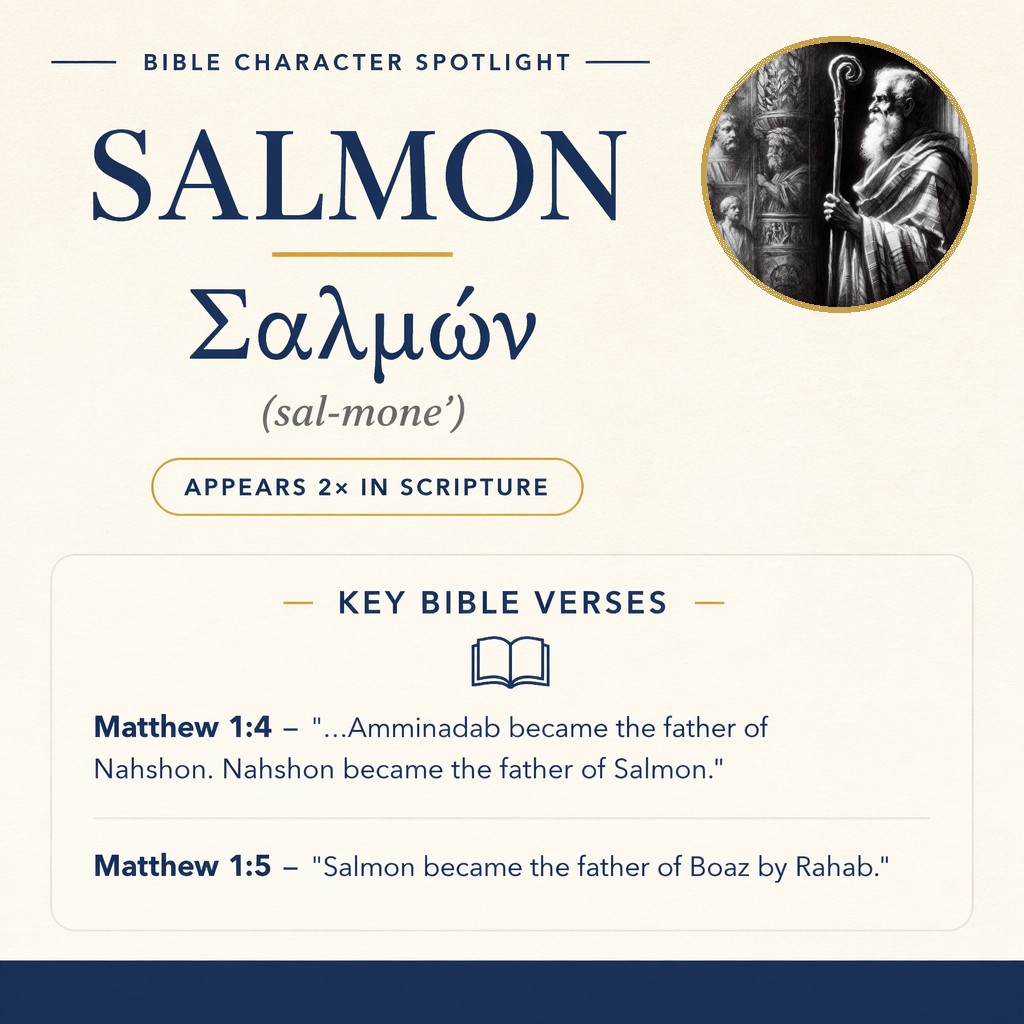
Salmon appears in Matthew’s genealogy, listed between Nahshon and Boaz (Matthew 1:4–5).

Family Line
“Salmon became the father of Boaz by Rahab” (Matthew 1:5), placing him in the line leading to David (Matthew 1:6).
Learn More →Name Origin
Strong’s lexicon identifies Salmon as a Greek form “of Hebrew origin” (Strong’s G4533; H08012).
Learn More →Salmon is a man named in the genealogy recorded in Matthew, presented as an ancestor in a line running from Judah to King David. The Greek form of his name (Σαλμών) is stated to be of Hebrew origin.
Salmon in Scripture
Salmon appears in Matthew 1 within a sequence of father-to-son links. The genealogy’s broader setting begins with the patriarchs and narrows toward Judah:
“Abraham became the father of Isaac. Isaac became the father of Jacob. Jacob became the father of Judah and his brothers.” (Matthew 1:2, WEB)
The line then continues through Judah by way of Perez and Hezron to Ram, placing Salmon within this extended family line:
“Judah became the father of Perez and Zerah by Tamar. Perez became the father of Hezron. Hezron became the father of Ram.” (Matthew 1:3, WEB)
Salmon is introduced after Ram, Amminadab, and Nahshon. Matthew states Salmon’s immediate ancestry and then immediately moves to his son:
“Ram became the father of Amminadab. Amminadab became the father of Nahshon. Nahshon became the father of Salmon.” (Matthew 1:4, WEB)
Next, Salmon is identified as the father of Boaz, and the genealogy specifies Boaz’s mother. The line then proceeds through Obed and Jesse:
“Salmon became the father of Boaz by Rahab. Boaz became the father of Obed by Ruth. Obed became the father of Jesse.” (Matthew 1:5, WEB)
Matthew continues the same genealogical pattern beyond Salmon, placing this line in relation to David and later descendants. The next verse ties Jesse directly to David:
“Jesse became the father of King David. David became the father of Solomon by her who had been Uriah’s wife.” (Matthew 1:6, WEB)
The genealogy then proceeds beyond David and Solomon into subsequent generations:
“Solomon became the father of Rehoboam. Rehoboam became the father of Abijah. Abijah became the father of Asa.” (Matthew 1:7, WEB)
“Asa became the father of Jehoshaphat. Jehoshaphat became the father of Joram. Joram became the father of Uzziah.” (Matthew 1:8, WEB)
Within this chapter’s flow, Salmon functions as a linking figure: Matthew places him between Nahshon and Boaz, and describes Boaz’s parentage as “by Rahab” (Matthew 1:5). In Matthew’s presentation, Salmon’s primary significance is genealogical—his role is to connect earlier ancestors (“Nahshon became the father of Salmon,” Matthew 1:4) with later ones (“Salmon became the father of Boaz,” Matthew 1:5), within the line that proceeds to “King David” (Matthew 1:6).
Name and Meaning
In the Greek text, Salmon is written as Σαλμών (transliteration: Salmon; pronunciation: sal-mone’). The name is described as being of Hebrew origin, derived from Hebrew (H08012).
Brief observation
Matthew’s genealogy highlights Salmon with two concise statements—“Nahshon became the father of Salmon” and “Salmon became the father of Boaz by Rahab” (Matthew 1:4–5)—marking him as a generational bridge in the line that continues to “King David” (Matthew 1:6).
Frequently Asked Questions
What does the name Salmon mean?
Salmon means “Salmon.”
How many times does Salmon appear in the Bible?
Salmon appears 2 times.
Who was Salmon?
Salmon is a person listed in Jesus’ genealogy in Matthew. He is named as the father of Boaz (Matthew 1:5).
Who were Salmon’s father and son in Matthew’s genealogy?
Matthew 1:4 says Nahshon became the father of Salmon, and Matthew 1:5 says Salmon became the father of Boaz.
Explore Further
If you found this page about Salmon interesting and would like to discover more about other biblical characters, explore our comprehensive Encyclopedia of Biblical Characters. For those looking to delve deeper into the Greek origins of these names and terms, our Greek Lexicon is an invaluable resource.
Sources: Name and occurrence data from Strong’s Exhaustive Concordance and STEPBible reference data (CC BY). Scripture quotations from the World English Bible (public domain).