Who was Boaz in the bible
Boaz is a wealthy relative of Naomi’s husband in Ruth 2, and appears in genealogies in 1 Chronicles 2:11–12; “Boaz” is also a temple pillar name in 1 Kings 7:21 and 2 Chronicles 3:17.

Ruth 2 Events
Boaz greeted the reapers, saying, “May Yahweh be with you” (Ruth 2:4), and directed Ruth, “Don’t go to glean in another field… stay here close to my maidens” (Ruth 2:8). He commanded his young men, “Let her glean even among the sheaves, and don’t reproach her” (Ruth 2:15).
Learn More →Genealogy Mentions
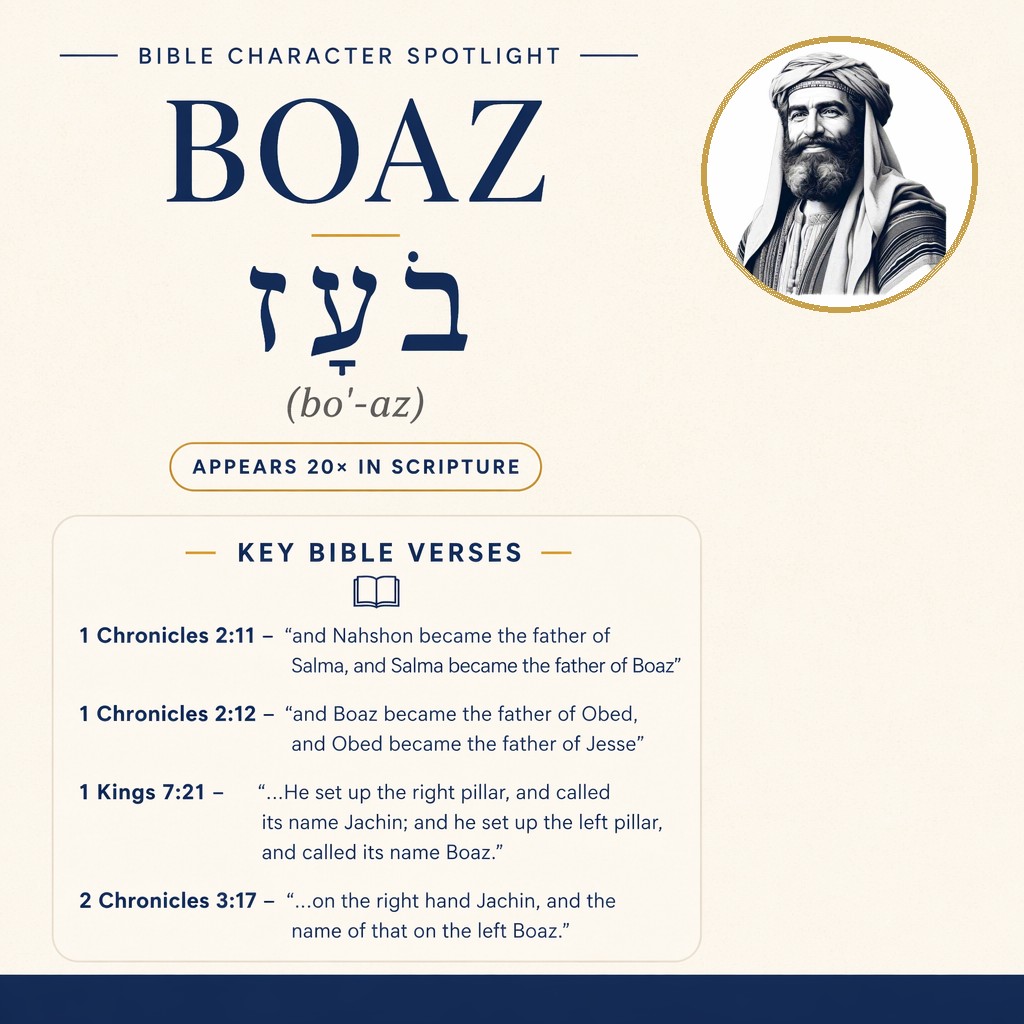
In a genealogy, “Salma became the father of Boaz” (1 Chronicles 2:11) and “Boaz became the father of Obed” (1 Chronicles 2:12). A separate use of the name appears when a temple pillar was called “Boaz” (1 Kings 7:21; 2 Chronicles 3:17).
Learn More →Boaz (בֹּעַז, Bo’az) is presented as “a mighty man of wealth, of the family of Elimelech,” known for his generous, protective treatment of Ruth as she gleaned in his field (Ruth 2:1–23). The same name also designates a pillar set up at the porch of the temple (1 Kings 7:21; 2 Chronicles 3:17), and in genealogical records Boaz appears as an ancestor in the line leading to Jesse (1 Chronicles 2:11–12).
Boaz in Scripture
In the narrative of Ruth 2, Boaz is introduced in connection with Naomi’s family and described in terms of social standing and resources.
“Naomi had a relative of her husband’s, a mighty man of wealth, of the family of Elimelech, and his name was Boaz.” (Ruth 2:1)
Ruth asked Naomi for permission to glean, seeking favor in someone’s sight, and Naomi agreed (Ruth 2:2). Ruth then went out to glean and came to a particular portion of a field identified as belonging to Boaz, again linking him with Elimelech’s family.
“She went, and came and gleaned in the field after the reapers; and she happened to come to the portion of the field belonging to Boaz, who was of the family of Elimelech.” (Ruth 2:3)
Boaz entered the scene “from Bethlehem” and greeted his reapers with a blessing invoking Yahweh, and they responded in kind.
“Behold, Boaz came from Bethlehem, and said to the reapers, ‘May Yahweh be with you.’ They answered him, ‘May Yahweh bless you.’ ” (Ruth 2:4)
Seeing Ruth among the workers, Boaz asked his servant in charge of the reapers about her identity.
“Then Boaz said to his servant who was set over the reapers, ‘Whose young lady is this?’ ” (Ruth 2:5)
The servant identified her as “the Moabite lady” who returned with Naomi from Moab, and reported her request and persistence at gleaning (Ruth 2:6–7). Boaz then addressed Ruth directly, calling her “my daughter,” and instructed her to keep close to his maidens rather than glean elsewhere.
“Then Boaz said to Ruth, ‘Listen, my daughter. Don’t go to glean in another field, and don’t go from here, but stay here close to my maidens.’ ” (Ruth 2:8)
Boaz continued by directing her attention to the field being reaped and granting her safety and access to water, explaining that he had instructed the young men not to touch her.
“Let your eyes be on the field that they reap, and go after them. Haven’t I commanded the young men not to touch you? When you are thirsty, go to the vessels, and drink from that which the young men have drawn.” (Ruth 2:9)
Ruth responded with humility, asking why she had found favor since she was “a foreigner” (Ruth 2:10). Boaz answered by describing what he had heard about her conduct toward Naomi after her husband’s death, emphasizing her loyalty and her decisive move to an unfamiliar people.
“Boaz answered her, ‘I have been told all about what you have done for your mother-in-law since the death of your husband, and how you have left your father, your mother, and the land of your birth, and have come to a people that you didn’t know before.’ ” (Ruth 2:11)
He then pronounced a blessing over her in Yahweh’s name, speaking of repayment and refuge under the God of Israel.
“May Yahweh repay your work, and a full reward be given to you from Yahweh, the God of Israel, under whose wings you have come to take refuge.” (Ruth 2:12)
Ruth sought continued favor, stating that Boaz had comforted her and spoken kindly, even though she was not like one of his servants (Ruth 2:13). At mealtime, Boaz invited her to eat with the reapers, providing bread and vinegar; she ate until satisfied and kept some back.
“At meal time Boaz said to her, ‘Come here, and eat some bread, and dip your morsel in the vinegar.’ She sat beside the reapers, and they passed her parched grain. She ate, was satisfied, and left some of it.” (Ruth 2:14)
When Ruth returned to glean, Boaz gave specific instructions to his young men to permit her to glean “even among the sheaves” without reproach, and to actively facilitate her gleaning by pulling out some from the bundles for her.
“When she had risen up to glean, Boaz commanded his young men, saying, ‘Let her glean even among the sheaves, and don’t reproach her.’ ” (Ruth 2:15)
“Also pull out some for her from the bundles, and leave it. Let her glean, and don’t rebuke her.” (Ruth 2:16)
Ruth gleaned “until evening,” then beat out what she had gleaned, “and it was about an ephah of barley” (Ruth 2:17). She brought it into the city, and also gave Naomi what she had left from her meal after she had enough (Ruth 2:18). Naomi asked where Ruth had gleaned and blessed the one who noticed her; Ruth answered by naming Boaz.
“Her mother-in-law said to her, ‘Where have you gleaned today? Where have you worked? Blessed be he who noticed you.’ She told her mother-in-law with whom she had worked, ‘The man’s name with whom I worked today is Boaz.’ ” (Ruth 2:19)
Naomi responded with a blessing to Yahweh and interpreted Boaz’s actions in terms of kindness shown toward “the living and to the dead.” She also identified Boaz’s relationship to them in terms of kinship.
“Naomi said to her daughter-in-law, ‘May he be blessed by Yahweh, who has not abandoned his kindness to the living and to the dead.’ Naomi said to her, ‘The man is a close relative to us, one of our near kinsmen.’ ” (Ruth 2:20)
Ruth relayed Boaz’s further instruction that she stay close to his young men until the completion of his harvest (Ruth 2:21). Naomi affirmed that it was good for Ruth to go out with his maidens to avoid danger elsewhere (Ruth 2:22). The chapter closes by reporting Ruth’s continued gleaning with Boaz’s maidens “to the end of barley harvest and of wheat harvest,” while living with her mother-in-law (Ruth 2:23).
“So she stayed close to the maidens of Boaz, to glean to the end of barley harvest and of wheat harvest; and she lived with her mother-in-law.” (Ruth 2:23)
Outside the Ruth narrative, genealogical material places Boaz within a line of descent: Salma fathered Boaz, and Boaz fathered Obed, leading onward to Jesse.
“and Nahshon became the father of Salma, and Salma became the father of Boaz,” (1 Chronicles 2:11)
“and Boaz became the father of Obed, and Obed became the father of Jesse;” (1 Chronicles 2:12)
Multiple bearers
The name Boaz applies to (1) a man associated with Bethlehem, the family of Elimelech, and the events of Ruth 2 (Ruth 2:1–23), and (2) a temple pillar, the left pillar set up at the porch of the temple.
“He set up the pillars at the porch of the temple. He set up the right pillar, and called its name Jachin; and he set up the left pillar, and called its name Boaz.” (1 Kings 7:21)
“He set up the pillars before the temple, one on the right hand, and the other on the left; and called the name of that on the right hand Jachin, and the name of that on the left Boaz.” (2 Chronicles 3:17)
Name and Meaning
The Hebrew name is written בֹּעַז and transliterated Bo’az (pronounced bo’-az). Its derivation is reported in lexicon tradition as coming from an unused root of uncertain meaning; the same lexicon gloss associates the name with Boaz as an ancestor of David and also as the name of a pillar in front of the temple.
Observation
Within Ruth 2, Boaz’s words and instructions combine blessing (“May Yahweh be with you,” Ruth 2:4) with concrete protection and provision (“Haven’t I commanded the young men not to touch you?” Ruth 2:9; “Let her glean even among the sheaves,” Ruth 2:15).
Frequently Asked Questions
What does the name Boaz mean?
Boaz is from an unused Hebrew root of uncertain meaning.
How many times does Boaz appear in the Bible?
Boaz occurs 20 times.
Who was Boaz?
Boaz is named as an ancestor of David, and he is also the name of a pillar in front of the temple. In the genealogy, “Salma became the father of Boaz” (1 Chronicles 2:11) and “Boaz became the father of Obed” (1 Chronicles 2:12).
What did Boaz say to Ruth about gleaning?
Boaz told Ruth not to glean in another field and to stay close to his maidens (Ruth 2:8).
Explore Further
If you found this page about Boaz interesting and would like to discover more about other biblical characters, explore our comprehensive Encyclopedia of Biblical Characters. For those looking to delve deeper into the Greek origins of these names and terms, our Greek Lexicon is an invaluable resource.
Sources: Name and occurrence data from Strong’s Exhaustive Concordance and STEPBible reference data (CC BY). Scripture quotations from the World English Bible (public domain).