
Who was Omar in the bible?
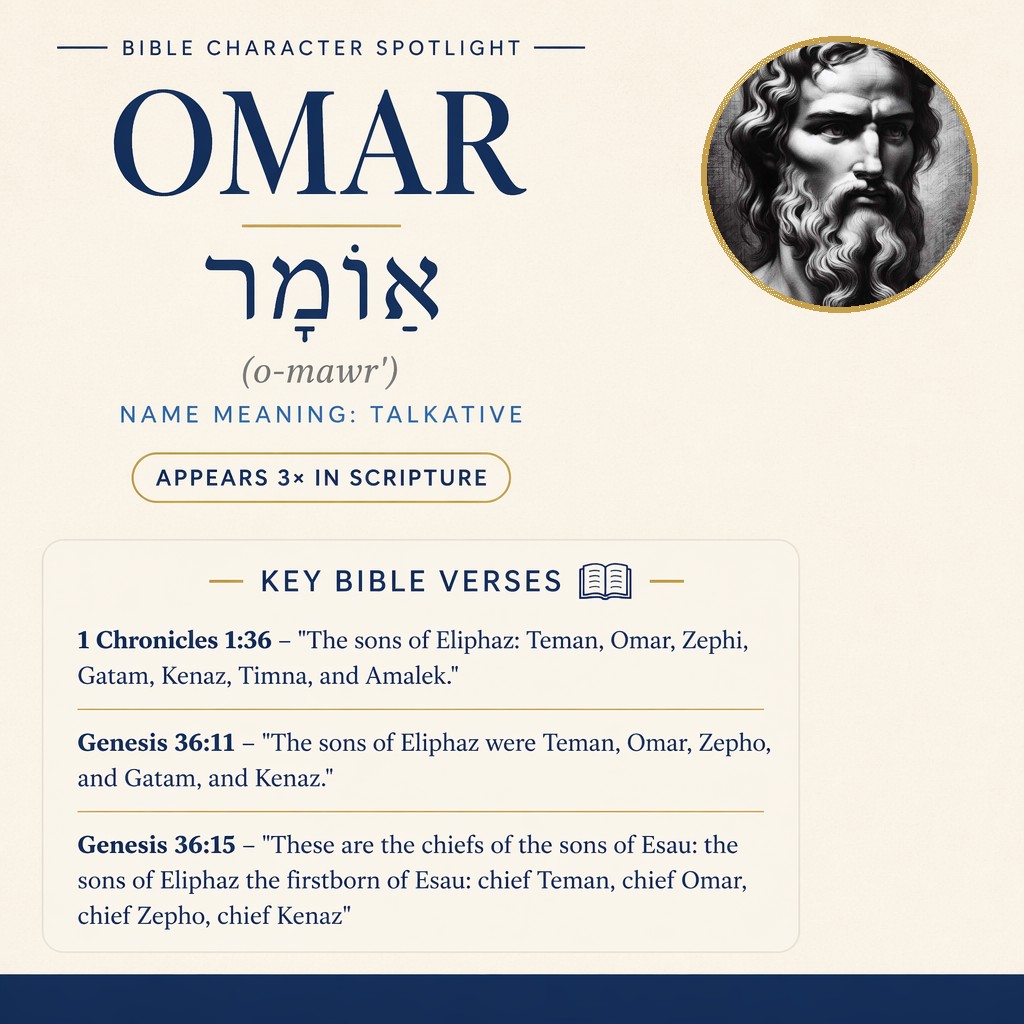
Omar is listed among the sons of Eliphaz, in Esau’s family line, appearing in Genesis 36:11, Genesis 36:15, and 1 Chronicles 1:36.

Family Line
Chronicles places Omar within Esau’s descendants: “The sons of Isaac: Esau and Israel” (1 Chronicles 1:34) and “The sons of Esau: Eliphaz” (1 Chronicles 1:35).
Learn More →Chief Among Sons
Omar is also listed among the chiefs from Eliphaz: “chief Teman, chief Omar, chief Zepho, chief Kenaz” (Genesis 36:15).
Learn More →Omar is named in Genesis and 1 Chronicles as one of the sons of Eliphaz, making him a descendant of Esau; a lexicon gloss identifies him as a grandson of Esau. The same lexicon entry derives the name from a Hebrew verb meaning “to say,” giving the sense “talkative.”
Omar in Scripture
Omar appears within genealogical lists that trace Esau’s line. In the Chronicler’s broader setting, Esau is presented as one of Isaac’s sons, alongside Israel.
“Abraham became the father of Isaac. The sons of Isaac: Esau and Israel.” (1 Chronicles 1:34, WEB)
The list then narrows to Esau’s sons, and then to the sons of Eliphaz (one of Esau’s sons), where Omar is named among his brothers.
“The sons of Esau: Eliphaz, Reuel, Jeush, Jalam, and Korah.” (1 Chronicles 1:35, WEB)
“The sons of Eliphaz: Teman, Omar, Zephi, Gatam, Kenaz, Timna, and Amalek.” (1 Chronicles 1:36, WEB)
Genesis 36 supplies the same family line in a chapter framed as Esau’s generations and connected to Edom. The chapter heading statement places Esau in relation to the Edomites and the region of Seir, and then names his sons, including Eliphaz.
“This is the history of the generations of Esau the father of the Edomites in the hill country of Seir:” (Genesis 36:9, WEB)
“these are the names of Esau’s sons: Eliphaz, the son of Adah, the wife of Esau; and Reuel, the son of Basemath, the wife of Esau.” (Genesis 36:10, WEB)
Within that framework, Omar is identified as one of Eliphaz’s sons.
“The sons of Eliphaz were Teman, Omar, Zepho, and Gatam, and Kenaz.” (Genesis 36:11, WEB)
Genesis 36 continues to expand the family list around Omar by noting other descendants connected to Eliphaz and to Esau’s other sons. For Eliphaz’s line, the chapter includes the mention of Timna and Amalek:
“Timna was concubine to Eliphaz, Esau’s son; and she bore to Eliphaz Amalek. These are the descendants of Adah, Esau’s wife.” (Genesis 36:12, WEB)
It also provides the lines of Reuel and of Esau’s other wife, Oholibamah:
“These are the sons of Reuel: Nahath, Zerah, Shammah, and Mizzah. These were the descendants of Basemath, Esau’s wife.” (Genesis 36:13, WEB)
“These were the sons of Oholibamah, the daughter of Anah, the daughter of Zibeon, Esau’s wife: she bore to Esau Jeush, Jalam, and Korah.” (Genesis 36:14, WEB)
Omar is named a second time in Genesis 36 when the chapter turns from listing sons to listing chiefs associated with Esau’s descendants. In that context Omar is explicitly called a chief among “the sons of Eliphaz the firstborn of Esau.”
“These are the chiefs of the sons of Esau: the sons of Eliphaz the firstborn of Esau: chief Teman, chief Omar, chief Zepho, chief Kenaz,” (Genesis 36:15, WEB)
The same section continues the enumeration of chiefs from Eliphaz’s line and then from Reuel’s line, keeping Omar within a broader register of leadership titles among Esau’s descendants, specifically connected with Edom.
“chief Korah, chief Gatam, chief Amalek. These are the chiefs who came of Eliphaz in the land of Edom. These are the sons of Adah.” (Genesis 36:16, WEB)
“These are the sons of Reuel, Esau’s son: chief Nahath, chief Zerah, chief Shammah, chief Mizzah. These are the chiefs who came of Reuel in the land of Edom. These are the sons of Basemath, Esau’s wife.” (Genesis 36:17, WEB)
“These are the sons of Oholibamah, Esau’s wife: chief Jeush, chief Jalam, chief Korah. These are the chiefs who came of Oholibamah the daughter of Anah, Esau’s wife.” (Genesis 36:18, WEB)
Taken together, these passages present Omar as (1) a son of Eliphaz within Esau’s genealogy and (2) one of the chiefs associated with that line, named among other chiefs “in the land of Edom.”
Name and Meaning
In Hebrew the name is written אוֹמָר, transliterated ‘Owmar and pronounced “o-mawr.” A lexicon entry derives it from the Hebrew root associated with the verb אָמַר (‘amar), “to say” (used broadly), and accordingly gives the sense “talkative.”
Brief observation
Omar’s appearances are confined to genealogical and chiefly lists, where he is placed within Esau’s line through Eliphaz and is singled out as “chief Omar” among “the chiefs who came of Eliphaz in the land of Edom” (Genesis 36:15–16, WEB).
Frequently Asked Questions
Who was Omar in the Bible?
Omar was a grandson of Esau. He is listed among the sons of Eliphaz (Genesis 36:11; 1 Chronicles 1:36).
What does the name Omar mean?
The name Omar means “talkative.”
How many times does Omar appear in the Bible?
Omar appears 3 times.
What role or title is linked with Omar in Genesis?
Genesis lists him as “chief Omar” among the chiefs of the sons of Esau (Genesis 36:15).
Explore Further
If you found this page about Omar interesting and would like to discover more about other biblical characters, explore our comprehensive Encyclopedia of Biblical Characters. For those looking to delve deeper into the Greek origins of these names and terms, our Greek Lexicon is an invaluable resource.
Sources: Name and occurrence data from Strong’s Exhaustive Concordance and STEPBible reference data (CC BY). Scripture quotations from the World English Bible (public domain).




