Exploring the Meaning of Kenodoxos in Greek
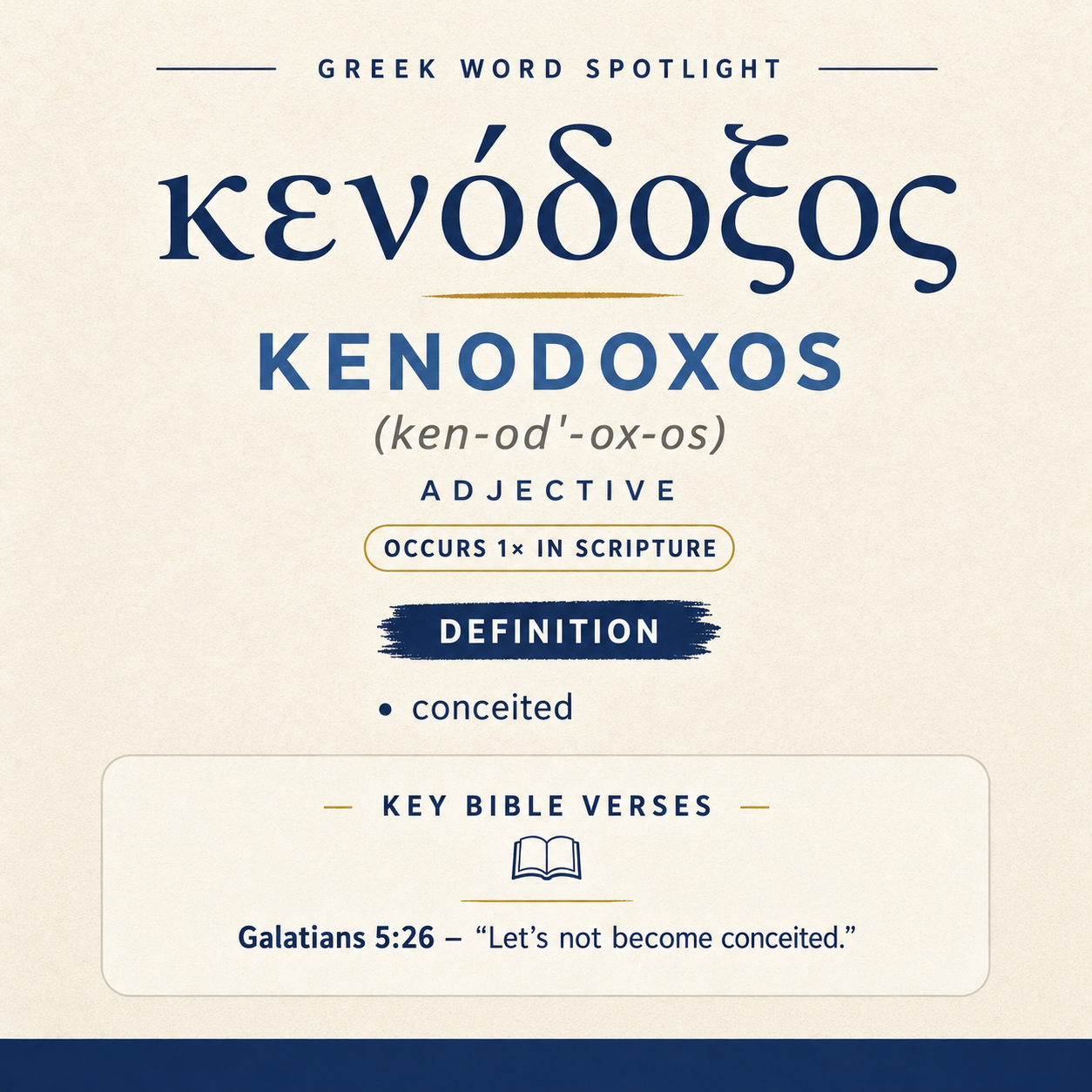
κενόδοξος means “conceited” and appears once in Scripture, in Galatians 5:26.
Verse Context
Galatians 5:26 warns: “Let’s not become conceited, provoking one another, and envying one another.”
Learn More →κενόδοξος means “conceited” and appears once in the New Testament, in Paul’s exhortation to the Galatians. In its lone occurrence it names a posture that distorts relationships within the community.
Root and Related Words
κενόδοξος is formed from kenos (κενός), “empty,” and doxa (δόξα), “glory.” The combination frames the adjective’s idea by placing “glory” language alongside a term for “emptiness,” producing a pointed expression for a stance of self-importance that lacks true substance.

Occurrences
“Let’s not become conceited, provoking one another, and envying one another.” (Galatians 5:26)
Here κενόδοξος is placed at the head of a short chain of community-rupturing behaviors. The verse is not merely a private warning about inward attitude; it is immediately social in its outworking: conceit issues in “provoking one another,” and it lives alongside “envying one another.” The word therefore functions as the seed posture from which competitive, reactive interactions grow. Paul frames it with an inclusive appeal (“Let’s not become…”), treating conceit as a risk that can arise within the group and then express itself outwardly in mutual irritation and resentment.
The syntax also shows how the term belongs to a relational triangle: one person’s conceit is not self-contained; it is linked with the impulse to needle or challenge others (“provoking”) and with the inward comparison that begrudges another’s standing (“envying”). Within this sentence, κενόδοξος marks the self-exalting stance that turns community members into rivals and judges, producing a climate where people either bait one another into conflict or simmer with jealousy.
Sense and Usage
The definition “conceited” in this context is sharpened by its placement between the inclusive caution (“Let’s not become…”) and the paired participles that describe what follows: “provoking… envying….” κενόδοξος thus signals more than a fleeting thought; it names a settled orientation that shapes conduct. Conceit, as used here, is not neutral self-confidence but a comparative posture that needs an audience and measures itself against others, so that relationships become arenas for proving, pressing, or resenting.
The word’s internal formation (kenos + doxa) supplies a vivid contour to the term’s force in Galatians 5:26. Doxa language commonly concerns honor and esteem; paired with “empty,” the compound portrays a kind of esteem-seeking that is hollow. In the verse, that hollowness becomes visible in the behaviors it generates: it does not build others up; it “provok[es]” them. It does not rejoice in another’s good; it “env[ies].” The result is a community dynamic where people are drawn into cycles of challenge and comparison rather than mutual good will.
Because κενόδοξος appears only in this tightly packed admonition, its usage is defined by this immediate moral-social setting: it is an adjective describing the sort of person the community must not become, and it is defined in practical terms by what it does to “one another.” The verse’s repeated reciprocal language (“one another… one another”) shows that conceit is treated as a threat specifically to shared life. It is not described through external markers, achievements, or status claims; its reality is recognized by its interpersonal fruit—how it moves a person to provoke and to envy.
Imagery
Although κενόδοξος is an adjective of character, Galatians 5:26 gives it a concrete relational picture: a circle of peers pulled into antagonism. The conceited stance stands at the start of a progression that can be imagined as repeated exchanges—one person needling another, another answering with resentment—until the community’s “one another” life is defined by comparison and rivalry.
Sources: Lexical data from Strong’s Exhaustive Concordance and the Translators Brief Lexicon of Extended Strongs for Greek (STEPBible, CC BY). Occurrence data from the Translators Amalgamated Greek New Testament (STEPBible, CC BY). Scripture quotations from the World English Bible (public domain).