Exploring the Meaning of Kenodoxia in Greek
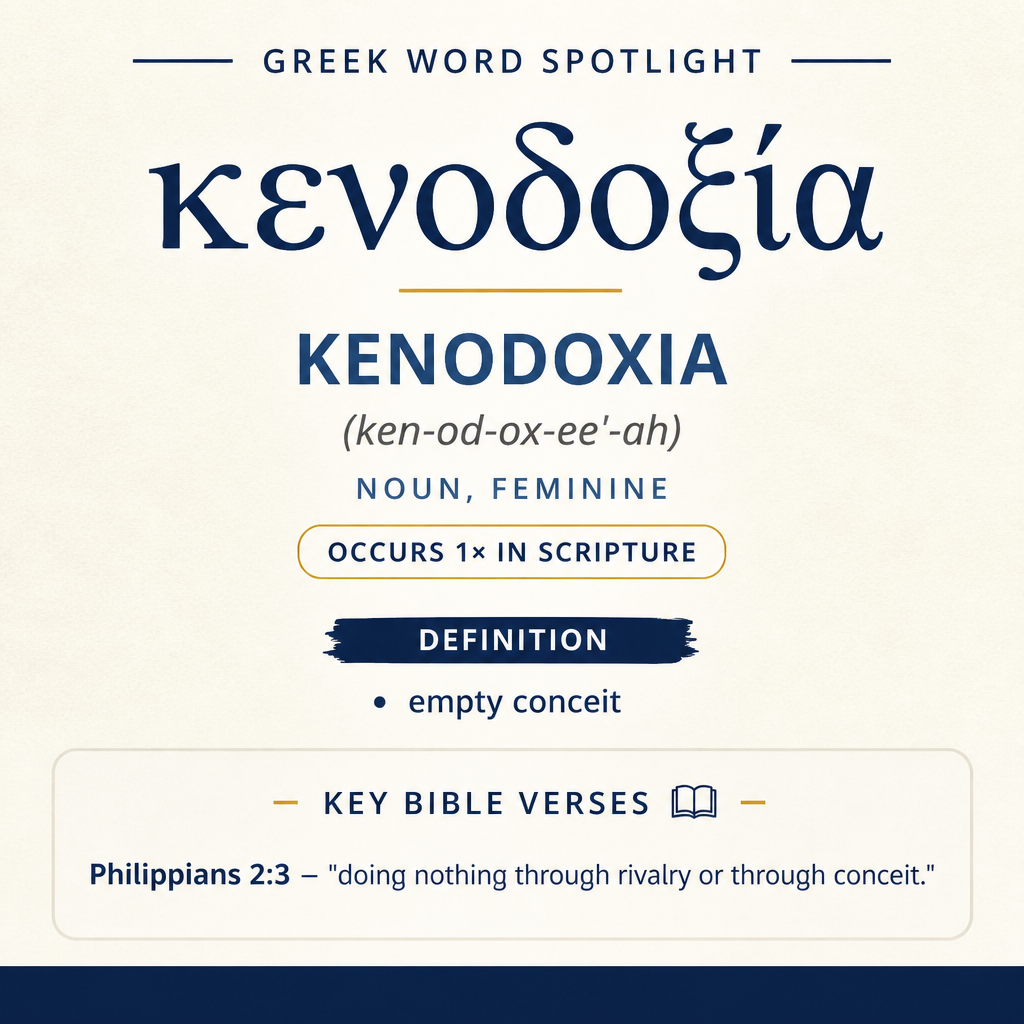
κενοδοξία means “empty conceit” and appears once in Scripture, in Philippians 2:3.
Verse Context
In Philippians 2:3, it is contrasted with humility and counting others better than oneself.
Learn More →κενοδοξία means “empty conceit,” and it appears once in the New Testament, in Paul’s instruction to the Philippian church about the manner of their life together. In its lone occurrence it stands as a motive to be refused, set opposite a posture of humility toward others.
Root and Related Words
Kenodoxia corresponds to the related adjective kenodoxos (κενόδοξος), “conceited” (Strong’s G2755), the term from which it derives.

Occurrences
“doing nothing through rivalry or through conceit, but in humility, each counting others better than himself;” (Philippians 2:3)
In Philippians 2:3, kenodoxia is placed alongside “rivalry” as a source from which actions must not proceed: “doing nothing through rivalry or through conceit.” The word functions as a motive-word; it names an inner driver that can shape outward behavior. Because the sentence is framed with an all-encompassing negative (“doing nothing”), kenodoxia is treated not as an occasional misstep but as a kind of underlying impulse that must be excluded from Christian conduct in the community addressed.
The immediate contrast clarifies the practical direction of the term. Kenodoxia is set opposite “humility,” which is then specified by an interpersonal practice: “each counting others better than himself.” In this line, the issue is not merely private self-estimation but the social consequences of self-regard. Kenodoxia is the inward posture that would tend to prevent this outward pattern of honoring others; humility is the posture that enables it. The verse therefore uses the term to identify a disposition that distorts relationships, especially when people’s actions are driven by self-importance rather than by a willingness to place others first in deliberate judgment (“counting”).
The structure of the clause also gives kenodoxia a particular rhetorical weight. It is paired with “rivalry” and introduced by the repeated preposition “through,” implying a channel or instrumentality: deeds can be carried out by means of rivalry, or by means of conceit. The parallelism suggests that kenodoxia is not only a personal flaw but a generator of divisive behavior comparable to rivalry. Within the single sentence, the word’s force is ethical and communal: it names a motive that is incompatible with the kind of shared life in which members actively regard one another as worthy of honor.
Sense and Usage
“Empty conceit” is a compact moral diagnosis, and Philippians 2:3 shows how it operates in practice. The verse does not treat conceit as a mere feeling; it is an active principle that can stand behind “doing.” By prohibiting any action done “through” it, the text portrays kenodoxia as a controlling rationale that can quietly explain why people pursue certain goals, adopt certain tones, or make certain judgments in a community setting.
The definition’s adjective “empty” contributes an evaluative judgment: the conceit in view has a hollowness to it, not a substance that can bear the weight of communal life. In the verse, that emptiness is implied by its inability to produce the behavior commended immediately afterward. The practice commanded—“in humility, each counting others better than himself”—requires a stable willingness to lower oneself in relative standing. Kenodoxia, by contrast, is the kind of self-regard that interrupts such counting, because its internal logic is oriented toward protecting or elevating the self. Philippians 2:3 therefore frames kenodoxia as a motive that is internally unfit for the life of mutual consideration the community is being taught.
The term also sits in a telling relationship with the other motive named: “rivalry.” Rivalry points to a competitive orientation toward others; kenodoxia names a self-focused posture. In the verse they are not identical, but they are neighbors: either can sit behind actions and produce a similar result. This pairing makes kenodoxia more than a solitary self-opinion; it is a disposition with social reach. Where rivalry openly contests others, kenodoxia covertly centers the self, and both undermine the humility that expresses itself in regarding others as better.
Because the passage defines humility with a participial practice—“each counting others better than himself”—kenodoxia is implicitly concerned with the opposite kind of “counting.” The verse’s logic suggests that the battle is fought at the level of deliberate valuation: how one calculates relative worth in the mind and heart, and how that calculation then shapes behavior. Kenodoxia, as “empty conceit,” is the sort of self-valuation that demands recognition and priority, and thus resists the verse’s call to treat others as better. The word’s contribution is therefore diagnostic and preventative: it names a motive to exclude so that the stated pattern of humility can actually take root in everyday dealings.
Finally, the singular appearance of kenodoxia in this verse makes its placement especially purposeful. Paul chooses a term that targets motive, then immediately supplies a positive replacement that is equally motive-level (“in humility”) and equally practical (“each counting”). Kenodoxia is not treated as an abstract vice floating above real choices; it is directly tethered to how members of a community approach one another in concrete evaluation and conduct. The verse thereby gives the word a clear ethical contour: it is a self-centered impulse that, when present, corrupts the manner in which one acts toward others.
Imagery in Context
Even in a short sentence, kenodoxia carries a vivid moral picture. Philippians 2:3 depicts actions as flowing “through” inner channels: either through rivalry, or through conceit, or—by contrast—in humility expressed by honoring others. In that picture, “empty conceit” resembles a hollow internal drive that still manages to steer behavior, whereas humility is pictured as a deliberate re-counting of others’ worth. The verse’s imagery is therefore relational and practical: motives become pathways, and the word marks one pathway that must be closed for a community to walk in humble regard for one another.
Sources: Lexical data from Strong’s Exhaustive Concordance and the Translators Brief Lexicon of Extended Strongs for Greek (STEPBible, CC BY). Occurrence data from the Translators Amalgamated Greek New Testament (STEPBible, CC BY). Scripture quotations from the World English Bible (public domain).