Exploring the Meaning of Kataskeuazo in Greek
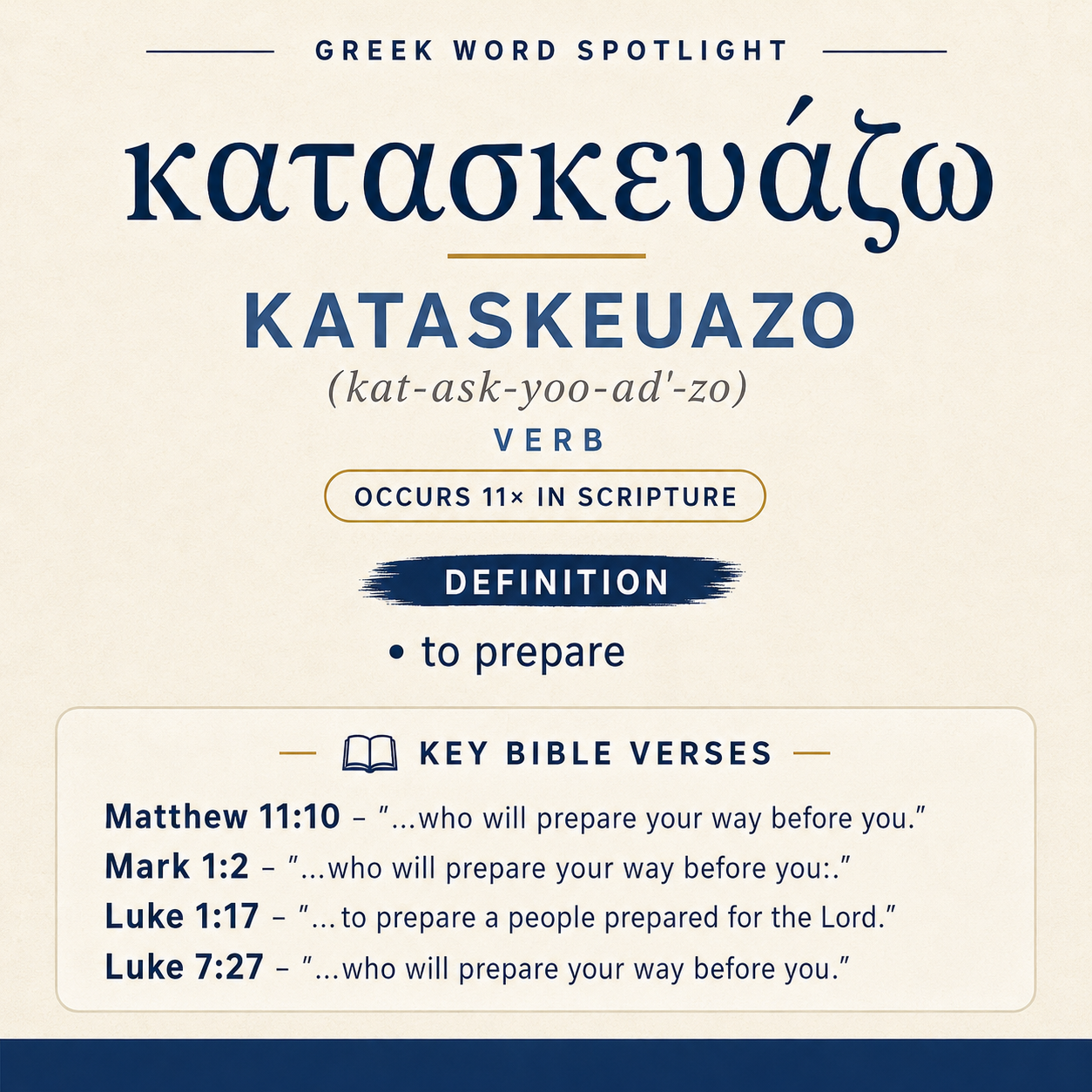
κατασκευάζω means “to prepare” and occurs 11 times in Scripture, including Matthew 11:10, Mark 1:2, Luke 7:27, and Hebrews 9:2.
Core Meaning
κατασκευάζω means “to prepare.” In the Gospels it describes preparing “your way” before you.
Learn More →Gospel Occurrences
It appears in Matthew 11:10, Mark 1:2, Luke 1:17, and Luke 7:27. These passages speak of a messenger going before to prepare the way.
Learn More →Hebrews Usage
In Hebrews 3:3–4 it is used for “built” (a house). In Hebrews 9:2 and 9:6 it describes the tabernacle and its parts being prepared.
Learn More →κατασκευάζω expresses the idea of preparing, and it is used for both personal readiness and the making-ready of concrete structures. In the quoted passages it ranges from preparing a way and a people, to preparing sacred space, to preparing a vessel that preserves life.
Occurrences
Matthew 11:10: “For this is he, of whom it is written, ‘Behold, I send my messenger before your face, who will prepare your way before you.’”
Here κατασκευάζω belongs to the messenger’s role “before your face,” and the object prepared is “your way.” The scene is directional and anticipatory: the verb frames the coming one’s arrival as preceded by deliberate readiness, with the “way” presented as something that can be made ready in advance.

Mark 1:2: “As it is written in the prophets, “Behold, I send my messenger before your face, who will prepare your way before you:”
Mark places the verb inside a formal citation (“written in the prophets”), so the “prepare” action carries the weight of a set announcement. The preparation is again focused on “your way,” emphasizing that the messenger’s work is not an end in itself but a directed task for the benefit of the one whose way is being prepared.
Luke 1:17: “He will go before him in the spirit and power of Elijah, ‘to turn the hearts of the fathers to the children,’ and the disobedient to the wisdom of the just; to prepare a people prepared for the Lord.”
Luke sets κατασκευάζω beside moral and relational change: “to turn the hearts” and to turn “the disobedient” toward “the wisdom of the just.” The verb’s object is not a road but “a people,” and the preparation is explicitly “for the Lord.” The wording “a people prepared” makes readiness the point of the action: the preparing aims at a condition of being ready.
Luke 7:27: “This is he of whom it is written, ‘Behold, I send my messenger before your face, who will prepare your way before you.’”
This occurrence returns to the messenger saying and repeats the same forward-looking arrangement: messenger first, then the prepared “way.” Within Luke’s narrative, the repetition ties identity (“This is he”) to function: the one identified is the one whose defining work is to prepare.
Hebrews 3:3: “For he has been counted worthy of more glory than Moses, because he who built the house has more honor than the house.”
In Hebrews 3:3 the verb appears in the image of construction: “he who built the house.” Preparation is expressed as the act that results in a “house,” and the comparison uses that act to argue about honor—honor attaches to the one who does the preparing/building rather than to the completed structure.
Hebrews 3:4: “For every house is built by someone; but he who built all things is God.”
The same construction imagery is expanded into a general principle: “every house is built by someone.” The verb’s contribution is to frame the house as a product of intentional preparation, and then to extend the thought beyond a single “house” to “all things,” placing ultimate agency with God as the one who “built all things.”
Hebrews 9:2: “For a tabernacle was prepared. In the first part were the lamp stand, the table, and the show bread; which is called the Holy Place.”
Here κατασκευάζω describes the tabernacle as something “prepared,” and the verse immediately inventories its contents: “the lamp stand, the table, and the show bread.” Preparation is therefore not abstract; it includes the arrangement of a defined space and the placing of specific items within “the first part,” identified as “the Holy Place.”
Hebrews 9:6: “Now these things having been thus prepared, the priests go in continually into the first tabernacle, accomplishing the services,”
This verse looks back to the prior description (“these things having been thus prepared”) and presents preparation as a prerequisite for ongoing action. The priests’ continual entrance and their “accomplishing the services” presuppose a prepared environment; the verb marks the conditions that make regular worshipful activity possible.
Hebrews 11:7: “By faith, Noah, being warned about things not yet seen, moved with godly fear, prepared a ship for the saving of his house, through which he condemned the world, and became heir of the righteousness which is according to faith.”
In Hebrews 11:7 the verb is explicitly practical and urgent: Noah “prepared a ship.” The purpose is stated—“for the saving of his house”—and the preparation responds to warning “about things not yet seen.” The verse links the preparing act with consequences beyond the household: “through which he condemned the world,” and it also sets the act within the larger description “By faith,” showing preparation as faith expressed in concrete making-ready.
1 Peter 3:20: “who before were disobedient, when God waited patiently in the days of Noah, while the ship was being built. In it, few, that is, eight souls, were saved through water.”
Although the focus here is on God’s patience and prior disobedience, the verb’s scene is the prolonged process “while the ship was being built.” Preparation is pictured as a work that takes time and proceeds during a period of waiting. The result is survival—“eight souls, were saved through water”—and the building activity stands in the background as the means by which that saving becomes a lived reality “in it.”

Sense and Usage
Across these passages, κατασκευάζω consistently describes preparation as purposeful readiness directed toward an anticipated outcome. In the messenger sayings (Matthew 11:10; Mark 1:2; Luke 7:27), preparation is oriented toward arrival: the “way” is something made ready in advance, with the messenger’s “before” positioning underscoring sequence and intention. Luke 1:17 extends the same preparing idea from a path to persons, aligning preparation with transformation that brings a community into a state suited “for the Lord.” There, preparation is not merely arranging externals; it is preparation that reaches hearts and wisdom, so that “a people prepared” exists as a formed, ready community.
Hebrews uses the verb to emphasize the maker’s agency and the prepared object’s dependence on that agency. In Hebrews 3:3–4, the “house” is an illustration: the act of building—of preparing the structure—grounds a claim about honor and ultimately about God as the one who “built all things.” The same preparing notion shifts to sacred space in Hebrews 9:2 and 9:6, where “a tabernacle was prepared” and where the phrase “having been thus prepared” makes preparation a condition for continual priestly activity. The description of parts and furnishings shows preparation as arrangement according to an ordered design: a space is made ready by being set up with what belongs in it.
Finally, Hebrews 11:7 and 1 Peter 3:20 show preparation as labor undertaken in view of threat and deliverance. Noah’s ship is “prepared…for the saving of his house,” and Peter’s “ship was being built” locates that preparation during a time of divine patience and human disobedience. In these scenes, preparation has a protective trajectory: it creates a place in which life is preserved (“In it…were saved through water”). Together these uses show that the verb can speak of preparing a way, preparing a people, preparing a sanctuary, and preparing a vessel—different objects, but the same core action of making ready for what is coming next.
Imagery
The passages cluster around two main images: a prepared route and a prepared structure. The “way” sayings cast preparation as clearing the approach for a significant arrival, with the messenger stationed ahead of time. Hebrews and the Noah texts cast preparation as constructing and fitting out what will be inhabited—“house,” “tabernacle,” “ship”—so that life, worship, and safety can proceed within what has been made ready.
Sources: Lexical data from Strong’s Exhaustive Concordance and the Translators Brief Lexicon of Extended Strongs for Greek (STEPBible, CC BY). Occurrence data from the Translators Amalgamated Greek New Testament (STEPBible, CC BY). Scripture quotations from the World English Bible (public domain).