Who was Dathan in the bible?
Dathan was an Israelite, a son of Eliab of Reuben, appearing in Numbers 16, Numbers 26:9, Deuteronomy 11:6, and Psalm 106:17.

Conflict With Moses
Dathan and Abiram refused Moses’ summons: “We won’t come up!” (Numbers 16:12). They were among those “who rebelled against Moses and against Aaron” (Numbers 26:9).
Learn More →His Outcome
Moses warned the congregation to depart “from the tents of these wicked men” (Numbers 16:26), and “the earth opened its mouth and swallowed them up” (Numbers 16:32; Deuteronomy 11:6). Psalm 106:17 says, “The earth opened and swallowed up Dathan.”
Learn More →Dathan is presented as an Israelite, appearing with Abiram as “the sons of Eliab, the son of Reuben” (Deuteronomy 11:6). In the wilderness narrative, he is shown among those who rose up against Moses and Aaron and who were swallowed by the earth (Numbers 16; Psalm 106:17).
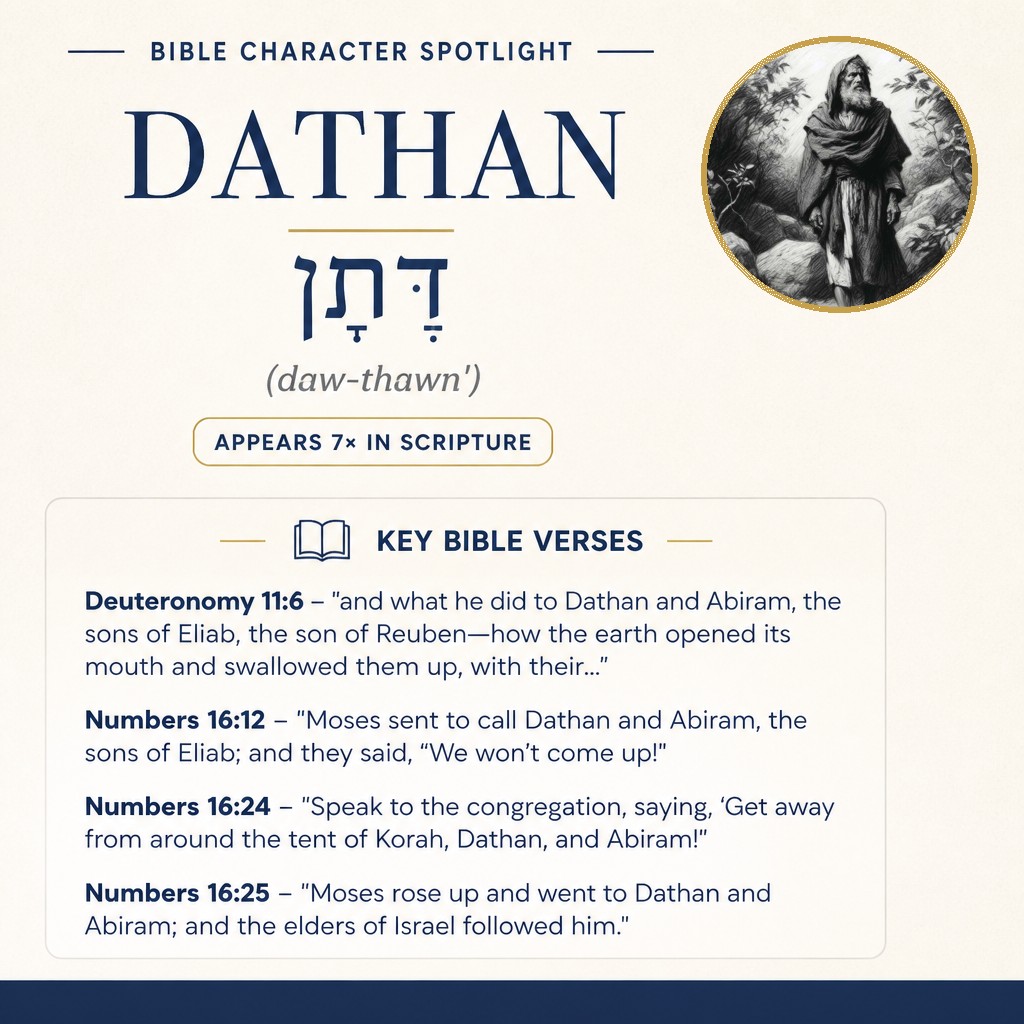
Dathan in Scripture
Dathan first appears in the account of a coordinated challenge involving Korah and others. The narrative introduces the group and places Dathan within a Reubenite line:
“Now Korah, the son of Izhar, the son of Kohath, the son of Levi, with Dathan and Abiram, the sons of Eliab, and On, the son of Peleth, sons of Reuben, took some men.” (Numbers 16:1)
The opposition is described as public and significant in scale, involving leaders:
“They rose up before Moses, with some of the children of Israel, two hundred fifty princes of the congregation, called to the assembly, men of renown.” (Numbers 16:2)
They directly contested Moses and Aaron’s position among the people, arguing that the congregation was holy and that Yahweh was among them:
“They assembled themselves together against Moses and against Aaron, and said to them, ‘You take too much on yourself, since all the congregation are holy, everyone of them, and Yahweh is among them! Why do you lift yourselves up above Yahweh’s assembly?’ ” (Numbers 16:3)
Moses responded first in a posture of submission—“he fell on his face” (Numbers 16:4)—and then announced a test by which Yahweh would show whom he had chosen (Numbers 16:5–7). Moses’ speech to Korah and the Levites frames the dispute as ultimately being “against Yahweh” rather than merely against Aaron (Numbers 16:8–11).
Within this larger conflict, Dathan and Abiram are singled out for a personal summons from Moses. Their refusal is explicit:
“Moses sent to call Dathan and Abiram, the sons of Eliab; and they said, ‘We won’t come up!’ ” (Numbers 16:12)
Their protest continues with accusations that Moses had brought them out “to kill us in the wilderness,” that he made himself “a prince,” and that he had not brought them into a land of “milk and honey” or given them “inheritance of fields and vineyards” (Numbers 16:13–14). They concluded again, “We won’t come up” (Numbers 16:14). Moses, for his part, appealed to Yahweh, denying exploitation of the people:
“Moses was very angry, and said to Yahweh, ‘Don’t respect their offering. I have not taken one donkey from them, neither have I hurt one of them.’ ” (Numbers 16:15)
As the confrontation proceeded, Yahweh directed the congregation to distance itself not only from Korah but also from Dathan and Abiram. The command is presented as a public warning:
“Speak to the congregation, saying, ‘Get away from around the tent of Korah, Dathan, and Abiram!’ ” (Numbers 16:24)
Moses then moved toward Dathan and Abiram, accompanied by Israel’s elders:
“Moses rose up and went to Dathan and Abiram; and the elders of Israel followed him.” (Numbers 16:25)
He urged the people to separate from them, describing them as “these wicked men” and warning that contact with what belonged to them could bring shared judgment (Numbers 16:26). The narrative then depicts Dathan and Abiram with their households at the entrances of their tents:
“So they went away from the tent of Korah, Dathan, and Abiram, on every side. Dathan and Abiram came out, and stood at the door of their tents with their wives, their sons, and their little ones.” (Numbers 16:27)
Moses declared that an extraordinary judgment would authenticate that “Yahweh has sent me to do all these works” (Numbers 16:28). He set the terms: if the men died a common death, it would indicate otherwise; but if the ground opened and swallowed them, it would show “that these men have despised Yahweh” (Numbers 16:29–30). The account immediately reports the specific judgment described:
“As he finished speaking all these words, the ground that was under them split apart. The earth opened its mouth and swallowed them up with their households, all of Korah’s men, and all their goods.” (Numbers 16:31–32)
The narrative continues:
“So they, and all that belonged to them went down alive into Sheol. The earth closed on them, and they perished from among the assembly.” (Numbers 16:33)
The wider community reacted with fear and flight, saying, “Lest the earth swallow us up!” (Numbers 16:34). In the same chapter, a separate act of judgment is recorded against “the two hundred fifty men who offered the incense” (Numbers 16:35), and the censers were turned into “a memorial to the children of Israel” to regulate who might approach to burn incense before Yahweh (Numbers 16:36–40). The chapter also describes a next-day complaint by “all the congregation” (Numbers 16:41), followed by a plague and Aaron’s actions to “make atonement for them” (Numbers 16:46–48), with the final tally: “fourteen thousand and seven hundred, in addition to those who died about the matter of Korah” (Numbers 16:49).
Other passages recall Dathan in summary form. In Deuteronomy, he is paired with Abiram in a remembrance of Yahweh’s acts “in the middle of all Israel”:
“[W]hat he did to Dathan and Abiram, the sons of Eliab, the son of Reuben—how the earth opened its mouth and swallowed them up, with their households, their tents, and every living thing that followed them, in the middle of all Israel;” (Deuteronomy 11:6)
In the census context, Dathan is again identified as a son of Eliab and is characterized as part of a rebellion:
“The sons of Eliab: Nemuel, Dathan, and Abiram. These are that Dathan and Abiram who were called by the congregation, who rebelled against Moses and against Aaron in the company of Korah when they rebelled against Yahweh;” (Numbers 26:9)
The Psalms also preserve a concise recollection of the same judgment:
“The earth opened and swallowed up Dathan, and covered the company of Abiram.” (Psalm 106:17)
Name and Meaning
The name is written in Hebrew script as דָּתָן, transliterated Dathan and pronounced daw-thawn’. Its derivation is described in the lexicon tradition as uncertain, and the same source identifies Dathan as an Israelite.
Observation
Across the accounts, Dathan is consistently remembered in connection with a public dispute “against Moses and against Aaron” and with the ensuing judgment in which “the earth opened its mouth and swallowed them up” (Numbers 26:9; Deuteronomy 11:6).
Frequently Asked Questions
What does the name Dathan mean?
Dathan is a Hebrew name of uncertain derivation; it is used as the name of an Israelite.
How many times does Dathan appear in the Bible?
Dathan appears 7 times.
Who was Dathan?
Dathan is identified as an Israelite. He is mentioned with Abiram as a son of Eliab, the son of Reuben (Deuteronomy 11:6).
What happened to Dathan according to Deuteronomy 11:6?
Deuteronomy 11:6 says the earth opened its mouth and swallowed up Dathan and Abiram, along with their households.
Explore Further
If you found this page about Dathan interesting and would like to discover more about other biblical characters, explore our comprehensive Encyclopedia of Biblical Characters. For those looking to delve deeper into the Greek origins of these names and terms, our Greek Lexicon is an invaluable resource.
Sources: Name and occurrence data from Strong’s Exhaustive Concordance and STEPBible reference data (CC BY). Scripture quotations from the World English Bible (public domain).