Who was Bezer in the bible?
Bezer (Betser) is named as a place in the tribe of Reuben and also as an Israelite in lists, appearing in Deuteronomy 4:43; Joshua 20:8; Joshua 21:36; 1 Chronicles 6:78; 1 Chronicles 7:37.

Place In Reuben
“Beyond the Jordan at Jericho eastward, they assigned Bezer in the wilderness in the plain out of the tribe of Reuben” (Joshua 20:8). It is also listed among towns “out of the tribe of Reuben” given “with its pasture lands” (Joshua 21:36).
Learn More →Name Notes
Strong’s H1221 (Betser) is explained as deriving from a term meaning an inaccessible spot; it can also refer to gold as dug. A lexicon gloss identifies Betser as “a place in Palestine; also an Israelite.”
Learn More →Bezer refers in Scripture chiefly to a place—named among locations “in the wilderness” east of the Jordan—while the same Hebrew name is also borne by an Israelite listed in a genealogy. A lexicon gloss identifies Betser as both “a place in Palestine” and “also an Israelite.”
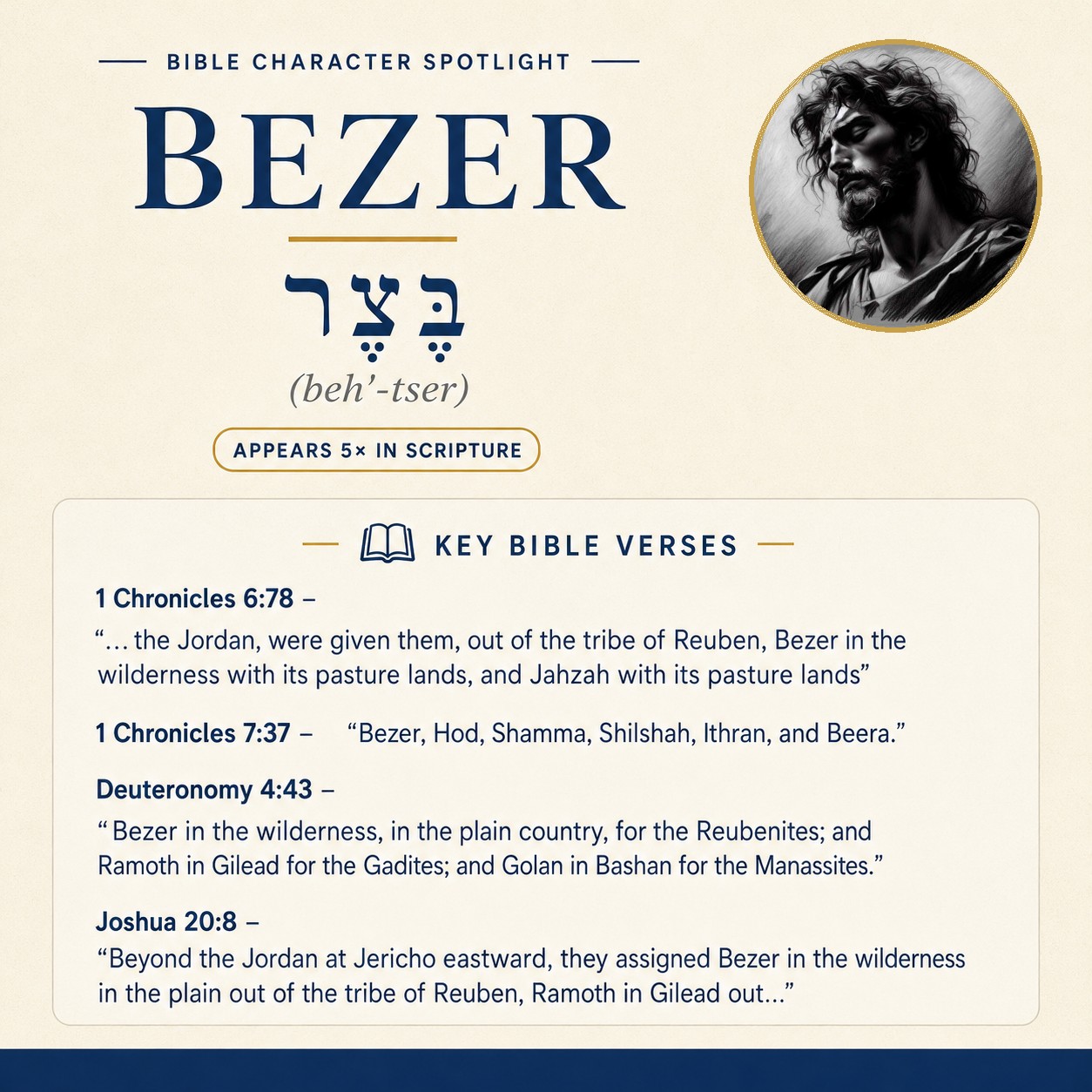
Bezer in Scripture
The earliest mention in the provided passages comes in Moses’ naming of locations for the tribes east of the Jordan. In that setting Bezer is specified as a wilderness location associated with Reuben.
“Bezer in the wilderness, in the plain country, for the Reubenites; and Ramoth in Gilead for the Gadites; and Golan in Bashan for the Manassites.” (Deuteronomy 4:43)
Joshua records an assignment “beyond the Jordan … eastward,” again placing Bezer “in the wilderness in the plain” and explicitly locating it “out of the tribe of Reuben.”
“Beyond the Jordan at Jericho eastward, they assigned Bezer in the wilderness in the plain out of the tribe of Reuben, Ramoth in Gilead out of the tribe of Gad, and Golan in Bashan out of the tribe of Manasseh.” (Joshua 20:8)
Later, in the listing of tribal distributions, Bezer appears again with “pasture lands” as a place given from Reuben’s territory.
“Out of the tribe of Reuben, Bezer with its pasture lands, Jahaz with its pasture lands,” (Joshua 21:36)
First Chronicles 6 provides extended context about the Levites and their assigned towns, setting Bezer within a broader account that begins with Levi’s descendants and then moves to the towns given to Levites from the tribes of Israel. The chapter opens by naming Levi’s sons and proceeds through genealogical lines, including the priestly line from Aaron:
“The sons of Levi: Gershon, Kohath, and Merari.” (1 Chronicles 6:1)
“The children of Amram: Aaron, Moses, and Miriam.” (1 Chronicles 6:3)
The chapter continues with a sequence of “became the father of” statements (1 Chronicles 6:4–15), then repeats Levi’s main family divisions (1 Chronicles 6:16–19) and provides additional genealogical details. In the midst of this larger Levitical framework, it describes how Levites were appointed for service at the tabernacle:
“Their brothers the Levites were appointed for all the service of the tabernacle of God’s house.” (1 Chronicles 6:48)
It also highlights Aaron and his sons’ role in offerings and atonement “according to all that Moses the servant of God had commanded” (1 Chronicles 6:49), then turns to the Levites’ “dwelling places” and the towns given to them. The chapter summarizes this distribution plainly:
“The children of Israel gave to the Levites the cities with their pasture lands.” (1 Chronicles 6:64)
Within the portion listing towns given to the sons of Merari from certain tribes, Bezer appears among towns given “beyond the Jordan at Jericho” from the tribe of Reuben. This mention places Bezer geographically “on the east side of the Jordan” and characterizes it as “in the wilderness,” again emphasizing the same general location as Deuteronomy and Joshua, and attaching “pasture lands” to it.
“and beyond the Jordan at Jericho, on the east side of the Jordan, were given them, out of the tribe of Reuben, Bezer in the wilderness with its pasture lands, and Jahzah with its pasture lands,” (1 Chronicles 6:78)
A separate occurrence of the name appears in a genealogical list in 1 Chronicles 7. There, Bezer is not described as a place but as a person’s name among other personal names, with no further details given in the verse itself.
“Bezer, Hod, Shamma, Shilshah, Ithran, and Beera.” (1 Chronicles 7:37)
Multiple Bearers of the Name
The provided references show two distinct uses of the name Bezer:
(1) Bezer as a place: Deuteronomy 4:43, Joshua 20:8, Joshua 21:36, and 1 Chronicles 6:78 each speak of Bezer as a location “in the wilderness” and “in the plain,” associated with “the Reubenites” and “out of the tribe of Reuben,” and twice described as having “pasture lands.”
(2) Bezer as an Israelite: 1 Chronicles 7:37 lists “Bezer” among a series of names, indicating an individual, but providing no tribal affiliation, family relationship, or actions in the verse quoted.
Name and Meaning
In Hebrew script the name is written בֶּצֶר, transliterated Betser and pronounced beh’-tser. A lexicon derivation connects it with the idea of “an inaccessible spot,” and also notes a component sense associated with “a clipping, i.e. gold (as dug …),” presenting these as the underlying semantic associations tied to the name’s Hebrew root.
Observation
Across the geographic references, Bezer is consistently tied to the same setting and tribal region—“in the wilderness” and “out of the tribe of Reuben” (Deuteronomy 4:43; Joshua 20:8; 1 Chronicles 6:78)—while 1 Chronicles 7:37 preserves the same name in a separate genealogical list as a personal name.
Frequently Asked Questions
What does the name Bezer mean?
Bezer means “an inaccessible spot.”
How many times does Bezer appear in the Bible?
Bezer appears 5 times.
Who was Bezer?
Bezer is the name of a place in Palestine and also the name of an Israelite.
Where was Bezer located?
Bezer is described as “in the wilderness in the plain out of the tribe of Reuben” (Joshua 20:8), and also as “beyond the Jordan at Jericho, on the east side of the Jordan” (1 Chronicles 6:78).
Explore Further
If you found this page about Bezer interesting and would like to discover more about other biblical characters, explore our comprehensive Encyclopedia of Biblical Characters. For those looking to delve deeper into the Greek origins of these names and terms, our Greek Lexicon is an invaluable resource.
Sources: Name and occurrence data from Strong’s Exhaustive Concordance and STEPBible reference data (CC BY). Scripture quotations from the World English Bible (public domain).