Who was Laban in the bible?
Laban is a Syrian man of Paddan Aram/Haran in Genesis 24–29, appearing in accounts about Rebekah and Jacob.

Family Links
Isaac took Rebekah, “the sister of Laban the Syrian,” as his wife (Genesis 25:20). Jacob went “to Laban, son of Bethuel the Syrian, the brother of Rebekah” (Genesis 28:5).
Learn More →In Genesis 29
Laban welcomed Jacob and said, “Surely you are my bone and my flesh” (Genesis 29:14). “Laban had two daughters… Leah… Rachel” (Genesis 29:16).
Learn More →Laban is presented in Genesis as a Mesopotamian man connected with Rebekah’s family, and his name is linked (by Hebrew derivation) with the idea of “white.” In the passages given, he appears as Rebekah’s brother and as the father of Leah and Rachel.
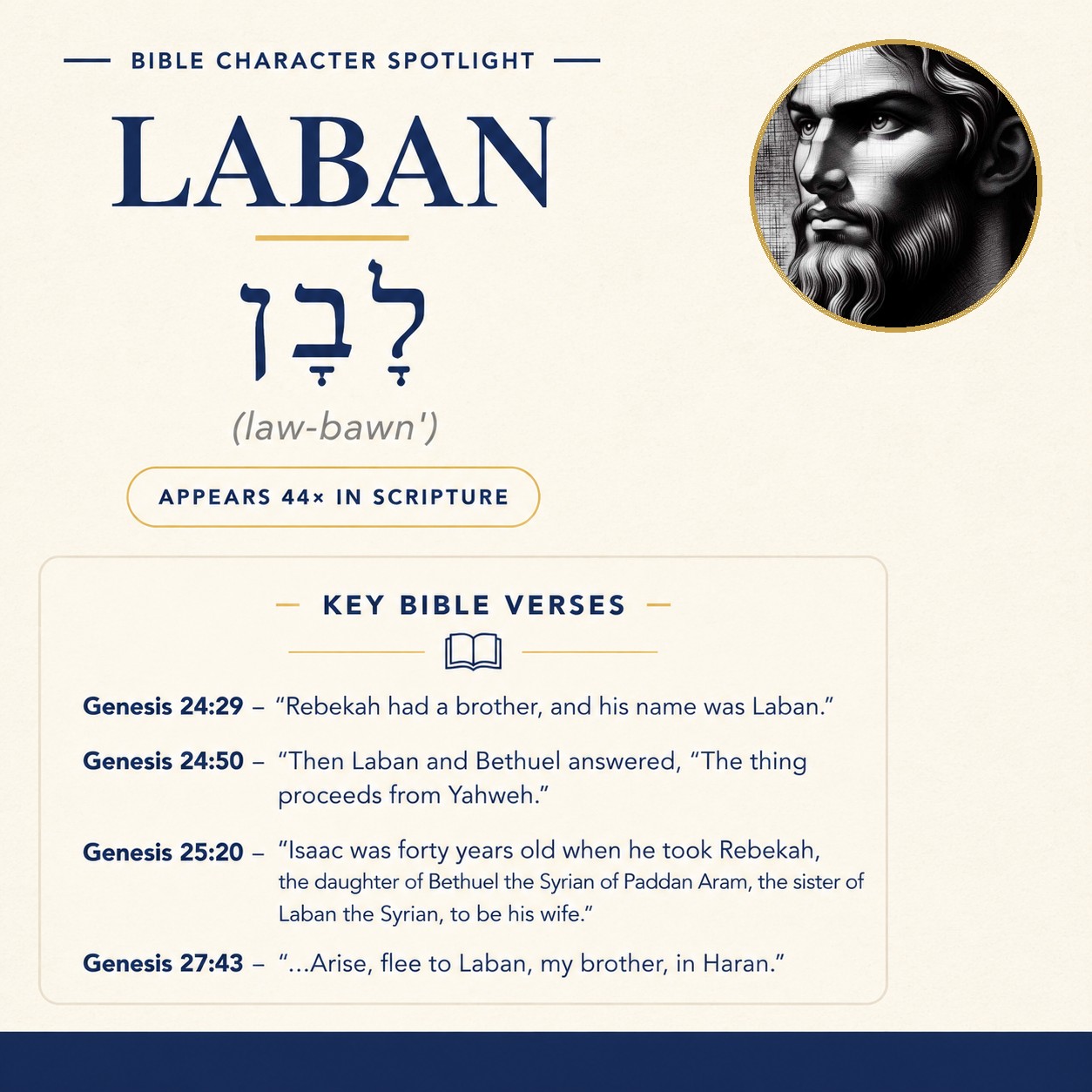
Laban in Scripture
Laban first appears in the account of Rebekah’s household when a man arrives at the spring. Genesis introduces him directly and places him in the scene by the water:
“Rebekah had a brother, and his name was Laban. Laban ran out to the man, to the spring.” (Genesis 24:29, WEB)
In the same chapter, Laban is paired with Bethuel in responding to what they perceive as Yahweh’s direction:
“Then Laban and Bethuel answered, “The thing proceeds from Yahweh. We can’t speak to you bad or good.” (Genesis 24:50, WEB)
Later, Laban is identified within Isaac’s marriage connection to Rebekah. The text states Rebekah’s parentage and then identifies her as Laban’s sister:
“Isaac was forty years old when he took Rebekah, the daughter of Bethuel the Syrian of Paddan Aram, the sister of Laban the Syrian, to be his wife.” (Genesis 25:20, WEB)
When Jacob is urged to flee, Laban is presented as a destination in Haran and as a close relative of Jacob’s mother. The instruction comes in direct speech:
“Now therefore, my son, obey my voice. Arise, flee to Laban, my brother, in Haran.” (Genesis 27:43, WEB)
Another command frames Jacob’s journey in terms of seeking a wife from within this same family network, explicitly naming Laban’s daughters as the source:
“Arise, go to Paddan Aram, to the house of Bethuel your mother’s father. Take a wife from there from the daughters of Laban, your mother’s brother.” (Genesis 28:2, WEB)
Genesis then narrates Jacob’s departure and states his destination with a fuller identification of Laban’s placement in the family:
“Isaac sent Jacob away. He went to Paddan Aram to Laban, son of Bethuel the Syrian, the brother of Rebekah, Jacob’s and Esau’s mother.” (Genesis 28:5, WEB)
The most sustained narrative involving Laban in the provided material is Genesis 29. The chapter begins with Jacob arriving “to the land of the children of the east” and noticing a well used to water gathered flocks. He questions local shepherds and learns they are “from Haran.” Jacob then asks about Laban, and the men identify him in relation to another ancestor named in the chapter:
“He said to them, “Do you know Laban, the son of Nahor?” They said, “We know him.” (Genesis 29:5, WEB)
Jacob asks about Laban’s welfare and is told, “It is well,” with the immediate note that “Rachel, his daughter, is coming with the sheep” (Genesis 29:6). The shepherds explain the local practice of waiting until all flocks assemble before rolling away the well’s stone to water the sheep (Genesis 29:7–8). While Jacob is still speaking, Rachel arrives “with her father’s sheep, for she kept them” (Genesis 29:9). Seeing her, Jacob acts decisively at the well:
“When Jacob saw Rachel the daughter of Laban, his mother’s brother, and the sheep of Laban, his mother’s brother, Jacob went near, and rolled the stone from the well’s mouth, and watered the flock of Laban his mother’s brother.” (Genesis 29:10, WEB)
Jacob then kisses Rachel, weeps, and explains the family connection: “Jacob told Rachel that he was her father’s relative, and that he was Rebekah’s son” (Genesis 29:12). Rachel runs and reports this to her father. Laban’s response is immediate and warmly physical, and the chapter records Laban’s reception of Jacob into his home:
“When Laban heard the news of Jacob, his sister’s son, he ran to meet Jacob, and embraced him, and kissed him, and brought him to his house. Jacob told Laban all these things.” (Genesis 29:13, WEB)
Laban explicitly recognizes Jacob as close kin, saying:
“Surely you are my bone and my flesh.” (Genesis 29:14, WEB)
Jacob stays with him “for a month” (Genesis 29:14). After this period, Laban raises the question of Jacob’s labor and compensation. He acknowledges the family relationship but insists that work should not be unpaid:
“Because you are my relative, should you therefore serve me for nothing? Tell me, what will your wages be?” (Genesis 29:15, WEB)
The narrative then gives a key family detail about Laban: he has two daughters, and their names and birth order are stated plainly:
“Laban had two daughters. The name of the elder was Leah, and the name of the younger was Rachel.” (Genesis 29:16, WEB)
Genesis 29 continues by describing Leah and Rachel and by stating that “Jacob loved Rachel” (Genesis 29:17–18). Jacob proposes a specific arrangement: “I will serve you seven years for Rachel, your younger daughter” (Genesis 29:18). Laban agrees that giving Rachel to Jacob is preferable to giving her to “another man,” and he tells Jacob, “Stay with me” (Genesis 29:19). Jacob serves seven years, which “seemed to him but a few days, for the love he had for her” (Genesis 29:20).
When the time is complete, Jacob demands the marriage he believes he has earned: “Give me my wife, for my days are fulfilled, that I may go in to her” (Genesis 29:21). Laban then stages a communal celebration—he “gathered together all the men of the place, and made a feast” (Genesis 29:22). Yet the evening brings a pivotal action by Laban: “In the evening, he took Leah his daughter, and brought her to Jacob. He went in to her” (Genesis 29:23). The text adds that Laban supplies a servant to Leah: “Laban gave Zilpah his servant to his daughter Leah for a servant” (Genesis 29:24).
In the morning, Jacob realizes the situation and confronts Laban with a direct accusation of deception:
“In the morning, behold, it was Leah! He said to Laban, “What is this you have done to me? Didn’t I serve with you for Rachel? Why then have you deceived me?” (Genesis 29:25, WEB)
Laban answers by appealing to a claimed local custom concerning marriage order:
“It is not done so in our place, to give the younger before the firstborn.” (Genesis 29:26, WEB)
He then offers a further arrangement: Jacob is to complete a week for Leah, and afterward Rachel will also be given, but only in exchange for additional service. Laban states the terms in a single speech:
“Fulfill the week of this one, and we will give you the other also for the service which you will serve with me for seven more years.” (Genesis 29:27, WEB)
Jacob accepts: “Jacob did so, and fulfilled her week. He gave him Rachel his daughter as wife” (Genesis 29:28). Again, the narrative notes Laban providing a servant, this time to Rachel: “Laban gave Bilhah, his servant, to his daughter Rachel to be her servant” (Genesis 29:29). Jacob then “served with him seven more years” (Genesis 29:30). The remainder of Genesis 29 shifts to Leah and Rachel’s situation in Jacob’s household and the births of Leah’s sons (Genesis 29:31–35), which forms the immediate outcome of the marriages arranged in Laban’s house.
Name and Meaning
In Hebrew script the name is לָבָן, transliterated Laban and pronounced law-bawn’. The name’s derivation is connected with a Hebrew term meaning “white,” with the component word laban (לָבָן) carrying that sense. A lexicon identity gloss also describes Laban as a Mesopotamian and notes that the name can also refer to a place in the Desert.
Observation
Across these passages, Laban is consistently shown as a close family figure who both welcomes Jacob—“embraced him, and kissed him, and brought him to his house” (Genesis 29:13)—and negotiates Jacob’s marriages and labor through agreements that shape Jacob’s life in Haran (Genesis 29:15–30).
Frequently Asked Questions
What does the name Laban mean?
Laban is given as the name of a Mesopotamian person; it is also used as a place name in the Desert.
How many times does Laban appear in the Bible?
Laban occurs 44 times.
Who was Laban in the Bible?
Laban is connected with Rebekah’s family: he is named as Rebekah’s brother (Genesis 24:29) and as the son of Bethuel the Syrian (Genesis 28:5).
What did Laban say about Jacob when they met?
Laban told Jacob, “Surely you are my bone and my flesh” (Genesis 29:14).
Explore Further
If you found this page about Laban interesting and would like to discover more about other biblical characters, explore our comprehensive Encyclopedia of Biblical Characters. For those looking to delve deeper into the Greek origins of these names and terms, our Greek Lexicon is an invaluable resource.
Sources: Name and occurrence data from Strong’s Exhaustive Concordance and STEPBible reference data (CC BY). Scripture quotations from the World English Bible (public domain).