
Who was Esau in the bible?
Esau is a biblical figure named in Romans 9:13, Hebrews 11:20, and Hebrews 12:16 in relation to Jacob, Isaac’s blessing, and selling his birthright.

Isaac’s Blessing
“By faith, Isaac blessed Jacob and Esau, even concerning things to come” (Hebrews 11:20).
Learn More →Birthright Sale
Hebrews warns against being “like Esau, who sold his birthright for one meal” (Hebrews 12:16).
Learn More →Esau (a Greek form of a Hebrew name) is a biblical figure mentioned in the New Testament alongside Jacob, particularly in discussions of divine election, patriarchal blessing, and a moral warning about treating sacred privileges as ordinary.
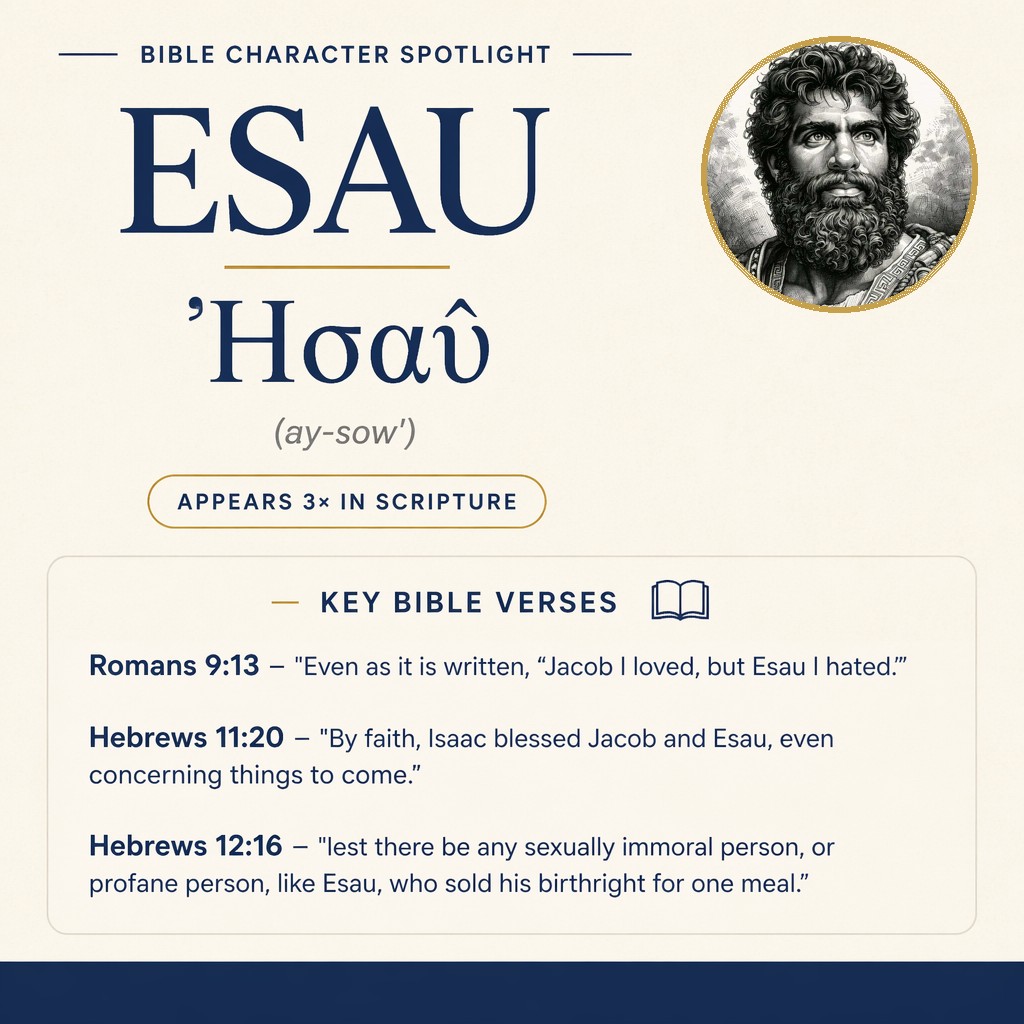
In the verses provided, Esau appears as one who was blessed by Isaac with Jacob and is also held up as an example of a “profane person” because he “sold his birthright for one meal.”
Esau in Scripture
Esau is named in Paul’s argument in Romans about God’s purpose in election. The immediate context frames the matter as decided before birth and apart from human deeds, and includes a statement about the elder and the younger:
“For being not yet born, neither having done anything good or bad, that the purpose of God according to election might stand, not of works, but of him who calls,” (Romans 9:11)
“it was said to her, ‘The elder will serve the younger.’” (Romans 9:12)
“Even as it is written, ‘Jacob I loved, but Esau I hated.’” (Romans 9:13)
Paul immediately presses the theological question of whether this implies injustice with God, and answers by denying it and appealing to God’s freedom to show mercy and compassion:
“What shall we say then? Is there unrighteousness with God? May it never be!” (Romans 9:14)
“For he said to Moses, ‘I will have mercy on whom I have mercy, and I will have compassion on whom I have compassion.’” (Romans 9:15)
“So then it is not of him who wills, nor of him who runs, but of God who has mercy.” (Romans 9:16)
In Hebrews, Esau is mentioned in a list of faith examples as one of the two recipients of Isaac’s blessing. The larger context recalls a promise tied to Isaac’s offspring, then states Isaac’s act of blessing:
“to whom it was said, ‘Your offspring will be accounted as from Isaac,’” (Hebrews 11:18)
“By faith, Isaac blessed Jacob and Esau, even concerning things to come.” (Hebrews 11:20)
Here Esau is presented simply as paired with Jacob: both are connected to Isaac, and both are included in Isaac’s blessing, which Hebrews characterizes as an act done “by faith” and oriented toward “things to come.”
Hebrews later refers to Esau in a direct moral warning set within an exhortation to pursue peace and sanctification and to watch carefully over the community so that none fall short:
“Follow after peace with all men, and the sanctification without which no man will see the Lord,” (Hebrews 12:14)
“looking carefully lest there be any man who falls short of the grace of God, lest any root of bitterness springing up trouble you, and many be defiled by it,” (Hebrews 12:15)
“lest there be any sexually immoral person, or profane person, like Esau, who sold his birthright for one meal.” (Hebrews 12:16)
Hebrews continues the warning by describing a later desire to inherit blessing and a rejection, using Esau as the illustrative case:
“For you know that even when he afterward desired to inherit the blessing, he was rejected, for he found no place for a change of mind though he sought it diligently with tears.” (Hebrews 12:17)
Across these passages, Esau functions in three related ways: (1) as a named counterpart to Jacob in a discussion of God’s calling and election; (2) as one included with Jacob in Isaac’s forward-looking blessing; and (3) as a cautionary example of treating what is weighty (“birthright” and “blessing”) in a manner Hebrews calls “profane,” trading it away “for one meal,” and later seeking an inheritance of blessing with sorrow but without the outcome desired.
Name and Meaning
In the Greek New Testament, the name is written Ἠσαῦ (transliteration: Esau; pronunciation: ay-sow’). Strong’s notes that the Greek form is of Hebrew origin (H06215), and the identity gloss identifies the bearer as Esau.
Observation
The verses set Esau at the intersection of God’s sovereign purpose (Romans 9:11–16) and an ethical warning against profaneness that discards a “birthright” for immediate appetite (Hebrews 12:16–17), while also remembering that Isaac “blessed Jacob and Esau” in an act described as “by faith” (Hebrews 11:20).
Frequently Asked Questions
What does the name Esau mean?
Esau means “Esau.”
How many times does Esau appear in the Bible?
Esau appears 3 times.
Who was Esau?
Esau is a person mentioned alongside Jacob and Isaac; Isaac blessed Jacob and Esau (Hebrews 11:20). Romans 9:13 also refers to Esau in contrast with Jacob.
What specific action is Esau known for in the New Testament?
Esau is described as someone “who sold his birthright for one meal” (Hebrews 12:16).
Explore Further
If you found this page about Esau interesting and would like to discover more about other biblical characters, explore our comprehensive Encyclopedia of Biblical Characters. For those looking to delve deeper into the Greek origins of these names and terms, our Greek Lexicon is an invaluable resource.
Sources: Name and occurrence data from Strong’s Exhaustive Concordance and STEPBible reference data (CC BY). Scripture quotations from the World English Bible (public domain).




