Exploring the Meaning of Katago in Greek
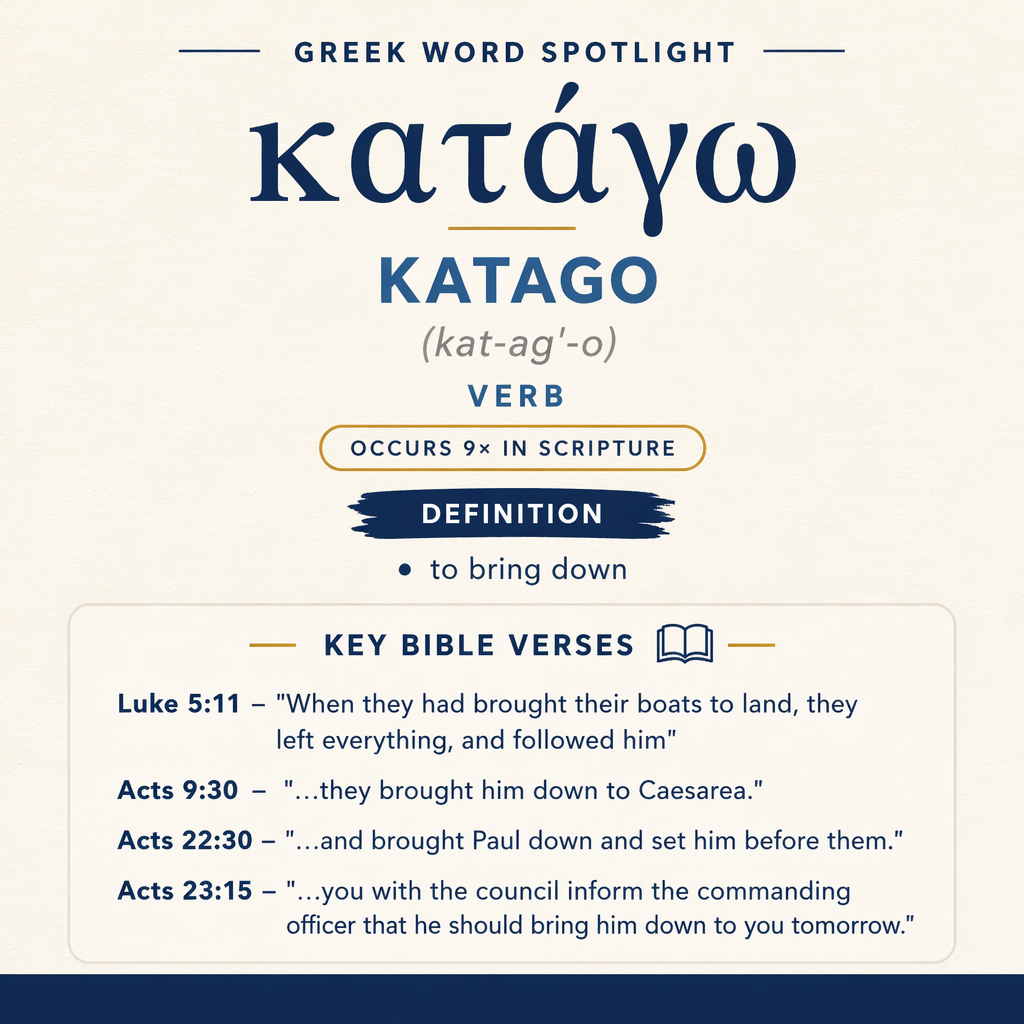
κατάγω means “to bring down” and occurs 9 times in Scripture, including Luke 5:11 and several passages in Acts.
Biblical Occurrences
It appears 9 times in Scripture. Listed occurrences include Luke 5:11 and Acts 9:30; 22:30; 23:15, 20, 28; 27:3; 28:12.
Learn More →Usage Snapshots
In Luke 5:11 it describes bringing boats to land. In Acts 9:30 it describes bringing someone down to Caesarea.
Learn More →κατάγω expresses the action of bringing something or someone down. In the passages where it appears, it frames movements to land, to a city, into an official setting, and even a conceptual “bringing down” in a rhetorical question.
Occurrences
“When they had brought their boats to land, they left everything, and followed him.” (Luke 5:11)
Here the verb marks the decisive end of a working sequence: the boats are brought down to the land, and that completed action becomes the immediate backdrop for leaving everything. The movement is not described in detail; the point is the boats’ arrival at land as a concluded act that frees the men to “follow him” without delay.

“When the brothers knew it, they brought him down to Caesarea, and sent him off to Tarsus.” (Acts 9:30)
The verb introduces a protective relocation. “The brothers” respond to what they “knew” by bringing “him” down to Caesarea; the downward movement is the first step in a chain of actions that ends with sending him off to Tarsus. In this scene, bringing down functions as an escorting transfer to a specific place that enables the next move.
“But on the next day, desiring to know the truth about why he was accused by the Jews, he freed him from the bonds, and commanded the chief priests and all the council to come together, and brought Paul down and set him before them.” (Acts 22:30)
Here κατάγω serves an official inquiry. The commanding figure “desired to know the truth” about the accusation, takes procedural steps (“freed him,” “commanded” the leaders to assemble), then “brought Paul down” and “set him before them.” The verb connects custody and hearing: Paul is moved down into the council’s presence so the accusation can be examined in a formal setting.
“Now therefore, you with the council inform the commanding officer that he should bring him down to you tomorrow, as though you were going to judge his case more exactly. We are ready to kill him before he comes near.” (Acts 23:15)
In this request, “bring him down” is the planned mechanism for access. The council is to ask that the prisoner be brought down “tomorrow,” under the pretense of closer judgment. The verb highlights how a legitimate-sounding transfer can be used to position someone for harm: the plot depends on the movement being granted.
“He said, “The Jews have agreed to ask you to bring Paul down to the council tomorrow, as though intending to inquire somewhat more accurately concerning him.” (Acts 23:20)
This verse reports the same intended action from another angle. The agreement is described as a request “to bring Paul down to the council tomorrow,” presented as an inquiry “more accurately.” The verb again emphasizes the physical transfer of Paul into the council’s reach, with the stated purpose of investigation masking the danger implied by the surrounding narrative in these verses.
“Desiring to know the cause why they accused him, I brought him down to their council.” (Acts 23:28)
Here the speaker describes his own decision: “Desiring to know the cause,” he “brought him down to their council.” The verb depicts bringing down as a deliberate investigative step—moving the accused person into the council’s forum so that the reason for the accusations may be clarified. The motion is purposeful and framed as inquiry-driven.
“The next day, we touched at Sidon. Julius treated Paul kindly, and gave him permission to go to his friends and refresh himself.” (Acts 27:3)
Although the verse focuses on touching at Sidon and Julius’s kindness, the scene is one of travel with stops. In such a context, κατάγω contributes the idea of bringing down to a landing or stopping point: the journey includes controlled arrivals where a ship is brought down to a place, enabling onshore interactions such as Paul’s visit to friends for refreshment.
“Touching at Syracuse, we stayed there three days.” (Acts 28:12)
Again the emphasis is on travel progress—touching at a port and remaining there. Within this kind of itinerary statement, κατάγω supports the sense of a vessel being brought down to a location as part of the voyage, resulting in a stay of defined length (“three days”). The verb’s force aligns with the practical reality of arriving and coming to rest at a destination.
“But the righteousness which is of faith says this, “Don’t say in your heart, ‘Who will ascend into heaven?’ (that is, to bring Christ down);” (Romans 10:6)
In Romans the verb is used in a parenthetical explanation: “to bring Christ down.” The phrase stands as the conceptual counterpart to “ascend into heaven,” using the downward movement to express an imagined action toward Christ. The verb’s contribution is the directional imagery—bringing down—employed rhetorically within an inner-heart warning (“Don’t say in your heart”).

Sense and Usage
Across these passages, “bringing down” regularly marks a controlled transfer that changes what is possible next. In Luke 5:11 it brings the boats to land, finishing a task and opening the way for an immediate life-change (“they left everything”). In Acts 9:30 it is a protective relocation carried out by “the brothers,” positioning the person brought down for further travel (“sent him off”).
In Acts 22:30 and Acts 23:28, the downward movement is explicitly tied to investigation: a desire “to know the truth” or “to know the cause” leads to bringing Paul down into the council’s setting. The verb fits the procedural rhythm of custody, assembly, and presentation—Paul is not merely moved; he is brought down to be “set… before them,” or brought into their council so that accusations can be examined.
Acts 23:15 and 23:20 show how the same kind of movement can be sought for darker purposes. The request that the commanding officer “bring him down” is framed as careful judgment or more accurate inquiry, yet the quoted plan depends on the transfer itself: once the person is on the way down toward the council, he becomes vulnerable (“We are ready to kill him before he comes near”). κατάγω thus serves as the pivot point between official procedure and ambush—what appears administratively ordinary becomes strategically decisive.
In the travel notes of Acts 27:3 and 28:12, the verb belongs to the world of voyages that include arrivals and stops. Touching at Sidon and Syracuse presupposes the action of being brought down to a place of landing, where time can be spent and permissions granted. Even when the verse’s surface wording highlights “touched at” and “stayed,” the movement implied is the same kind of directed descent to a definite location, resulting in rest or delay in the journey.
Romans 10:6 takes the same directional idea and places it inside a rhetorical question: the imagined action “to bring Christ down” corresponds to the idea of crossing a boundary by one’s own initiative. Here “bringing down” is not narrated as travel or escort; it functions as conceptual motion attached to a heart-saying. The verb’s downward direction supplies vivid spatial language for an inward posture—what one presumes can be done or demanded.
Imagery
The imagery of κατάγω in these verses is consistently concrete: boats brought to land, a person brought down to a city, and a prisoner brought down to a council chamber. Even in Romans 10:6, where the movement is hypothetical, the same downward trajectory gives weight to the statement, as though a person could summon Christ by an act of descent. In every setting, bringing down is an action that relocates its object into a new place where the next decisive event—following, sending, examining, plotting, resting, or reasoning—can occur.
Sources: Lexical data from Strong’s Exhaustive Concordance and the Translators Brief Lexicon of Extended Strongs for Greek (STEPBible, CC BY). Occurrence data from the Translators Amalgamated Greek New Testament (STEPBible, CC BY). Scripture quotations from the World English Bible (public domain).