Exploring the Meaning of Katagonizomai in Greek
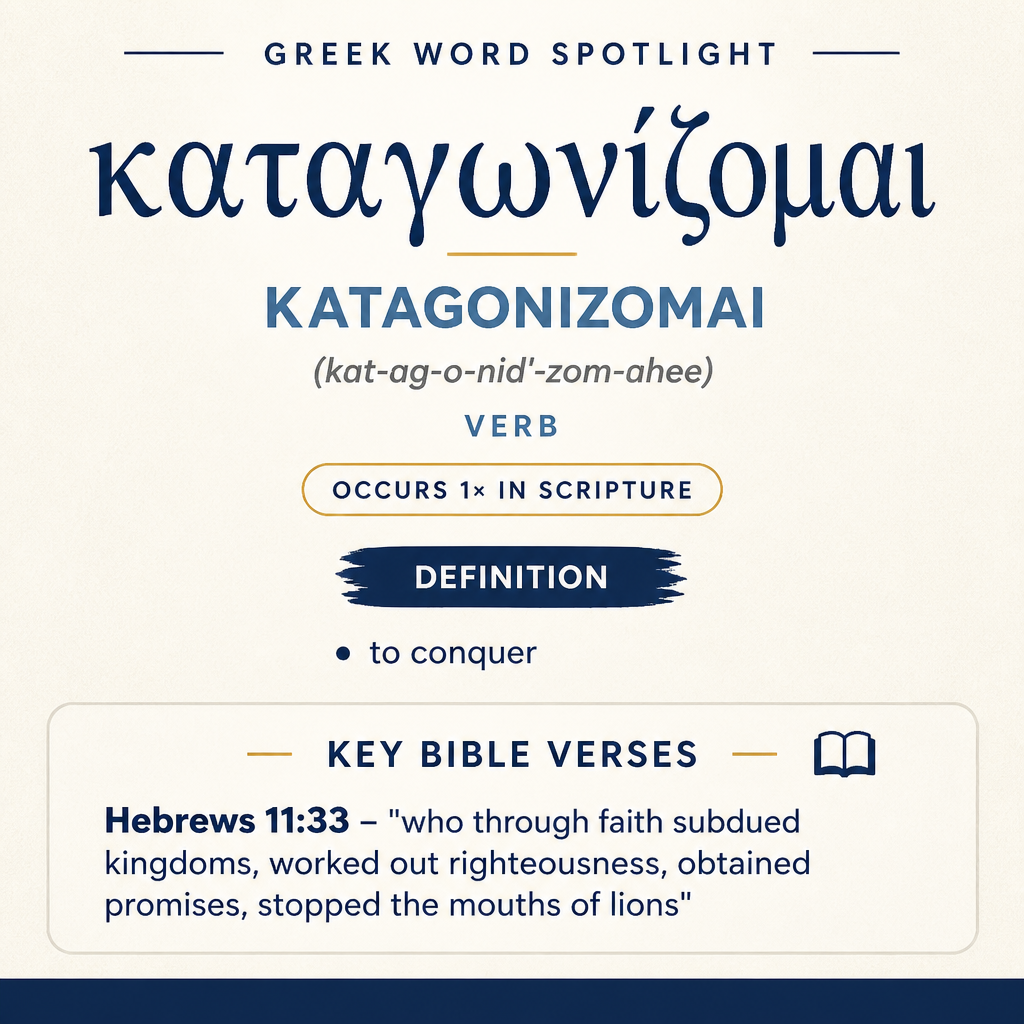
καταγωνίζομαι means “to conquer” and appears once in Scripture, in Hebrews 11:33.
Scripture Occurrence
It occurs 1 time in Scripture. The occurrence is in Hebrews 11:33.
Learn More →Context in Hebrews
In Hebrews 11:33 it is used within the description: “who through faith subdued kingdoms, worked out righteousness, obtained promises, stopped the mouths of lions,”.
Learn More →Katagonizomai means “to conquer” and appears in the faith catalogue of Hebrews 11. In that context it names a kind of victory accomplished “through faith” alongside other decisive achievements.
Root and Related Words
Katagonizomai is linked with kata (κατά), “according to,” and agonizomai (ἀγωνίζομαι), “to struggle.” The combination places the verb within a word-family that speaks in terms of struggle and contest, with kata shaping how that struggle is framed.

Occurrences
“who through faith subdued kingdoms, worked out righteousness, obtained promises, stopped the mouths of lions,” (Hebrews 11:33)
Here katagonizomai functions as a compact victory-verb inside a rapid series of faith-driven actions. The verse moves in a chain of achievements: “subdued kingdoms,” then “worked out righteousness,” “obtained promises,” and finally “stopped the mouths of lions.” Within that sequence, “through faith” supplies the manner or means, and the clustered verbs supply the kinds of outcomes credited to faith.
“Subdued kingdoms” sets the tone as a public, large-scale triumph. In such a line, katagonizomai contributes the idea of overcoming opposition in a way that results in mastery rather than mere survival. The noun “kingdoms” implies organized power structures, so the conquest described is not private or incidental but decisive enough to be remembered as a defining act. The verse’s style is intentionally sweeping: it does not describe tactics, time, or place; it names the result, letting the victory itself carry the weight. Katagonizomai fits that style by highlighting conquest as an accomplished fact.
The rest of the verse broadens the picture of what “conquer” looks like in Hebrews 11: it is paired with moral and covenantal language (“worked out righteousness,” “obtained promises”) and with deliverance from lethal threat (“stopped the mouths of lions”). This tight juxtaposition helps locate katagonizomai among a spectrum of faith’s outcomes. The conquering is not isolated from righteousness and promise; it sits beside them as one facet of the same faith-filled life.
Sense and Usage
The single attestation in Hebrews 11:33 places katagonizomai in a summary statement rather than a narrative scene. That rhetorical setting matters for how “to conquer” is heard: the verb is not painting a moment-by-moment struggle but naming the end-state—victory—within a list that compresses many lives and episodes into a few lines. The effect is to treat conquest as one recognizable mark among other recognizable marks of faith at work.
In this verse, the verb’s sense is concrete and outcome-oriented. It is attached to an object (“kingdoms”), which keeps “to conquer” tethered to something external and resistant. Even without additional detail, the collocation “subdued kingdoms” frames conquest as overcoming power that would otherwise dominate. Katagonizomai therefore carries the weight of reversal: the would-be ruled become rulers in the specific respect named, because conquest has occurred.
At the same time, Hebrews 11:33 does not allow conquest to stand as the only or even the central achievement; it is one item in a list, surrounded by acts of righteousness and experiences of fulfilled promise. That literary placement shapes its nuance: conquest is part of a larger portrait of faithful endurance and faithful action. The series also prevents the reader from shrinking the verb into purely political victory, because the verse immediately turns to ethical and covenantal outcomes and to rescue from mortal danger. Within this compressed catalogue, “to conquer” is one way faith is seen to prevail.
The links with kata (κατά), “according to,” and agonizomai (ἀγωνίζομαι), “to struggle,” locate katagonizomai in a conceptual neighborhood where victory is associated with contest. In Hebrews 11:33 the contest is not described; only the result is. Yet the association with struggle fits the verse’s pattern: these are not casual accomplishments but hard-won outcomes presented as the fruit of faith. The conquest implied by the verb is thus compatible with the strenuous character suggested by the surrounding achievements, even though the text keeps the focus on the conquered end rather than on the process.
Imagery
Hebrews 11:33 offers conquest imagery in its starkest form: “subdued kingdoms.” The phrase evokes the fall of resistance and the securing of dominance, and it sits beside equally vivid deliverance imagery—“stopped the mouths of lions.” Together these images place katagonizomai among scenes of intense opposition where faith is portrayed as prevailing, whether over broad realms of power or over immediate threats to life.
Sources: Lexical data from Strong’s Exhaustive Concordance and the Translators Brief Lexicon of Extended Strongs for Greek (STEPBible, CC BY). Occurrence data from the Translators Amalgamated Greek New Testament (STEPBible, CC BY). Scripture quotations from the World English Bible (public domain).