
Exploring the Meaning of Kartereo in Greek
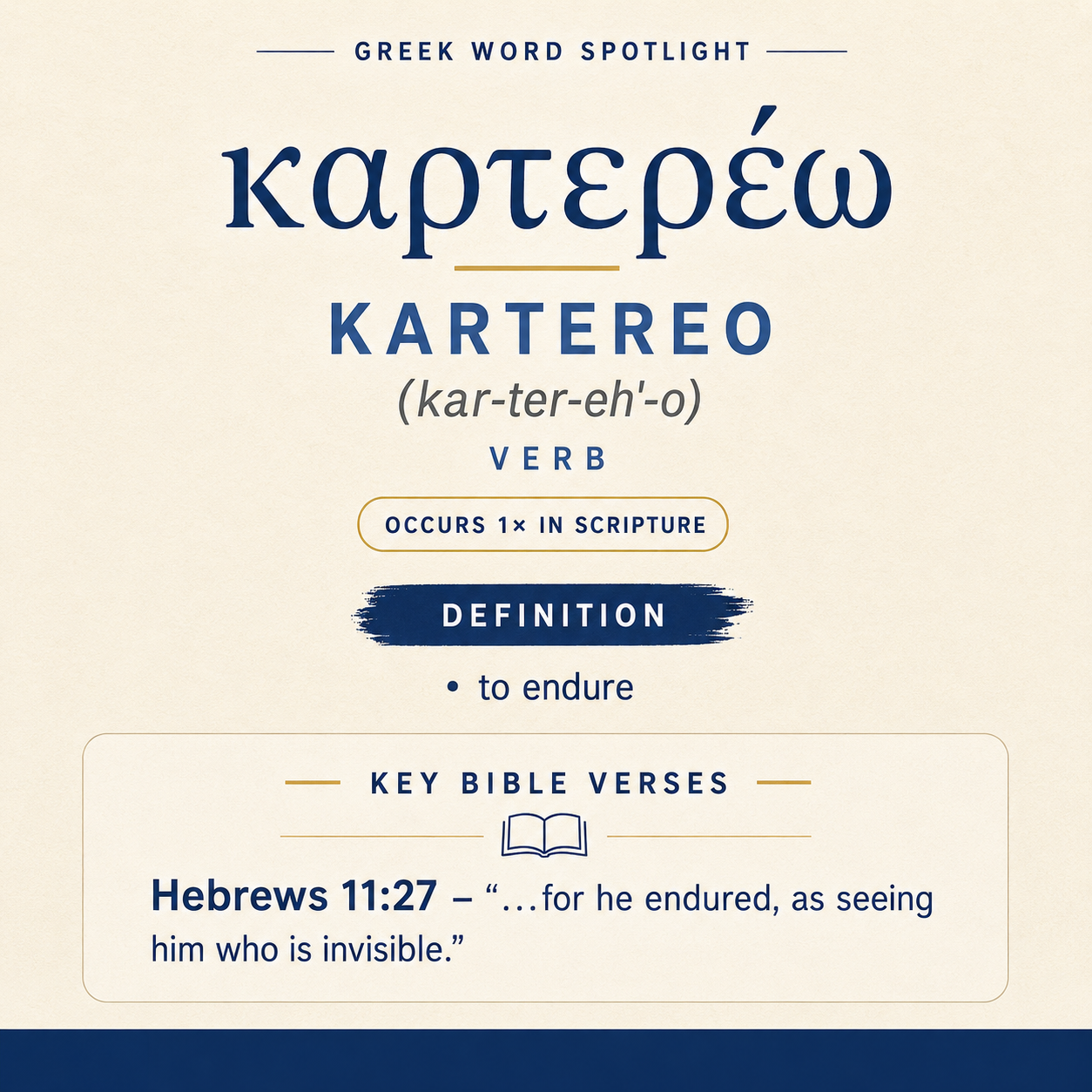
καρτερέω means “to endure” and appears once in Scripture, in Hebrews 11:27.
Hebrews Context
In Hebrews 11:27, it describes Moses enduring “as seeing him who is invisible.”
Learn More →καρτερέω means “to endure.” It appears once, in Hebrews 11:27, where it describes a steadfast continuance in the face of fear and royal wrath.
Root and Related Words
καρτερέω is related to kratos (κράτος), “power” (Strong’s G2904).

Occurrences
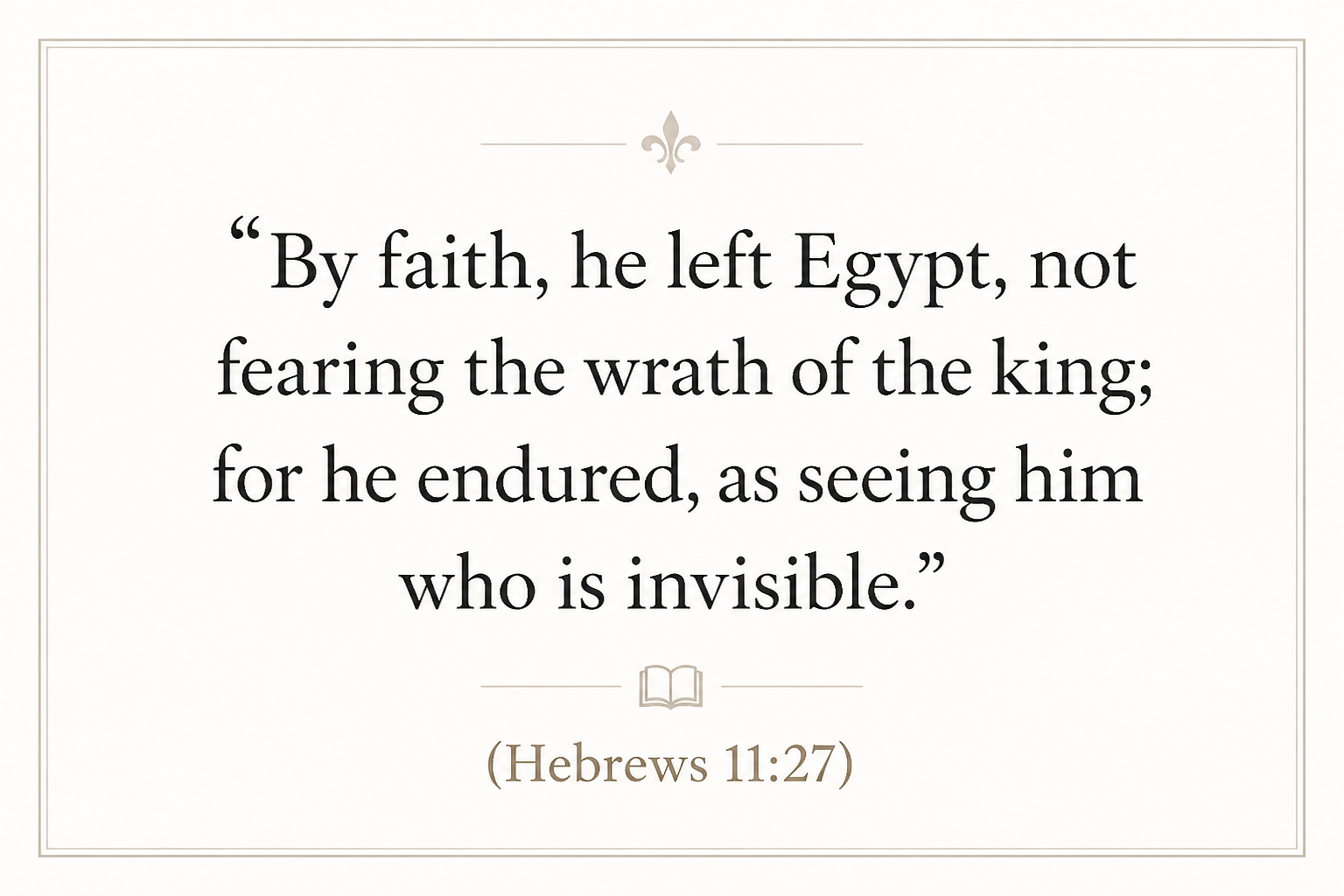
“By faith, he left Egypt, not fearing the wrath of the king; for he endured, as seeing him who is invisible.” (Hebrews 11:27)
In this sentence the verb sits at the hinge between two pressures and one sustaining perception. The pressure is explicit: “the wrath of the king.” The human response that would naturally arise from that threat is also named: fear. The verse frames the action negatively (“not fearing”) and then supplies the inner explanation (“for he endured”), presenting endurance as the reason his departure from Egypt was not governed by fear. In other words, endurance here is not mere survival after the fact; it is the steady persistence that holds a course of action while a reason to panic remains present.
The clause “By faith” governs the whole description, so endurance is depicted as faith’s active expression in a dangerous setting. The narrative movement is outward—“he left Egypt”—but the word καρτερέω draws attention to what is held firm within the person as he leaves. The king’s wrath is real, and the text does not soften it; endurance is the counterforce that keeps that wrath from controlling the decision.
The final phrase clarifies what accompanies this endurance: “as seeing him who is invisible.” The wording is strikingly concrete—“seeing”—even while the object is “invisible.” The verse therefore portrays endurance as sustained by a kind of sight that is not simply visual. Endurance is not described as stubbornness or emotional numbness; it is attached to a continuing orientation toward “him who is invisible.” Within the verse’s logic, endurance holds steady because attention is fixed elsewhere than the king’s anger. The verb thus contributes a sense of maintained resolve: the person remains at his course because his perception is anchored beyond the immediate threat.
Sense and Usage
With the single attestation in Hebrews 11:27, καρτερέω is presented in a tightly defined setting: endurance under intimidation. The text places endurance alongside fear, wrath, and departure, and it treats endurance as the sustaining factor that explains why fear does not govern the outcome. Endurance therefore functions as a continuing steadiness rather than a momentary impulse. The verse does not depict a quick escape driven by adrenaline; it depicts a departure carried through with a settled firmness.
The related noun kratos (κράτος), “power,” provides a useful frame for the kind of endurance described. The king possesses power expressed as “wrath,” and that wrath is a form of pressure intended to compel fear and compliance. Endurance, in the verse’s presentation, is the opposite of being overpowered by that pressure. It is the strength to remain constant when another’s power threatens to dictate one’s choices. The text’s construction (“not fearing… for he endured”) shows endurance operating as an inner staying-power that resists the coercive effect of wrath.
Within this verse, endurance is also tied to perception: “as seeing him who is invisible.” The phrase does not merely add a religious flourish; it explains the manner in which endurance is carried. Endurance is not portrayed as detached from thought; it is sustained by an ongoing act of regarding—“seeing”—that reorders what is most compelling. The visible threat is the king’s wrath; endurance is linked to a different focus, “him who is invisible.” The interplay between visible and invisible shapes the reader’s understanding of endurance here: it is the capacity to persist when the strongest immediate stimulus is not allowed to become the final authority.
Because Hebrews 11:27 frames the whole action “By faith,” endurance is not an isolated virtue functioning on its own. It is integrated into faith’s way of acting: faith leaves, faith does not fear, faith endures, faith “sees” what cannot be seen. In that integrated chain, endurance serves as the continuing firmness that connects confession to conduct. The verse’s pacing suggests duration: fear would not be a one-time temptation, and wrath would not be a one-time rumor. Endurance is the ability to remain steady across that span until the leaving is accomplished.
Imagery and Effect
The imagery is dominated by contrast: a king whose wrath can be felt, and “him who is invisible” who cannot be seen. καρτερέω stands between those two poles. It names the steady persistence that does not let the palpable threat become the controlling reality, because the enduring person lives as though he truly “sees” what is invisible.
Sources: Lexical data from Strong’s Exhaustive Concordance and the Translators Brief Lexicon of Extended Strongs for Greek (STEPBible, CC BY). Occurrence data from the Translators Amalgamated Greek New Testament (STEPBible, CC BY). Scripture quotations from the World English Bible (public domain).




