
Exploring the Meaning of Karpos in Greek
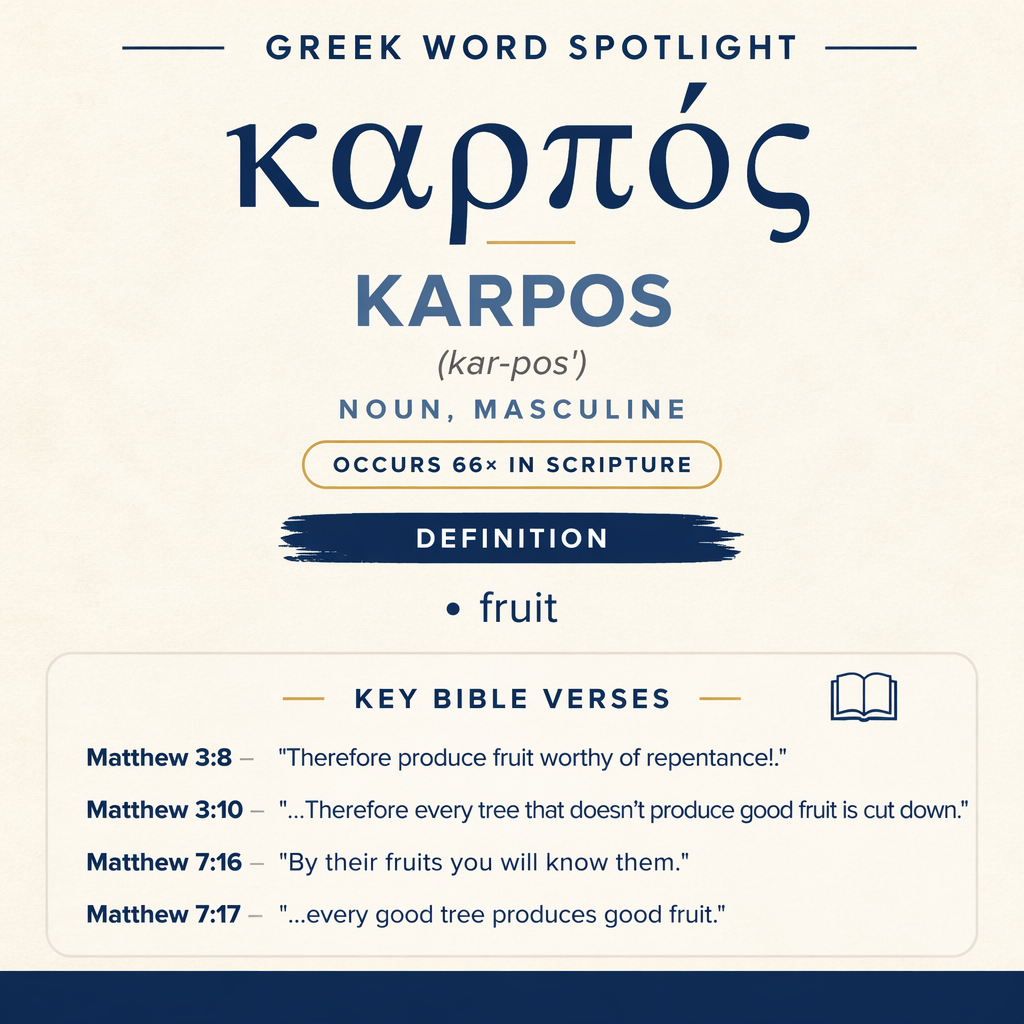
καρπός means “fruit” and appears 66 times in Scripture, including key sayings in Matthew 3, 7, and 12.
Core Meaning
καρπός is defined as “fruit.” In Matthew it refers to the fruit produced by a tree.
Learn More →Matthew Examples
Matthew 3:8 urges producing “fruit worthy of repentance,” and Matthew 3:10 warns that trees without good fruit are cut down. Matthew 7:16–20 and 12:33 use fruit to identify whether a tree is good or corrupt.
Learn More →Recognizable Outcomes
Matthew 7:16–20 teaches, “By their fruits you will know them.” Matthew 12:33 links a tree’s condition with the goodness or corruption of its fruit.
Learn More →καρπός means “fruit,” and in the passages below it appears both as literal produce from plants and as a vivid way of speaking about what a life or message yields. The selected occurrences cluster around trees, soil, and harvest imagery, where “fruit” becomes the concrete evidence that something is healthy, changed, or genuinely productive.
Root and Related Words
Related: harpazo (ἁρπάζω), “to seize” (Strong’s G726).

Occurrences
Matthew 3:8 — “Therefore produce fruit worthy of repentance!”
Here καρπός functions as the demanded outcome of “repentance.” The command does not describe repentance as a mere claim or intention; it calls for “fruit” that matches it—something observable and fitting to the change implied by repentance.

Matthew 3:10 — “Even now the ax lies at the root of the trees. Therefore every tree that doesn’t produce good fruit is cut down, and cast into the fire.”
“Fruit” is the decisive criterion by which a tree is spared or destroyed. The image links καρπός to evaluation: the tree’s fate turns on whether it “produce[s] good fruit,” and the lack of such fruit is treated as sufficient ground for judgment.
Matthew 7:16 — “By their fruits you will know them. Do you gather grapes from thorns, or figs from thistles?”
In this saying, καρπός is what makes something knowable. The rhetorical questions about “grapes” and “figs” press the point that fruit corresponds to the kind of plant; καρπός is the expected produce that reveals what a thing truly is.
Matthew 7:17 — “Even so, every good tree produces good fruit; but the corrupt tree produces evil fruit.”
“Fruit” is paired with moral quality: good trees yield “good fruit,” corrupt trees “evil fruit.” καρπός is presented as the natural output that aligns with a tree’s condition, making the contrast sharp and concrete.
Matthew 7:18 — “A good tree can’t produce evil fruit, neither can a corrupt tree produce good fruit.”
καρπός here underscores consistency between source and outcome. The statement frames “fruit” as constrained by the nature of the tree: the kind of καρπός produced is not random but bound to what the tree is.
Matthew 7:19 — “Every tree that doesn’t grow good fruit is cut down, and thrown into the fire.”
This repeats the inspection-and-judgment motif with a slightly different verb (“doesn’t grow good fruit”). καρπός remains the measurable product that determines the tree’s end; failure to yield “good fruit” leads to removal and destruction.
Matthew 7:20 — “Therefore by their fruits you will know them.”
The conclusion returns to καρπός as the basis for recognition. The plural “fruits” highlights repeated or multiple outcomes: what someone produces over time is what identifies them in practice.
Matthew 12:33 — “Either make the tree good, and its fruit good, or make the tree corrupt, and its fruit corrupt; for the tree is known by its fruit.”
καρπός anchors a tight parallel: tree and fruit correspond, and the tree is “known” by its fruit. The verse uses the simplicity of agricultural observation to insist that what a tree yields is not a peripheral detail but the defining evidence of its state.
Matthew 13:8 — “Others fell on good soil, and yielded fruit: some one hundred times as much, some sixty, and some thirty.”
In the seed-and-soil setting, καρπός is the harvest that results when seed lands in “good soil.” The varying numbers focus attention on abundance and degree: fruitfulness can be real and yet differ in measure, while still being “fruit.”
Matthew 13:26 — “But when the blade sprang up and produced fruit, then the darnel weeds appeared also.”
Here καρπός marks a stage of growth: the plant first becomes a “blade,” then it “produced fruit.” The appearance of weeds alongside that development suggests that the emergence of fruit is a moment when the field’s true mixture becomes evident.
Matthew 21:19 — “Seeing a fig tree by the road, he came to it, and found nothing on it but leaves. He said to it, “Let there be no fruit from you forever!” Immediately the fig tree withered away.”
In this roadside scene, καρπός is the expected yield of a fig tree, contrasted with mere “leaves.” The absence of fruit prompts a pronounced sentence—“Let there be no fruit from you forever!”—and the immediate withering dramatizes fruitlessness as a decisive failure, not a minor shortcoming.
Matthew 21:34 — “When the season for the fruit came near, he sent his servants to the farmers, to receive his fruit.”
καρπός here is the awaited produce tied to a “season,” something that can be due and collected. The owner’s action—sending servants “to receive his fruit”—treats fruit as the rightful return of the vineyard’s work and stewardship.
Sense and Usage
Across these passages καρπός keeps its straightforward sense of “fruit,” yet it operates in two closely connected ways. First, it appears as literal agricultural output: trees have fruit (or fail to), soil yields fruit in differing amounts, and a season arrives when fruit is due and gathered. These scenes rely on ordinary expectations—fig trees should bear figs; good soil should yield a crop; a harvest has a proper time—so that “fruit” is a stable, visible product that can be checked.
Second, the same concreteness makes καρπός a natural term for outcomes that reveal inner reality. A tree’s fruit is not an accessory but a disclosure: “By their fruits you will know them” (Matthew 7:16, 7:20). The repeated linkage of good/corrupt trees with good/evil fruit (Matthew 7:17–18; Matthew 12:33) presses the logic that what is produced corresponds to what is present at the source. Likewise, “fruit worthy of repentance” (Matthew 3:8) presents fruit as the fitting, demonstrable product of a claimed turning—something that can be weighed as “worthy” or not.
The word also carries an implicit standard of timeliness and expectation. A tree is not judged for failing to bear fruit in the abstract but because fruit is what trees are for; the ax “lies at the root” because fruit is missing (Matthew 3:10), and the fig tree is condemned because it has “nothing on it but leaves” (Matthew 21:19). In the vineyard setting, fruit is something owed in its season (Matthew 21:34). In the sower imagery, fruit is the sign that the seed has truly taken hold in “good soil” (Matthew 13:8), even though the harvest may vary widely in quantity.
Imagery
These occurrences consistently make “fruit” the visible end of a hidden process: what happens in roots, soil, and the tree’s condition becomes public in what hangs on branches or fills a harvest. Because καρπός is tangible, it readily serves as the point where assessment happens—whether one is “known” (Matthew 7:16; Matthew 12:33), whether a tree stands or is cut down (Matthew 3:10; Matthew 7:19), and whether a planted field has truly yielded what it was meant to yield (Matthew 13:8; Matthew 21:34).
Sources: Lexical data from Strong’s Exhaustive Concordance and the Translators Brief Lexicon of Extended Strongs for Greek (STEPBible, CC BY). Occurrence data from the Translators Amalgamated Greek New Testament (STEPBible, CC BY). Scripture quotations from the World English Bible (public domain).




