
Exploring the Meaning of Kardia in Greek
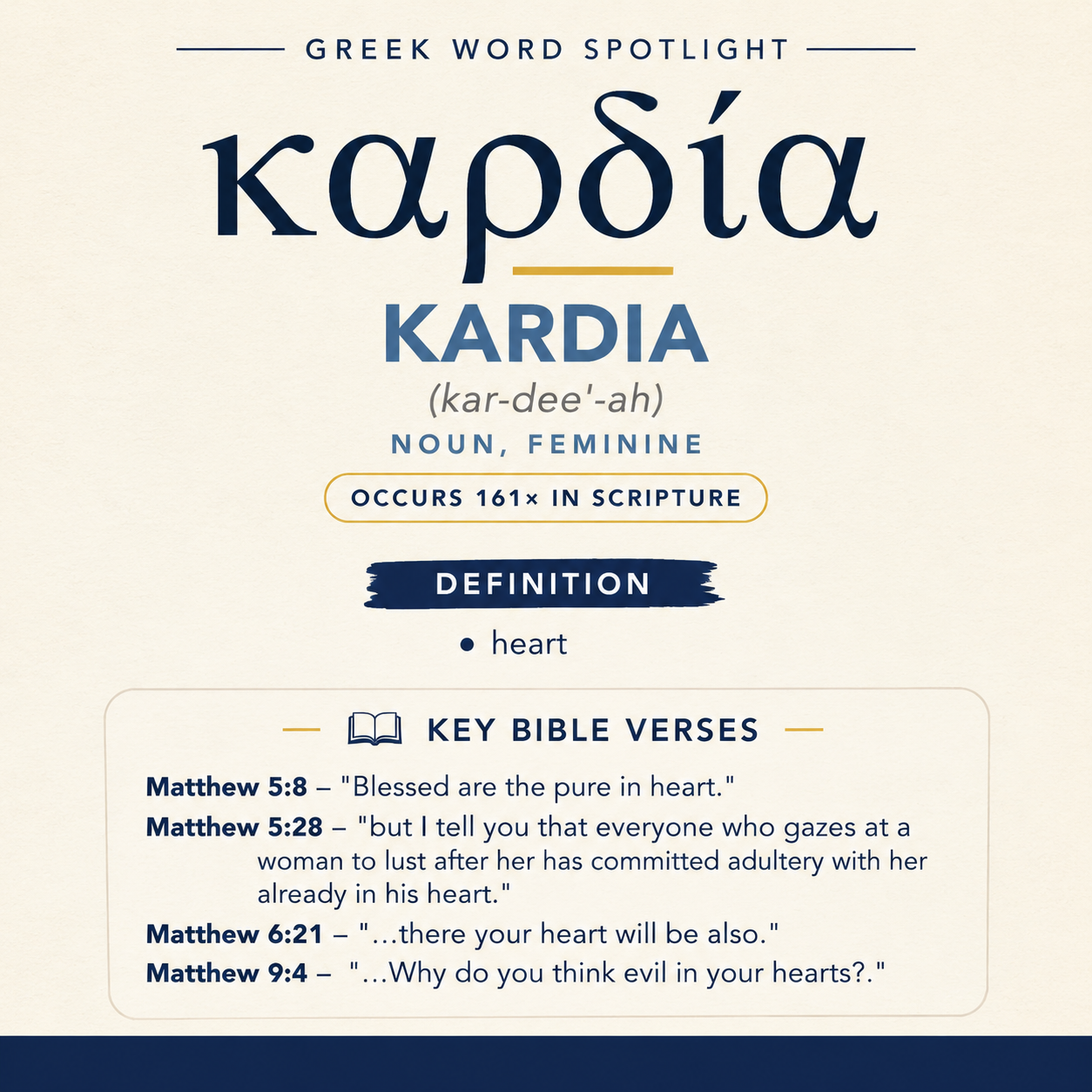
καρδία (Kardia) means “heart” and occurs 161 times in Scripture, including passages in Matthew.
Matthew Examples
In Matthew 5:8 it speaks of being “pure in heart,” and in Matthew 6:21 it links heart to treasure.
Learn More →Inner Thoughts
Matthew 5:28 and 9:4 use καρδία for inner desire and thoughts: lust “in his heart” and “evil in your hearts.”
Learn More →καρδία means “heart,” a key term in Matthew’s teaching scenes for inner purity, desire, thought, and responsiveness. In the selected passages, it marks both the inward center from which words and deeds flow and a figurative “heart” located in the earth.
Occurrences
Matthew 5:8: “Blessed are the pure in heart, for they shall see God.”
Here καρδία identifies the interior sphere in which “purity” is evaluated. The blessing is tied to a heart characterized as “pure,” and the promised outcome (“they shall see God”) is attached directly to that inward condition rather than to outward status or display.
Matthew 5:28: “but I tell you that everyone who gazes at a woman to lust after her has committed adultery with her already in his heart.”
In this saying, καρδία is the location where a decisive moral act is reckoned to have already occurred. The language presses the issue beneath visible behavior: the gaze “to lust after her” culminates in adultery “already” within the heart, making the heart the arena where culpability is established.
Matthew 6:21: “for where your treasure is, there your heart will be also.”
καρδία is presented as following what a person values. “Treasure” functions as a pointer: the heart is said to be “there” where the treasure is, describing a directional pull or attachment of the heart toward what is prized.
Matthew 9:4: “Jesus, knowing their thoughts, said, “Why do you think evil in your hearts?”
Here καρδία is the inward setting of thought. The question links “thoughts” with the heart (“in your hearts”), and specifically names the content as “evil,” showing the heart as a place where reasoning and intent can be morally assessed.
Matthew 11:29: “Take my yoke upon you, and learn from me, for I am gentle and humble in heart; and you will find rest for your souls.”
In this invitation, καρδία describes the inner character of Jesus: “gentle and humble in heart.” The heart is the seat of these qualities, and the promise of “rest for your souls” is grounded in the kind of heart Jesus claims to have, presenting his inward disposition as the basis for his manner of relating to learners.
Matthew 12:34: “You offspring of vipers, how can you, being evil, speak good things? For out of the abundance of the heart, the mouth speaks.”
καρδία is pictured as a source that overflows into speech. The saying ties identity (“being evil”) to the impossibility of producing “good things” in speech, because the mouth draws on the heart’s “abundance.” The heart functions as the reservoir whose contents determine what is spoken.
Matthew 12:35: “The good man out of his good treasure brings out good things, and the evil man out of his evil treasure brings out evil things.”
Though καρδία is not repeated in this sentence, it continues the same picture introduced immediately before: an inner “treasure” from which outward “things” are brought out. In the flow of thought, the “good treasure” and “evil treasure” correspond to what fills a person inwardly, matching the preceding claim that speech proceeds “out of the abundance of the heart.”
Matthew 12:40: “For as Jonah was three days and three nights in the belly of the whale, so will the Son of Man be three days and three nights in the heart of the earth.”
Here καρδία is used in a striking spatial metaphor: “the heart of the earth.” The phrase locates the Son of Man’s three-day interval in the earth’s “heart,” paralleling Jonah’s confinement “in the belly of the whale.” The heart-language conveys an interior depth—an “inside” of the earth corresponding to the whale’s “belly” in the comparison.
Matthew 13:15: “for this people’s heart has grown callous, their ears are dull of hearing, they have closed their eyes; or else perhaps they might perceive with their eyes, hear with their ears, understand with their heart, and would turn again; and I would heal them.’”
In this quotation, καρδία is the organ of “understand[ing].” The people’s heart “has grown callous,” a condition paired with dulled ears and closed eyes; the result is blocked perception and hearing. The alternative is a chain of restored receptivity culminating in “understand with their heart” and “turn again,” showing the heart as central to grasping and responding.
Matthew 13:19: “When anyone hears the word of the Kingdom, and doesn’t understand it, the evil one comes, and snatches away that which has been sown in his heart. This is what was sown by the roadside.”
Here καρδία is the place where the “word of the Kingdom” is “sown.” The failure to “understand it” is linked with vulnerability: the evil one “snatches away” what has been planted in the heart. The heart is thus depicted as the field of reception where the message rests (or fails to remain) after hearing.
Matthew 15:8: “‘These people draw near to me with their mouth, and honor me with their lips; but their heart is far from me.”
In this contrast, καρδία marks the true measure of nearness to God. Mouth and lips can perform honor, yet the heart may be “far.” The statement sets external acts of speech against the heart’s distance, making καρδία the decisive indicator of genuine approach.
Matthew 15:18: “But the things which proceed out of the mouth come out of the heart, and they defile the man.”
Here καρδία again stands behind speech, but now with a focus on moral contamination. What “proceed[s] out of the mouth” is traced back to what “come[s] out of the heart,” and this heart-origin is what “defile[s] the man.” The heart is presented not merely as an inward space but as the generator of what renders a person unclean.

Sense and Usage
Across these passages, καρδία consistently functions as the inward center from which a person’s moral and spiritual life is judged. It is the locus of purity (Matthew 5:8) and the place where desire is counted as a decisive transgression (Matthew 5:28), so that καρδία becomes the site where the hidden movement of the self is weighed. The heart is also portrayed as mobile in its attachments: it “will be” where one’s “treasure is” (Matthew 6:21), so that what is valued effectively maps where the heart resides.
Several sayings frame the heart as the seat of cognition and intent. Evil can be “think[ed]…in your hearts” (Matthew 9:4), and understanding can occur “with their heart” (Matthew 13:15). Yet the heart can also become resistant: it “has grown callous” (Matthew 13:15), which, alongside dulled ears and closed eyes, describes a whole-person dulling of receptivity. In the parable explanation, the heart is the place where the word is “sown” (Matthew 13:19); when understanding is absent, the seed does not remain, and the heart’s role as a receiving interior is exposed as contested terrain.
Speech is repeatedly traced to the heart as its source. “Out of the abundance of the heart, the mouth speaks” (Matthew 12:34), and “the things which proceed out of the mouth come out of the heart” (Matthew 15:18). In these contexts, καρδία is not simply private interiority; it is the wellspring that shows itself publicly. The paired statement about good and evil “treasure” (Matthew 12:35) continues the same logic: what is stored within is what is brought out. This makes the heart decisive for evaluating words, because words are treated as outward expressions of inner abundance.
Finally, καρδία can describe not only the inner self but also the inner part of a physical reality: “the heart of the earth” (Matthew 12:40). This use draws on the everyday sense of “heart” as an interior core, applying it to the earth in a concrete image of depth and containment. Even here, the word’s force is to mark what is central and inward—whether in human life (purity, desire, thought, understanding, distance, defilement) or in a spatial metaphor (earth’s interior).
Imagery
The imagery attached to καρδία in these scenes is vivid and varied: a heart that can be “pure” or “callous,” a heart that can be “far,” a heart that holds “treasure,” and a heart that contains “abundance” that spills out through the mouth (Matthew 5:8; Matthew 13:15; Matthew 15:8; Matthew 6:21; Matthew 12:34). The sowing image places the heart in the role of soil receiving seed (Matthew 13:19), while “the heart of the earth” extends the picture of heart as an inner core into the realm of place and burial-like depth (Matthew 12:40).
Sources: Lexical data from Strong’s Exhaustive Concordance and the Translators Brief Lexicon of Extended Strongs for Greek (STEPBible, CC BY). Occurrence data from the Translators Amalgamated Greek New Testament (STEPBible, CC BY). Scripture quotations from the World English Bible (public domain).




