
Exploring the Meaning of Theopneustos in Greek
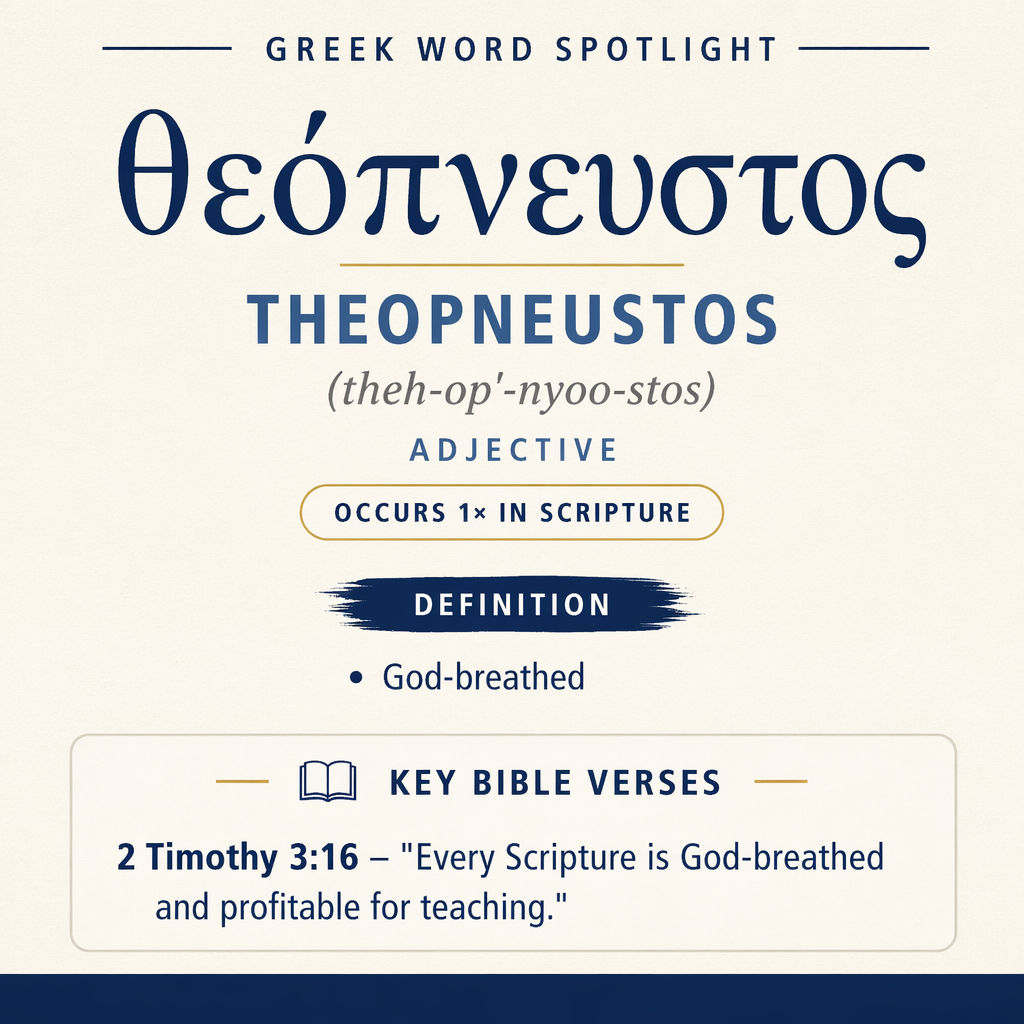
θεόπνευστος means “God-breathed” and appears once in Scripture, in 2 Timothy 3:16.
Scripture Occurrence
This word occurs one time in Scripture. It appears in 2 Timothy 3:16.
Learn More →Verse Context
In 2 Timothy 3:16, it describes “Every Scripture” as God-breathed. The verse also says Scripture is profitable for teaching, reproof, correction, and instruction in righteousness.
Learn More →θεόπνευστος means “God-breathed” and appears once in the New Testament, in Paul’s statement about Scripture in 2 Timothy 3:16. In that sentence it characterizes “Every Scripture” and frames why Scripture is useful for the church’s life and practice.
Root and Related Words
θεόπνευστος is related to theos (θεός), “God” (Strong’s G2316), and pneo (πνέω), “to blow” (Strong’s G4154). Joined together, these components form a compact description that links God with breath or blowing, supplying the imagery behind the adjective.

Occurrences
“Every Scripture is God-breathed and profitable for teaching, for reproof, for correction, and for instruction in righteousness,” (2 Timothy 3:16)
Here θεόπνευστος functions as a predicate description of “Every Scripture.” The verse does not treat Scripture as one helpful resource among others; instead it gives Scripture a distinctive quality that grounds everything that follows. Because Scripture is described this way, it is then called “profitable,” and the profit is spelled out in four coordinated purposes: “teaching,” “reproof,” “correction,” and “instruction in righteousness.” The adjective therefore stands at the head of a chain of consequences: Scripture’s value in shaping belief and conduct is tied directly to what Scripture is, not merely to what it happens to accomplish.

The placement of θεόπνευστος also matters for the verse’s logic. The statement begins universally—“Every Scripture”—and immediately assigns this quality before listing any practical uses. The result is that the usefulness (“profitable”) is not presented as an accidental benefit but as a fitting outcome of Scripture’s character. In the immediate scene of this line, θεόπνευστος is the key term that marks Scripture as bearing God’s own involvement, and thus underwrites why Scripture is able to do what the verse claims it does: teach, expose what is wrong (“reproof”), set things right (“correction”), and train a person toward “righteousness.”
Sense and Usage
“God-breathed” is a compressed metaphor. Without expanding the definition beyond the term itself, the imagery is clear: breath is an extension of the breather, and the adjective links Scripture to God by that image. In 2 Timothy 3:16, this does not operate as a poetic flourish detached from everyday ministry. It is directly connected to concrete outcomes in the community’s life: doctrinal formation (“teaching”), moral and spiritual evaluation (“reproof”), restoration to a right path (“correction”), and ongoing formation into right living (“instruction in righteousness”). The verse holds these together in a single sentence so that θεόπνευστος is not an isolated label but the source-concept that makes Scripture’s multiple forms of benefit coherent.
The term also shapes how the reader hears the word “Scripture” in this line. “Every Scripture” is not treated merely as an archive of revered religious texts; it is treated as something that bears a defining relation to God. That relation is expressed with the breath-image rather than, for example, a statement about human authors or a description of literary style. As a result, the force of θεόπνευστος in this verse is simultaneously theological and practical: it speaks about God’s connection to Scripture, and it immediately bears on Scripture’s function within teaching and formation.
Within the limits of its single attestation, θεόπνευστος is used to qualify Scripture as a whole (“Every Scripture”), and the verse’s scope suggests breadth rather than selectivity. The term is not attached to one isolated portion or one particular use-case; instead, the adjective characterizes Scripture generally, and the subsequent list of benefits ranges from initial instruction to ongoing moral training. In this way, θεόπνευστος in 2 Timothy 3:16 serves as the hinge between Scripture’s origin-character and Scripture’s communal usefulness.
Imagery
The breath imagery carried by θεόπνευστος fits the verse’s movement from source to effect. Breath is unseen yet known by its results, and in this sentence Scripture’s described quality is likewise made visible through its effects: it teaches, reproves, corrects, and instructs in righteousness. The adjective thus invites the reader to connect God’s involvement with Scripture to Scripture’s capacity to shape understanding and life in tangible ways.
Sources: Lexical data from Strong’s Exhaustive Concordance and the Translators Brief Lexicon of Extended Strongs for Greek (STEPBible, CC BY). Occurrence data from the Translators Amalgamated Greek New Testament (STEPBible, CC BY). Scripture quotations from the World English Bible (public domain).





