Exploring the Meaning of Euthumeo in Greek
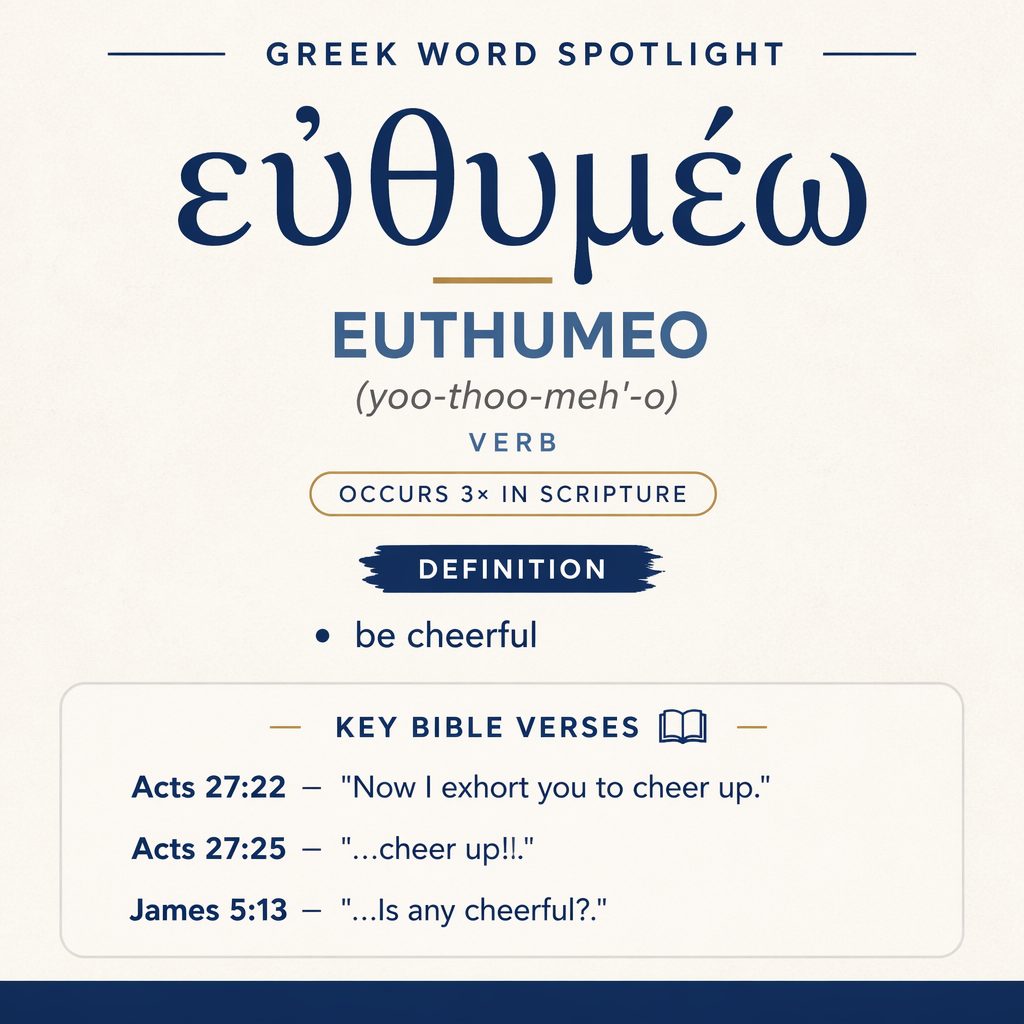
εὐθυμέω means “be cheerful” and appears three times in Scripture: Acts 27:22, Acts 27:25, and James 5:13.
Acts Usage
In Acts 27:22 and 27:25, it is used as an exhortation to “cheer up” during the voyage and shipwreck account.
Learn More →James Usage
In James 5:13, it describes someone who is cheerful and instructs that person to sing praises.
Learn More →εὐθυμέω means “be cheerful.” It appears in the crisis narrative of Acts 27 and in James’s practical counsel for suffering and joy.
Root and Related Words
εὐθυμέω (Euthumeo) is related to the adjective εὔθυμος (euthymos), “encouraging” (Strong’s G2115).

Occurrences
Acts 27:22 — “Now I exhort you to cheer up, for there will be no loss of life among you, but only of the ship.”
Here the verb is spoken as a direct exhortation in the middle of danger at sea. The call to “cheer up” is tied to a concrete assurance: “there will be no loss of life among you.” Cheerfulness is not portrayed as a vague mood but as a response summoned by a stated outcome—life will be preserved even though “only … the ship” will be lost. In this scene, εὐθυμέω functions as a steadying word meant to shape the crew’s inner state in line with a specific promise about survival.
Acts 27:25 — “Therefore, sirs, cheer up! For I believe God, that it will be just as it has been spoken to me.”
The second use repeats the same imperative, now reinforced by a reason that looks beyond the visible situation: “For I believe God.” The command “cheer up!” is anchored not merely in a prediction, but in confidence that what has been spoken will come to pass: “it will be just as it has been spoken to me.” εὐθυμέω thus carries the force of reassurance addressed to others (“sirs”), inviting them into a shared posture of cheerfulness grounded in belief. Within the flow of the verse, the verb stands at the hinge between exhortation and rationale, presenting cheerfulness as the fitting stance when one accepts the reliability of what God has spoken.
James 5:13 — “Is any among you suffering? Let him pray. Is any cheerful? Let him sing praises.”
In James, εὐθυμέω is not an emergency command but a condition within the community: “Is any cheerful?” The verse places cheerfulness alongside suffering, giving each its appropriate expression—prayer for the sufferer and praise for the cheerful. The word marks an inner state that can be recognized (“any … cheerful?”) and then directed toward a fitting outward act: “Let him sing praises.” In this setting, cheerfulness is treated as spiritually active rather than idle; it becomes the occasion for worshipful speech and song.
Sense and Usage
Across these passages, “be cheerful” is applied both as an exhortation offered to people under pressure and as a describable state within ordinary community life. In Acts 27 the verb appears as a spoken intervention: cheerfulness is urged precisely when circumstances would normally crush it. The surrounding lines explain why such cheerfulness is reasonable in that moment—first by pointing to the preservation of life, and then by grounding that preservation in belief that what has been spoken will happen. In other words, cheerfulness is portrayed as something that can be called forth through persuasion and trust, not merely something that rises or falls with immediate conditions.
James 5:13 complements this by showing what cheerfulness does when it is present. The verse pairs two contrasting experiences (“suffering” and “cheerful”) and assigns each an action that matches it. Cheerfulness finds its outlet in “sing[ing] praises,” suggesting that the state named by εὐθυμέω is not self-contained but communicative: it turns the heart outward and upward in voiced gratitude. The result is a practical map of expression—prayer for distress, praise for cheerfulness—where inner condition and outward practice are joined.
Read together, these uses sketch the word’s range in lived situations without changing its basic sense. In a storm-tossed setting, being cheerful is urged as a stabilizing posture that corresponds to credible reassurance. In congregational counsel, being cheerful is recognized as a real condition among believers and is directed toward praise. The repeated imperative in Acts also highlights how cheerfulness can be communal: it is addressed to a group (“among you”; “sirs”), aiming to lift collective morale in response to a shared hope. James, by contrast, individualizes the question (“Is any among you…? Let him…”), indicating that cheerfulness may be present in some even while others suffer, and each person’s response can be appropriate to their current state.
Imagery in Context
In Acts 27, εὐθυμέω carries the feel of light breaking into a dark scene: words spoken aboard a ship where loss is expected, yet life is promised—“no loss of life among you, but only of the ship” (Acts 27:22). In James 5:13, the imagery shifts from crisis to gathered worship: cheerfulness becomes audible as “sing praises,” a sound that fits a heart at ease and turns that ease into thanksgiving.
Sources: Lexical data from Strong’s Exhaustive Concordance and the Translators Brief Lexicon of Extended Strongs for Greek (STEPBible, CC BY). Occurrence data from the Translators Amalgamated Greek New Testament (STEPBible, CC BY). Scripture quotations from the World English Bible (public domain).