
Exploring the Meaning of Epikathizo in Greek
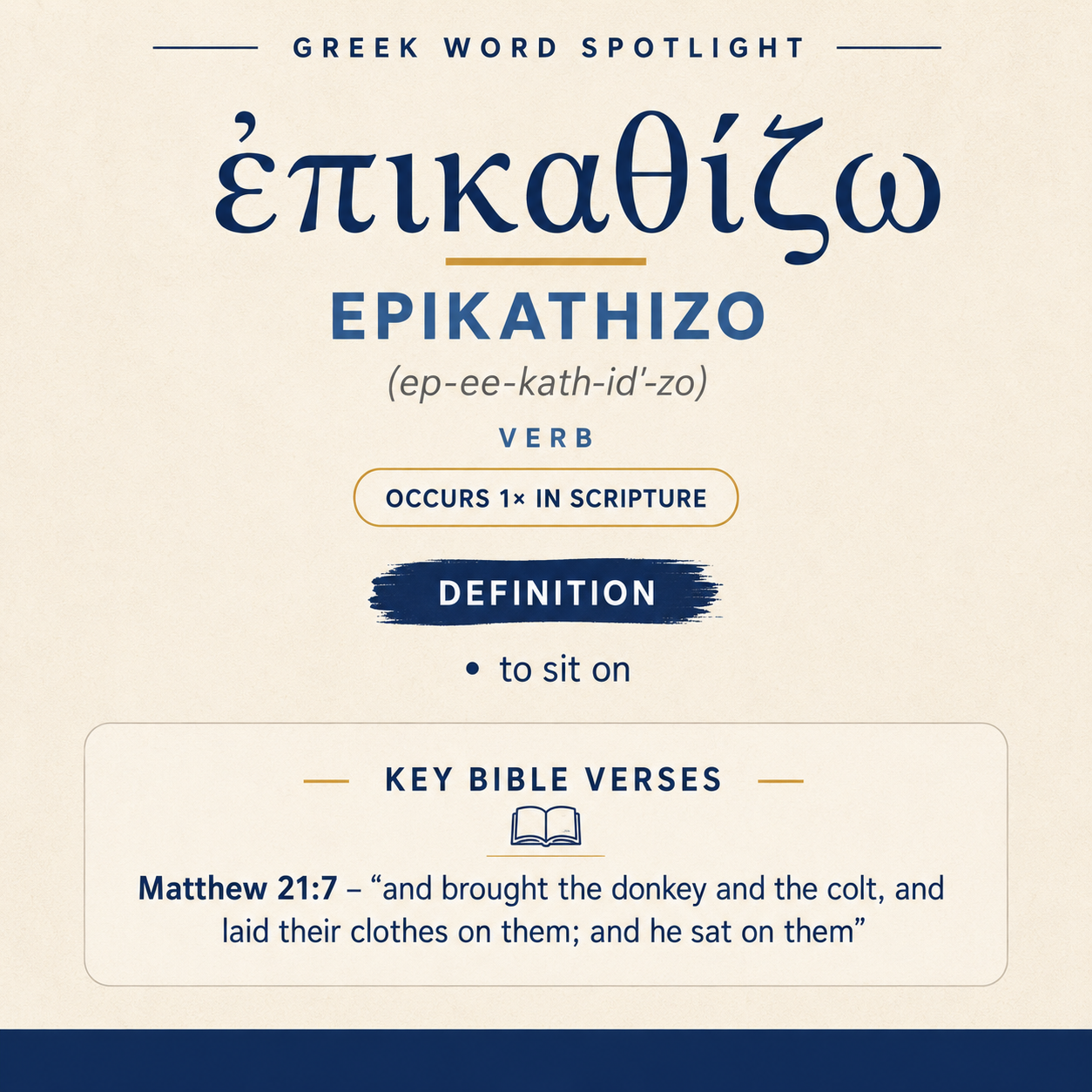
ἐπικαθίζω means “to sit on” and appears once in Scripture, in Matthew 21:7.
Verse Context
In Matthew 21:7, donkey and colt have clothes laid on them, and “he sat on them.”
Learn More →ἐπικαθίζω expresses the act “to sit on,” and it is attested in the Gospel narrative of Jesus’ entry into Jerusalem. Its single New Testament occurrence appears in Matthew’s description of Jesus mounting the animals brought to Him.
Root and Related Words
ἐπικαθίζω is built from epi (ἐπί), “upon/to/against” (Strong’s G1909), and kathizo (καθίζω), “to seat” (Strong’s G2523). The combination yields a verb that depicts seating oneself in a way that is oriented “upon” something.

Occurrences
“and brought the donkey and the colt, and laid their clothes on them; and he sat on them.” (Matthew 21:7)
In this scene, the action unfolds in a clear sequence: animals are brought, garments are placed on them, and then Jesus performs the climactic bodily action described by ἐπικαθίζω. The verb supplies the decisive movement from preparation to use: the clothing becomes a saddle-like covering only because He actually sits upon what has been arranged. The verse presents the sitting as the culminating step that turns the donkeys and the placed garments into the immediate means of conveyance for the entry that follows.

The immediate context in the sentence shapes how the verb is heard. First, the disciples “laid their clothes on them,” and then “he sat on them.” The second clause is tethered to the first: the garments are not merely carried along but function as the surface on which He sits. The verb therefore marks a physical contact and a deliberate taking of position, not a passing touch. It conveys a controlled, intentional posture: Jesus does not merely stand near the animals or lead them; He seats Himself upon them as one who is to be carried.
The final phrase, “on them,” keeps the image concrete. Matthew’s wording holds together donkey, colt, and garments as the immediate objects in view, and ἐπικαθίζω is the verb that binds Jesus’ body to that prepared surface. In narrative terms, this is the moment the entry becomes visible and public: the animals and the draped clothing are present, but the entry is not underway until the rider sits upon them. ἐπικαθίζω thus carries the weight of transition—preparations completed, motion ready to begin—without needing to describe anything beyond the simple act of sitting on.
Sense and Usage
Because ἐπικαθίζω means “to sit on,” its sense is spatial and bodily: it depicts a person taking a seated position upon something else. In Matthew 21:7, that “something” is not an abstract object but a prepared riding arrangement. The verb’s force lies in its concreteness. It signals a shift from standing and walking to being borne by another—an embodied choice that changes how a figure is presented in public space.
The verb also implies a completed action rather than an ongoing posture. The narrative does not linger on the seated state; it reports the act of seating as the key event. That single motion gathers into itself the prior actions (bringing animals, laying garments) and gives them their immediate purpose. The garments are spread “on them,” and then the sitting occurs “on them”: the repetition of “on” frames ἐπικαθίζω as the act that matches and answers the earlier placement. The verb’s meaning remains simple, but its placement makes it a hinge in the sentence’s structure.
Within the verse, ἐπικαθίζω is also a marker of authority and intention, not by adding a new gloss, but by what sitting on an animal normally accomplishes in a travel scene: it establishes who rides and who is led. Matthew’s description does not require any additional explanation for the reader to understand the social and visual effect of the seated position. The verb supplies that effect by naming the action directly, letting the scene’s components—animals, garments, rider—speak for themselves.
Finally, ἐπικαθίζω participates in the verse’s vivid physicality. The sentence is composed of concrete items (“donkey,” “colt,” “clothes”) and simple motions (“brought,” “laid,” “sat”). In such a style, the verb does not serve as ornament; it serves as the narrative’s essential physical verb. The meaning “to sit on” is therefore not only a dictionary gloss but an action that anchors the moment in the body: Jesus’ entry begins with the ordinary, visible act of sitting upon what has been placed for Him.
Imagery
Matthew 21:7 frames ἐπικαθίζω with tactile imagery: fabric laid over animals, and a rider settling onto that fabric. The verb invites the reader to picture weight transferring downward and a journey about to commence—an entry that starts, not with speech, but with the simple act of taking a seat upon what has been prepared.
Sources: Lexical data from Strong’s Exhaustive Concordance and the Translators Brief Lexicon of Extended Strongs for Greek (STEPBible, CC BY). Occurrence data from the Translators Amalgamated Greek New Testament (STEPBible, CC BY). Scripture quotations from the World English Bible (public domain).




