Exploring the Meaning of Entrepo in Greek
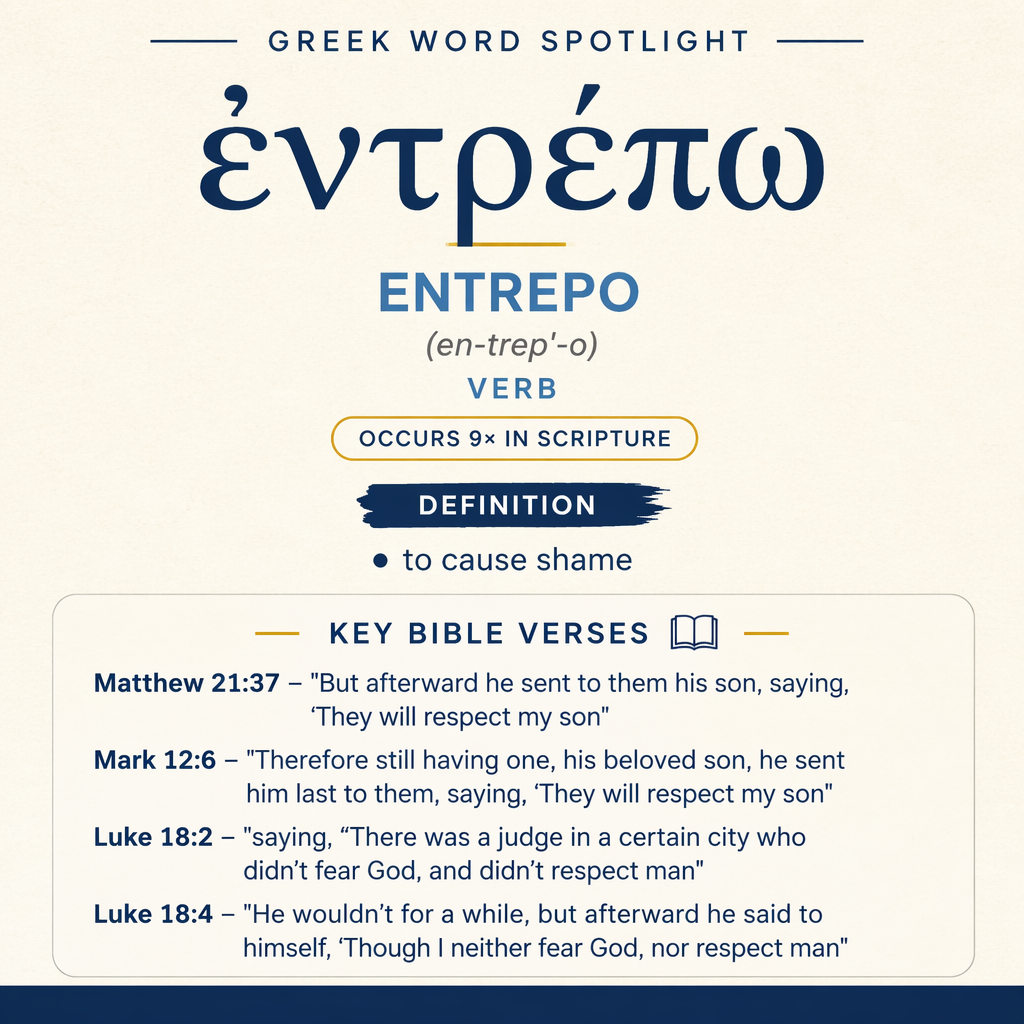
ἐντρέπω means “to cause shame” and occurs 9 times in Scripture, including Matthew 21:37 and 1 Corinthians 4:14.
Core Meaning
ἐντρέπω is defined as “to cause shame.” In several passages it is translated with the idea of being ashamed or shaming.
Learn More →Gospel Usage
In the vineyard parables it appears as “They will respect my son” (Matthew 21:37; Mark 12:6; Luke 20:13). In Luke 18:2, 18:4 it is used of a judge who didn’t “respect man.”
Learn More →Letter Usage
Paul says, “I don’t write these things to shame you” (1 Corinthians 4:14). It also appears in contexts aiming that an opposing person “may be ashamed” (2 Thessalonians 3:14; Titus 2:8).
Learn More →ἐντρέπω expresses the action of causing shame, a force that can be expected, refused, or intentionally brought about. In the cited passages it appears in vineyard parables about a “beloved son,” in a judge’s self-description, and in several apostolic settings where shame functions as a corrective social outcome.
Occurrences
“But afterward he sent to them his son, saying, ‘They will respect my son.’” (Matthew 21:37)
Within the owner’s expectation, the sending of “his son” is framed as a final appeal that should trigger shame in the tenants. The word supplies the social and moral pressure presumed to arise simply from the son’s status: the tenants are expected to be moved to the appropriate response because failing to do so would be shameful.

“Therefore still having one, his beloved son, he sent him last to them, saying, ‘They will respect my son.’” (Mark 12:6)
The same expectation is sharpened by “beloved” and “last.” The word marks the owner’s calculation that the climactic sending will cause shame that restrains wrongdoing. The anticipated reaction is not described as persuasion by argument, but as the socially compelling force that ought to arise when the beloved son arrives.
“saying, “There was a judge in a certain city who didn’t fear God, and didn’t respect man.” (Luke 18:2)
The judge is introduced by what he lacks: he “didn’t fear God” and “didn’t respect man.” Here ἐντρέπω highlights an absence of the ordinary shame that would be produced by regard for others. The judge is characterized as someone unmoved by the kinds of relationships and expectations that normally generate shame-based restraint.
“He wouldn’t for a while, but afterward he said to himself, ‘Though I neither fear God, nor respect man,” (Luke 18:4)
The judge repeats his self-assessment internally as he deliberates. The word contributes the same idea, but now as a confessed principle guiding his conduct: he recognizes that he does not operate under the pressure of shame in relation to people. The repetition underscores that his later action (in the broader scene implied by his deliberation) will not be explained by a sudden awakening of shame.
“The lord of the vineyard said, ‘What shall I do? I will send my beloved son. It may be that seeing him, they will respect him.’” (Luke 20:13)
Here the word is attached to “seeing him”: the owner imagines that the mere sight of the “beloved son” will cause shame. The formulation shows ἐντρέπω working as an expected response to presence and recognition rather than to coercion. It is the hoped-for turning point in the conflict, grounded in what the son represents.
“I don’t write these things to shame you, but to admonish you as my beloved children.” (1 Corinthians 4:14)
In this pastoral clarification, ἐντρέπω names an aim Paul explicitly rejects for his writing: his purpose is not “to shame you.” The word therefore frames shame as a possible effect of communication—something a writer could intentionally cause—yet Paul distinguishes it from “admonish you,” which he aligns with the relationship “my beloved children.” The contrast presents shame as a tool that can be set aside for a different kind of correction.
“If any man doesn’t obey our word in this letter, note that man, that you have no company with him, to the end that he may be ashamed.” (2 Thessalonians 3:14)
The word is the stated goal of a community action: reduced association (“have no company with him”) is directed “to the end that he may be ashamed.” ἐντρέπω here functions as an intended outcome meant to bring the disobedient person to a sense of disgrace, using social distance as the means by which shame is caused.
“and soundness of speech that can’t be condemned, that he who opposes you may be ashamed, having no evil thing to say about us.” (Titus 2:8)
In this setting the cause of shame is “soundness of speech that can’t be condemned.” The opponent is brought to shame not by retaliation but by being deprived of legitimate accusations: he ends up “having no evil thing to say about us.” ἐντρέπω thus describes shame that arises when opposition collapses under the weight of unimpeachable conduct and speech.
“Furthermore, we had the fathers of our flesh to chasten us, and we paid them respect. Shall we not much rather be in subjection to the Father of spirits, and live?” (Hebrews 12:9)
The word appears in a recollection of childhood discipline: “we paid them respect.” In this context it denotes the kind of response elicited by “chasten us”—a response consistent with being brought under proper order through correction. The rhetorical question then leverages that experience toward “be in subjection,” treating the respect as an appropriate, expected posture in view of fatherly authority.

Sense and Usage
Across these passages, ἐντρέπω operates as a relational force: it arises (or fails to arise) in the presence of persons whose standing should matter, in the face of correction, and within the social mechanisms of a community. The vineyard scenes show it as an expectation tied to the arrival of the “beloved son.” The owner’s reasoning presumes that the son’s appearance should cause shame sufficient to change behavior; ἐντρέπω is treated as something that can be triggered by recognition—“seeing him”—and by the implicit obligations a son embodies.
Luke’s judge illustrates the opposite condition: a person can be described by his immunity to this pressure. By pairing “didn’t fear God” with “didn’t respect man,” the narrative portrays a figure who lacks both vertical accountability and horizontal social shame. When the judge repeats the phrase in his own internal speech, ἐντρέπω becomes a self-conscious description of his moral stance: he knows that human regard does not produce shame in him, and he acts accordingly.
In the apostolic passages, the word is handled with pastoral precision. Paul’s statement, “I don’t write these things to shame you,” treats shame as a potential effect of admonitory speech, but not always a rightful intention. The relationship “my beloved children” frames the choice: admonition can be delivered without aiming at humiliation. By contrast, 2 Thessalonians makes shame the explicit goal of a measured communal response—“have no company with him”—so that the person’s disobedience is confronted through a felt loss of normal association. Titus presents a different pathway: shame arises when opposition is left empty-handed by “soundness of speech that can’t be condemned,” so that the opponent is ashamed precisely because he “having no evil thing to say.” In Hebrews, respect is connected to chastening and subjection, showing ἐντρέπω as the fitting response elicited by fatherly discipline rather than by mere social scrutiny.
Imagery and Patterns
Two images dominate the word’s settings. In the vineyard accounts, ἐντρέπω is the hoped-for reaction to the visible arrival of the “beloved son,” an appeal to shame meant to restrain violence and injustice without immediate force. In the community and household-shaped passages, shame is attached to correction—either deliberately withheld (“not…to shame you”), carefully applied through social boundaries (“have no company with him, to the end that he may be ashamed”), or induced indirectly through integrity (“soundness of speech”). The passages together portray shame as powerful, but requiring discernment: it can be absent in hardened characters, expected in the face of rightful authority, and employed or avoided as circumstances demand.
Sources: Lexical data from Strong’s Exhaustive Concordance and the Translators Brief Lexicon of Extended Strongs for Greek (STEPBible, CC BY). Occurrence data from the Translators Amalgamated Greek New Testament (STEPBible, CC BY). Scripture quotations from the World English Bible (public domain).