Exploring the Meaning of Enduo in Greek
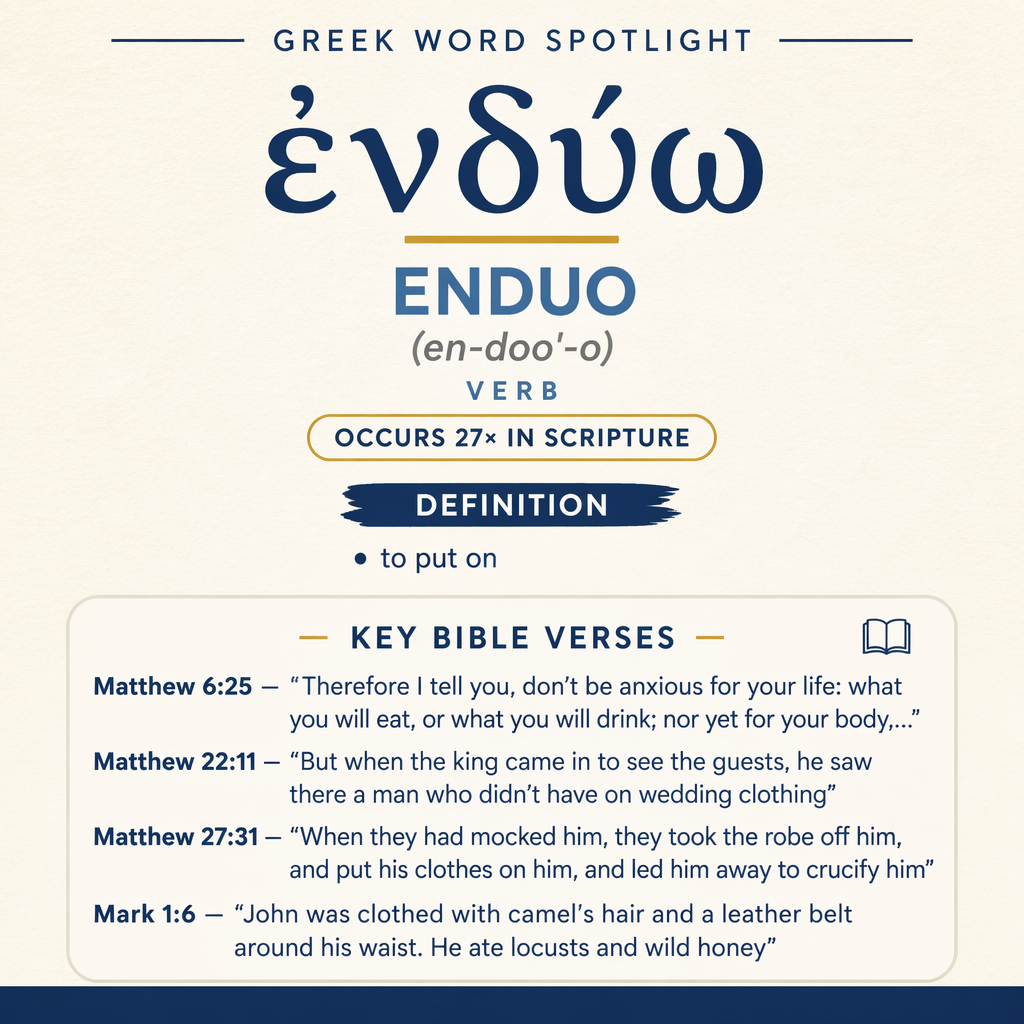
ἐνδύω means “to put on” and occurs 27 times in Scripture, including Matthew 6:25; 22:11; 27:31; Mark 1:6; 6:9; 15:20; Luke 8:27; 12:22.
Core Meaning
ἐνδύω means “to put on.” The listed verses use it for clothing and being clothed.
Learn More →Gospel Examples
It appears in scenes about clothing or lack of clothing: wedding clothing (Matthew 22:11), putting clothes on Jesus (Matthew 27:31; Mark 15:20), and John being clothed (Mark 1:6).
Learn More →Teaching Contexts
In Matthew 6:25 and Luke 12:22, ἐνδύω appears in Jesus’ teaching about not being anxious for the body. Luke 8:27 uses it of a man who wore no clothes.
Learn More →ἐνδύω describes the act of putting something on, especially clothing, and it appears in scenes ranging from ordinary dress and travel to royal display, mockery, and vivid figurative language. In these passages it helps frame bodily need, social fitness, restoration, public identity, and a metaphor of being clothed with power or armor.
Occurrences
Matthew 6:25 — “Therefore I tell you, don’t be anxious for your life: what you will eat, or what you will drink; nor yet for your body, what you will wear. Isn’t life more than food, and the body more than clothing?”
Here ἐνδύω anchors a basic human concern: what the body will be dressed in. The verb sits alongside eating and drinking as part of “your life,” but the saying presses beyond the immediate act of dressing toward a perspective on what constitutes life and the body.
Matthew 22:11 — “But when the king came in to see the guests, he saw there a man who didn’t have on wedding clothing,”
In this banquet scene, the presence or absence of what one has put on becomes a visible marker when the king “came in to see the guests.” ἐνδύω contributes the idea of an expected covering appropriate to the setting; the lack of wedding clothing is noticed precisely because clothing is the outward sign of readiness to participate.
Matthew 27:31 — “When they had mocked him, they took the robe off him, and put his clothes on him, and led him away to crucify him.”
In the mockery and transition to execution, ἐνδύω is part of a sequence of actions done to Jesus. The soldiers remove one garment (“the robe”) and then actively dress him again with “his clothes,” making the act of putting on a step in their handling of him as they “led him away.”
Mark 1:6 — “John was clothed with camel’s hair and a leather belt around his waist. He ate locusts and wild honey.”
Here ἐνδύω describes John’s characteristic apparel: camel’s hair with a leather belt. The verb supports a portrait that combines diet and clothing into a unified description of his public presence; what he has put on is part of how he is recognized.
Mark 6:9 — “but to wear sandals, and not put on two tunics.”
In travel instructions, ἐνδύω appears in a restriction: sandals are permitted, but “not put on two tunics.” The verb highlights deliberate choices about what to dress in, keeping clothing minimal and purposeful for the journey.
Mark 15:20 — “When they had mocked him, they took the purple off him, and put his own garments on him. They led him out to crucify him.”
As in Matthew’s account, ἐνδύω occurs amid stripping and re-dressing. The “purple” is removed, then Jesus is clothed again with “his own garments,” and the dressing action stands as the final preparation before he is “led… out,” underscoring how clothing can be manipulated in humiliation and then reset to ordinary attire.
Luke 8:27 — “When Jesus stepped ashore, a certain man out of the city who had demons for a long time met him. He wore no clothes, and didn’t live in a house, but in the tombs.”
In this encounter, ἐνδύω is implied negatively: the man “wore no clothes.” His lack of being clothed is paired with his living situation—“didn’t live in a house, but in the tombs”—so the absence of clothing functions as an outward sign of his extreme condition and separation from normal life.
Luke 12:22 — “He said to his disciples, “Therefore I tell you, don’t be anxious for your life, what you will eat, nor yet for your body, what you will wear.”
This repeats the same concern as Matthew 6:25, now directed explicitly to “his disciples.” ἐνδύω remains tied to anxiety about bodily provision; what one puts on becomes a test case for whether life is governed by worry or trust in provision beyond the self.
Luke 15:22 — ““But the father said to his servants, ‘Bring out the best robe, and put it on him. Put a ring on his hand, and sandals on his feet.”
In the father’s command, ἐνδύω is a decisive act of restoration and honor: the “best robe” is brought out and actively placed on the son. Clothing is coordinated with other visible items (“a ring… sandals”), so being clothed functions as a public re-acceptance into the household.
Luke 24:49 — “Behold, I send out the promise of my Father on you. But wait in the city of Jerusalem until you are clothed with power from on high.”
Here ἐνδύω shifts from literal garments to a metaphor of being covered or outfitted with “power from on high.” The passive framing (“until you are clothed”) presents power as something received rather than self-produced, and it is linked to timing and readiness: they are to “wait… until” this clothing has taken place.
Acts 12:21 — “On an appointed day, Herod dressed himself in royal clothing, sat on the throne, and gave a speech to them.”
ἐνδύω depicts deliberate self-presentation: Herod “dressed himself in royal clothing,” then takes the throne and speaks. The clothing is part of staging authority; what is put on supports the public act of ruling and oratory in a formal setting.
Romans 13:12 — “The night is far gone, and the day is near. Let’s therefore throw off the deeds of darkness, and let’s put on the armor of light.”
In Paul’s exhortation, ἐνδύω is explicitly figurative: believers are urged to “put on the armor of light.” The verb’s concrete action of dressing becomes an image for adopting a new stance suited to the approaching “day,” set in contrast to “throw off the deeds of darkness.”

Sense and Usage
Across these passages, ἐνδύω consistently works with the tangible act of dressing as a way to mark condition, fitness, and identity. In Matthew 6:25 and Luke 12:22, the act of putting on clothing represents ordinary bodily need—something so basic it easily becomes a focus of anxiety. The pairing of clothing with food and drink places ἐνδύω in the realm of daily provision, while the surrounding questions (“Isn’t life more than food, and the body more than clothing?”) keep the physical act in view but refuse to let it define the whole of life.
Several occurrences show clothing as a social signal. In Matthew 22:11 the lack of wedding clothing is not merely personal preference; it is an observable mismatch between garment and occasion, noticeable when the king inspects the guests. In Luke 15:22 the father’s instruction to “put it on him” uses the same basic action, but now as a positive, public re-clothing that aligns the son with the household’s honor. Acts 12:21 illustrates the same dynamic from a political angle: Herod’s royal clothing is part of his throne-speech setting, a chosen exterior that supports the role he is about to perform.
Other texts highlight how clothing can be imposed, removed, or withheld, making ἐνδύω a verb of power dynamics. In Matthew 27:31 and Mark 15:20, dressing and undressing happen in the hands of mockers; the act of putting on is not self-directed but done to Jesus in the course of humiliating treatment and procedural movement toward crucifixion. Luke 8:27 depicts the opposite of being dressed—“He wore no clothes”—and that nakedness is presented as part of the man’s breakdown of ordinary human habitation (“didn’t live in a house, but in the tombs”). Mark 6:9 shows a controlled simplicity: “not put on two tunics,” using the same concrete action to set limits and define the manner of going out.
Finally, Luke 24:49 and Romans 13:12 demonstrate how readily ἐνδύω carries metaphorical weight without leaving behind its clothing imagery. In Luke, “clothed with power from on high” portrays power as something that envelops and equips, something one can be “clothed with” as with a garment. In Romans, “put on the armor of light” draws on the familiar act of dressing for protection and readiness; the command pairs with “throw off” to create a full change of outfit—removing one set of practices and adopting another—while keeping the underlying picture of intentional preparation.
Imagery
The word’s imagery in these verses moves between the wardrobe and the wider world: from everyday concerns about what one will wear, to the distinctiveness of John’s camel-hair clothing, to a king’s inspection of a guest’s attire, to the father’s best robe placed on a restored son. It can be the tool of mockery when others dress and undress a victim, and it can become a powerful metaphor—being clothed “with power from on high” or putting on “the armor of light”—where the familiar act of dressing supplies a picture of readiness and public visibility.
Sources: Lexical data from Strong’s Exhaustive Concordance and the Translators Brief Lexicon of Extended Strongs for Greek (STEPBible, CC BY). Occurrence data from the Translators Amalgamated Greek New Testament (STEPBible, CC BY). Scripture quotations from the World English Bible (public domain).