
Understanding the Significance of Duno in Greek
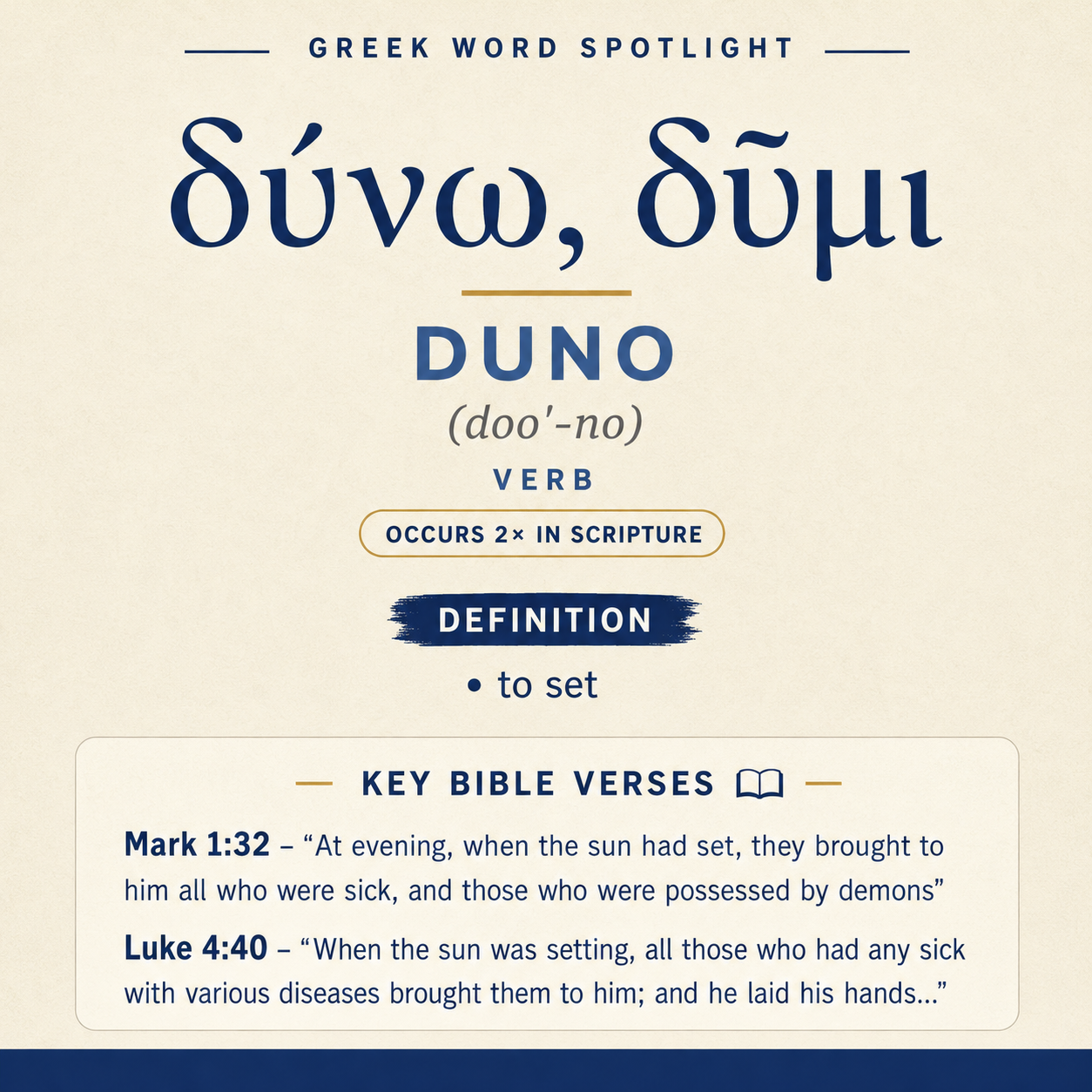
δύνω, δῦμι (Duno) means “to set” and appears in Mark 1:32 and Luke 4:40.
Core Meaning
This verb means “to set.” In both occurrences it describes the sun setting.
Learn More →Scripture Occurrences
It occurs 2 times in Scripture. The references are Mark 1:32 and Luke 4:40.
Learn More →Verse Context
Mark 1:32 notes evening after the sun had set, when the sick were brought to Jesus. Luke 4:40 describes the sun setting as people brought the sick and Jesus laid hands on them.
Learn More →δύνω, δῦμι expresses the setting of the sun, marking the day’s turn into evening in two Gospel scenes. In both passages it frames the time when many sick people are brought to Jesus for healing.
Occurrences
“At evening, when the sun had set, they brought to him all who were sick, and those who were possessed by demons.” (Mark 1:32)
Here the verb situates the action at a precise threshold: “At evening, when the sun had set.” The setting of the sun functions as the temporal hinge that introduces what follows—“they brought to him all who were sick, and those who were possessed by demons.” The clause does more than supply a time-of-day detail; it gathers the scene into a single moment when daylight is finished and the community’s response becomes visible and organized. The narrative moves from the day’s close to a wide, inclusive movement of people toward Jesus: “all who were sick,” alongside “those who were possessed by demons.” By anchoring the bringing of the afflicted to the moment the sun has set, the verb helps the reader sense the onset of evening as the backdrop for the influx of need and the beginning of a sustained encounter.
The structure of the sentence also places the setting as a precondition: first the evening arrives with the sun’s setting, then “they brought” the sick and demon-possessed. The verb therefore contributes to pacing—holding the action until the day has reached its end—and to atmosphere, with the transition into evening forming the stage for the gathering at Jesus’ presence.
“When the sun was setting, all those who had any sick with various diseases brought them to him; and he laid his hands on every one of them, and healed them.” (Luke 4:40)
Luke presents the same natural marker as an unfolding process: “When the sun was setting.” The setting of the sun frames a scene of repeated, individual acts of care: “all those who had any sick with various diseases brought them to him.” The word for setting functions as the time signal under which a broad and varied group arrives, described not only as sick but as suffering “various diseases.” Within this temporal frame, the verse emphasizes the personal scope of Jesus’ response: “he laid his hands on every one of them, and healed them.” The sun’s setting thus forms the horizon against which a series of healings occurs, each one involving direct contact and attention.
The verb’s contribution here is to define the moment when the stream of people comes and when the healings take place. It also supports the verse’s movement from collective to individual: the setting sun gathers “all those” who bring the sick, and then the scene narrows to “every one of them” who receives Jesus’ hands and healing. The time reference, tied to the sun’s setting, keeps the scene grounded in a concrete, observable transition in the day while the narrative highlights the comprehensive reach of the healing—no one brought is excluded from the touch and the cure.

Sense and Usage
The sense “to set” is illustrated in both occurrences through the same visible phenomenon: the sun reaching the end of its daily course. In Mark the phrase is completed—“the sun had set”—which presents the setting as an accomplished fact that has already happened by the time the bringing begins. In Luke the phrasing is progressive—“the sun was setting”—which portrays the setting as in motion as the people arrive and as Jesus heals. These two ways of describing the same event show how the verb can function either to mark a completed boundary (“had set”) or to locate action within the ongoing transition (“was setting”), while keeping the sense centered on the sun’s setting.
In both passages, the verb does narrative work by providing a shared, public clock. The sun’s setting is not a private or hidden marker; it is a natural signal available to everyone in the scene. That makes it suitable for introducing the collective action described: “they brought to him all who were sick” (Mark), and “all those who had any sick with various diseases brought them to him” (Luke). The word therefore connects the physical world and the social world: a change in the sky corresponds to a change in the flow of people, from the day’s ordinary activities into an evening defined by seeking help.
The setting of the sun also functions as a narrative threshold between what precedes and what follows inside each verse. The time clause comes first, and then the verbs of response and care follow: people “brought” the sick, and Jesus “laid his hands” and “healed.” Within the limited attestation here, “to set” is not used metaphorically or transferred to other objects; it is tied to the sun and used to locate moments of gathering and healing. The effect is to situate Jesus’ healing ministry in ordinary time: the scenes occur at day’s end, when light fades and evening comes on, and yet the activity described is expansive—“all who were sick,” “every one of them.”
Because the word marks the day’s close, it also highlights the continuity and persistence of the need presented. As the sun sets, the number and variety of the sick do not diminish; instead, the arrival of evening is the moment when many are brought. In Luke, the careful phrasing—“various diseases,” “every one of them”—is held together under the time marker of the setting sun, emphasizing both breadth (many conditions) and completeness (each person touched and healed). The verb thus contributes to the portrayal of time as a container for ministry: the setting sun frames an interval in which people come, Jesus receives them, and healing is enacted person by person.
Imagery
In these two verses the image carried by “to set” is simple and concrete: the sun lowering into the evening. Yet the natural image shapes the emotional tone of the scenes. The day’s fading light coincides with people bringing illness and affliction into Jesus’ presence, and with the calm, direct actions of care described—bringing, laying on hands, healing. The setting sun, as the day turns, becomes the quiet backdrop for an intense convergence of human need and deliberate, individual attention.
Sources: Lexical data from Strong’s Exhaustive Concordance and the Translators Brief Lexicon of Extended Strongs for Greek (STEPBible, CC BY). Occurrence data from the Translators Amalgamated Greek New Testament (STEPBible, CC BY). Scripture quotations from the World English Bible (public domain).





