
Exploring the Meaning of Hellen in Greek
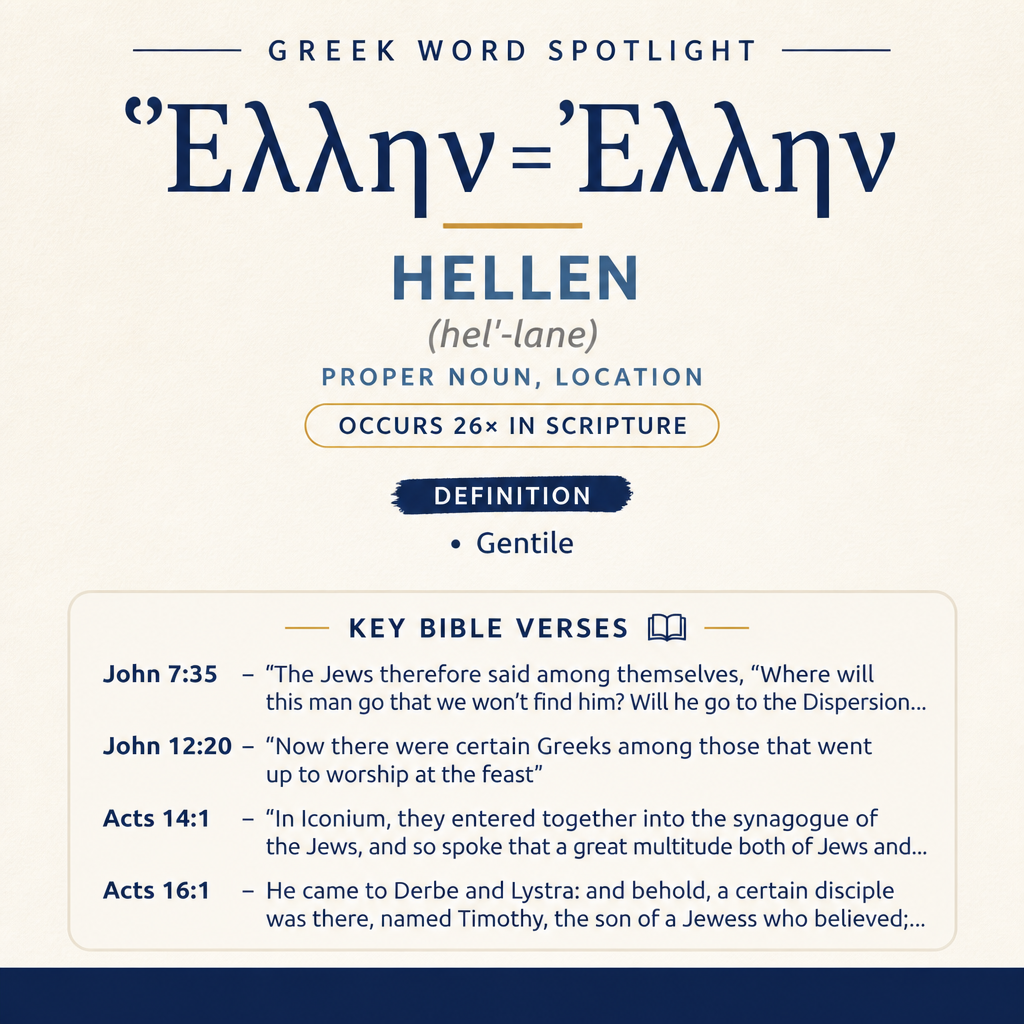
Ἕλλην (Hellen) means “Gentile” and appears 26 times in Scripture, including John 7:35; John 12:20; and multiple places in Acts.
Core Meaning
Ἕλλην is defined as “Gentile.” It is a Greek word transliterated Hellen.
Learn More →Where It Appears
It occurs 26 times in Scripture. Sample references include John 7:35 and John 12:20.
Learn More →Acts Usage
Acts frequently pairs it with “Jews,” as in Acts 18:4. Other listed occurrences include Acts 14:1, 17:4, and 18:17.
Learn More →Ἕλλην names a “Gentile” in the passages listed here, marking people distinguished from Jews in worship, synagogue life, public disputes, and the spread of teaching. Across John and Acts it regularly functions as one side of a repeated pair (“Jews and Greeks”), and at key points it becomes a flashpoint for questions of access and defilement.
Occurrences
John 7:35: “The Jews therefore said among themselves, “Where will this man go that we won’t find him? Will he go to the Dispersion among the Greeks, and teach the Greeks?”
Here Ἕλλην frames the imagined destination and audience of “this man.” The Jews’ question sets “the Dispersion among the Greeks” as a place where instruction could be carried out, and then sharpens the point by repeating the term: “teach the Greeks.” The word thus functions as a label for an identifiable non-Jewish audience, pictured as reachable in a dispersed setting.
John 12:20: “Now there were certain Greeks among those that went up to worship at the feast.”
Ἕλλην identifies worshipers present “at the feast,” locating Gentiles within a pilgrim setting. The statement is simple but weighty in scene-setting: among those who “went up to worship” are “certain Greeks,” indicating Gentile participation in the act of worship without narrating their role beyond their presence.
Acts 14:1: “In Iconium, they entered together into the synagogue of the Jews, and so spoke that a great multitude both of Jews and of Greeks believed.”
In this synagogue context, Ἕλλην appears in a paired formula—“both of Jews and of Greeks”—to describe the breadth of response to the speaking. The word contributes a social boundary marker: belief is not limited to one community but crosses from Jews to Gentiles, presented as two distinct groups within the same report of belief.
Acts 16:1: “He came to Derbe and Lystra: and behold, a certain disciple was there, named Timothy, the son of a Jewess who believed; but his father was a Greek.”
Ἕλλην characterizes Timothy’s father in contrast to “a Jewess who believed.” The term provides family and identity context for Timothy: his mother is described by Jewish identity and faith, while his father is designated a Gentile. The word here functions descriptively, anchoring Timothy’s mixed household background in the narrative.
Acts 16:3: “Paul wanted to have him go out with him, and he took and circumcised him because of the Jews who were in those parts; for they all knew that his father was a Greek.”
Ἕλλην explains what “they all knew” and why a particular action was taken “because of the Jews.” The word pinpoints the known fact—Timothy’s father’s Gentile identity—which becomes socially significant in the presence of Jews “in those parts.” In the scene, Ἕλλην is not merely a label but a publicly recognized identity shaping communal perception.
Acts 17:4: “Some of them were persuaded and joined Paul and Silas, of the devout Greeks a great multitude, and not a few of the chief women.”
Ἕλλην appears modified by “devout,” and the narrative highlights quantity: “a great multitude.” The word thus marks a Gentile segment of the persuaded group, distinguished by religious disposition (“devout”) and counted alongside “not a few of the chief women.” It helps map the composition of those who join Paul and Silas.
Acts 18:4: “He reasoned in the synagogue every Sabbath and persuaded Jews and Greeks.”
Ἕλλην again belongs to a set pair—“Jews and Greeks”—in a synagogue setting. The term helps portray the scope of persuasion as it reaches beyond Jews to Gentiles, while keeping the two groups conceptually distinct. The scene ties the word to regular teaching (“every Sabbath”) and its cross-community impact.
Acts 18:17: “Then all the Greeks seized Sosthenes, the ruler of the synagogue, and beat him before the judgment seat. Gallio didn’t care about any of these things.”
Here Ἕλλην identifies the crowd that initiates public violence: “all the Greeks seized Sosthenes.” The term functions as a collective identifier of the actors in the event, distinguishing them from Sosthenes, who is labeled “the ruler of the synagogue.” In this courtroom-adjacent setting (“before the judgment seat”), the word marks a Gentile group as the immediate agents of disorder.
Acts 19:10: “This continued for two years, so that all those who lived in Asia heard the word of the Lord Jesus, both Jews and Greeks.”
Ἕλλην contributes to a regional summary of dissemination: in “Asia” over “two years,” “all those who lived” hear, specified as “both Jews and Greeks.” The term marks Gentiles as included within the total audience, while the phrase keeps the two categories explicit in reporting the reach of the message.
Acts 19:17: “This became known to all, both Jews and Greeks, who lived at Ephesus. Fear fell on them all, and the name of the Lord Jesus was magnified.”
Ἕλλην again completes the “both Jews and Greeks” pairing, now within Ephesus. The word helps define the social breadth of the reaction: what “became known” spreads across both communities, and the resulting “fear” falls on “them all.” The term thus participates in describing a shared public awareness and response among Gentiles together with Jews.
Acts 20:21: “testifying both to Jews and to Greeks repentance toward God, and faith toward our Lord Jesus.”
Ἕλλην marks one of the two addressed groups in a concise description of testimony. The content—“repentance toward God, and faith toward our Lord Jesus”—is presented as delivered to Jews and equally to Gentiles. The word here highlights the deliberate inclusiveness of the testimony’s audience without collapsing the distinction between the groups.
Acts 21:28: “crying out, “Men of Israel, help! This is the man who teaches all men everywhere against the people, and the law, and this place. Moreover, he also brought Greeks into the temple, and has defiled this holy place!””
Here Ἕλλην appears in an accusation aimed at provoking alarm: “he also brought Greeks into the temple.” The word carries the charge’s edge, since the alleged act is tied directly to the claim of defilement: “and has defiled this holy place!” In the scene, identifying the people as Gentiles is essential to the accusation’s force and the crowd’s appeal for help.

Sense and Usage
Across these passages Ἕλλην functions as a stable identity label that organizes people in relation to Jews. The recurring pairing “Jews and Greeks” (Acts 14:1; 18:4; 19:10; 19:17; 20:21) shows how the term can work as a broad social category for Gentiles when the narrative is describing scope—who believes, who is persuaded, who hears, who knows, and who is addressed with testimony. The repeated formula keeps the categories visible even when the effect is shared, as when “fear fell on them all” at Ephesus (Acts 19:17) or when hearing extends to “all those who lived in Asia” (Acts 19:10).
In more particular scenes, Ἕλλην can narrow from a category in a summary statement to a defining detail with immediate consequences. Timothy’s father being “a Greek” (Acts 16:1) is not an incidental ethnographic note; it becomes a known public fact that shapes how Timothy can move among Jews in that region (Acts 16:3). Similarly, “devout Greeks” (Acts 17:4) portrays Gentiles not merely as outsiders but as a recognizable subset characterized by religious seriousness, prominent enough to be counted as “a great multitude.” In Acts 18:17 the term becomes a collective label for a crowd acting in public, while in Acts 21:28 it becomes a trigger word in a temple accusation, tightly connected to the claim of defilement.
In John the word appears in forward-looking questions and scene-setting at worship. The speculation, “Will he go to the Dispersion among the Greeks, and teach the Greeks?” (John 7:35) presents Gentiles as a plausible audience located within dispersion geography and reachable by teaching. The notice, “there were certain Greeks among those that went up to worship at the feast” (John 12:20), places Gentiles within the orbit of festival worship. Taken together with Acts, these uses show Ἕλλην operating both as a large-scale descriptor in mission reports and as a precise identifier that can shape expectations, stir conflict, or explain decisions.
Imagery and Themes
The passages attach Ἕλλην to a set of repeated public spaces: synagogue, feast, judgment seat, and temple. In synagogue scenes the word frequently stands alongside “Jews,” marking Gentiles as present and responsive to reasoning and persuasion (Acts 14:1; 18:4). In civic space it marks a crowd capable of seizing and beating a synagogue ruler “before the judgment seat” (Acts 18:17). In the temple accusation it marks the alleged boundary-crossing that, in the accusers’ framing, turns teaching “all men everywhere” into a concrete offense: “he also brought Greeks into the temple” (Acts 21:28). Alongside these tensions, the same term repeatedly appears in statements of wide hearing and shared impact—Gentiles included among those who hear the word, know what has happened, and are called to repentance and faith (Acts 19:10; 19:17; 20:21).
Sources: Lexical data from Strong’s Exhaustive Concordance and the Translators Brief Lexicon of Extended Strongs for Greek (STEPBible, CC BY). Occurrence data from the Translators Amalgamated Greek New Testament (STEPBible, CC BY). Scripture quotations from the World English Bible (public domain).




