Exploring the Meaning of Doreomai in Greek
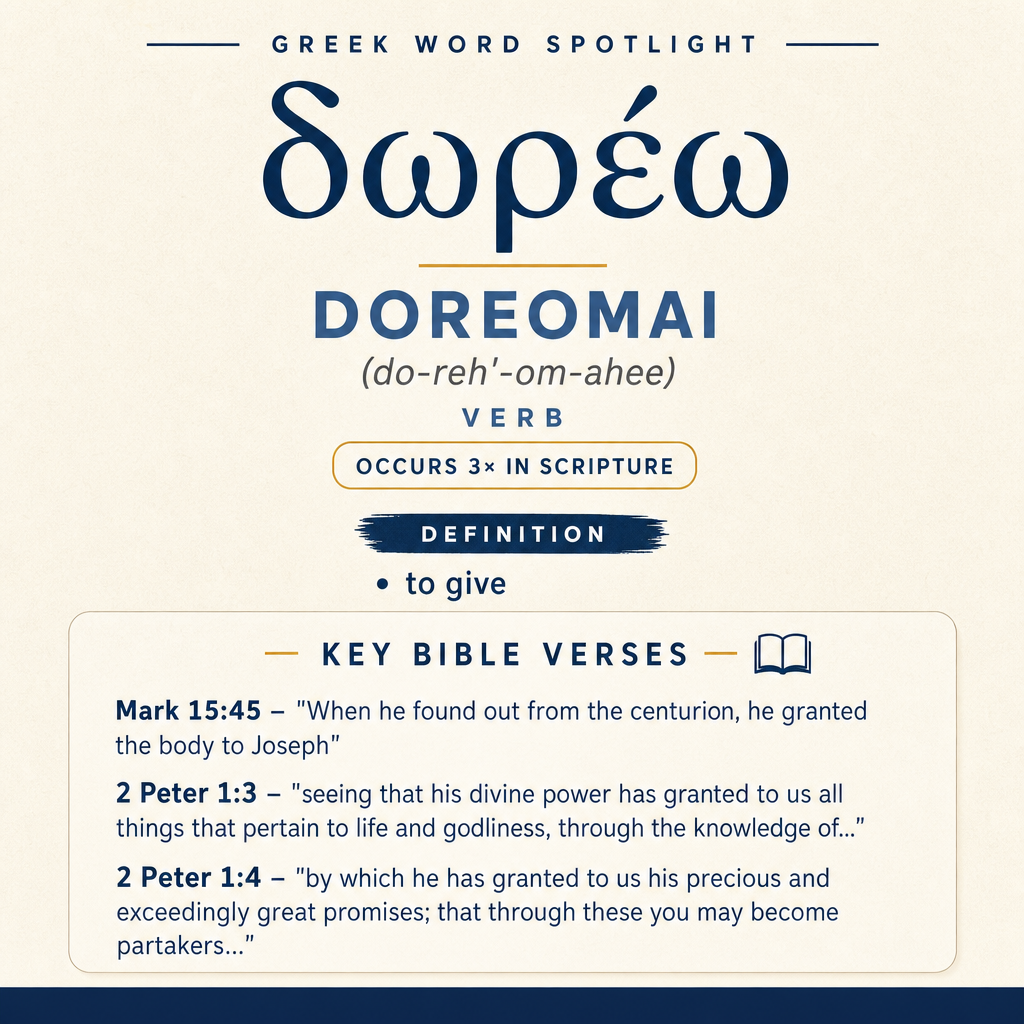
δωρέω (Doreomai) means “to give” and occurs three times: Mark 15:45; 2 Peter 1:3; 2 Peter 1:4.
Core Meaning
δωρέω means “to give.” In its recorded uses, it describes something being granted.
Learn More →Mark Context
In Mark 15:45, after confirming from the centurion, he granted the body to Joseph. The verb is used for the granting of Jesus’ body.
Learn More →Peter Context
In 2 Peter 1:3, divine power has granted all things pertaining to life and godliness. In 2 Peter 1:4, he has granted precious and exceedingly great promises.
Learn More →δωρέω means “to give.” It appears in a narrative setting involving Jesus’ body (Mark 15:45) and in two closely linked statements about what has been granted to believers (2 Peter 1:3–4).
Root and Related Words
δωρέω (Doreomai) is related to the noun doron (δῶρον), “gift” (Strong’s G1435). This relationship places the verb in the semantic orbit of something bestowed as a gift, highlighting the act of granting rather than the process of exchange.

Occurrences
“When he found out from the centurion, he granted the body to Joseph.” (Mark 15:45)
Here δωρέω describes an official act carried out after verification: “When he found out from the centurion,” the decision is made to “grant the body to Joseph.” The verb frames the transfer as a permitted bestowal from someone with authority. The centurion’s report functions as the basis for the granting, so the giving is not casual distribution but an authorized release of something under control. In the scene, the object given—“the body”—underscores that what is granted is specific, concrete, and consequential, and that the granting changes who may rightfully take possession.

“seeing that his divine power has granted to us all things that pertain to life and godliness, through the knowledge of him who called us by his own glory and virtue,” (2 Peter 1:3)
In this statement, δωρέω presents divine power as the agent that “has granted to us all things that pertain to life and godliness.” The verb is paired with an expansive object (“all things”) and a defined scope (“that pertain to life and godliness”), which gives the granting a comprehensive reach within that stated domain. The clause “through the knowledge of him who called us by his own glory and virtue” places the granting alongside relational knowing and calling: what is granted is connected to “the knowledge of him” and to the one “who called us.” The verb thus carries the force of an accomplished bestowal—something already conferred—rather than a mere offer, and it situates the recipients (“to us”) as those who benefit from a prior divine action.
“by which he has granted to us his precious and exceedingly great promises; that through these you may become partakers of the divine nature, having escaped from the corruption that is in the world by lust.” (2 Peter 1:4)
Here δωρέω again speaks of what “he has granted to us,” now specifying the gift as “his precious and exceedingly great promises.” The adjectives (“precious,” “exceedingly great”) accent the worth and magnitude of what is given, and the possessive “his” anchors the promises in the giver. The verse then unfolds the purpose and result tied to what is granted: “that through these you may become partakers of the divine nature,” and it depicts an outcome described as “having escaped from the corruption that is in the world by lust.” In this context the verb introduces the promises as the means through which the subsequent effects are expressed (“through these”), so the granting is presented not only as an act of giving but as the initiating provision that makes the described participation and escape intelligible within the verse’s own logic.
Sense and Usage
Across these three passages, δωρέω consistently expresses the act of giving as a granting—an action that places something into another’s possession or benefit. Mark 15:45 shows granting in a public, controlled setting: the body is not simply taken, but “granted,” and the surrounding wording (“found out from the centurion”) highlights that the giving follows confirmation and is executed by someone with the right to release what is being requested. The verb therefore fits a scene where permission and authority shape the transfer.
In 2 Peter 1:3–4, the same verb is used twice in quick succession to describe what has been granted “to us.” The repeated construction foregrounds the giver and the beneficiaries: divine power “has granted,” and “he has granted.” The objects of giving are described in two complementary ways—first broadly (“all things that pertain to life and godliness”), then more specifically (“his precious and exceedingly great promises”). The granting in these verses is not portrayed as a negotiated arrangement; it is depicted as an action already accomplished (“has granted”), and the emphasis falls on the sufficiency and value of what has been bestowed.
The immediate phrasing in 2 Peter also shows how the verb can carry forward an argument. In 1:3, the granting is connected with “the knowledge of him who called us,” which links the giving with relationship and calling. In 1:4, the granting introduces “promises” that function as instruments (“through these”) leading to a described participation and an escape from “corruption.” Within these two verses, δωρέω anchors a sequence: the giver grants, the recipients receive, and what is granted is portrayed as the means by which the subsequent realities are spoken of. Without adding extra senses, the usage here demonstrates that “to give” can be expressed in a way that stresses provision and benefaction—something conferred that carries intended effect.
Taken together, the occurrences show δωρέω operating naturally in both tangible and intangible domains: a physical object (“the body”) in Mark, and wide-ranging provisions and promises in 2 Peter. In each case, the verb draws attention to the giver’s initiative and capacity to bestow, and it frames the recipients as those upon whom the granting has been enacted.
Imagery in Context
Mark 15:45 supplies a stark, concrete picture of granting: an authorized release of “the body to Joseph” after confirmation from a centurion. 2 Peter 1:3–4, by contrast, uses the language of granting to portray a generous bestowal with enduring effects—“all things that pertain to life and godliness” and “precious and exceedingly great promises”—so that the act of giving is pictured as provision that supports and carries forward the life described in the text itself.
Sources: Lexical data from Strong’s Exhaustive Concordance and the Translators Brief Lexicon of Extended Strongs for Greek (STEPBible, CC BY). Occurrence data from the Translators Amalgamated Greek New Testament (STEPBible, CC BY). Scripture quotations from the World English Bible (public domain).