Exploring the Meaning of Dakno in Greek
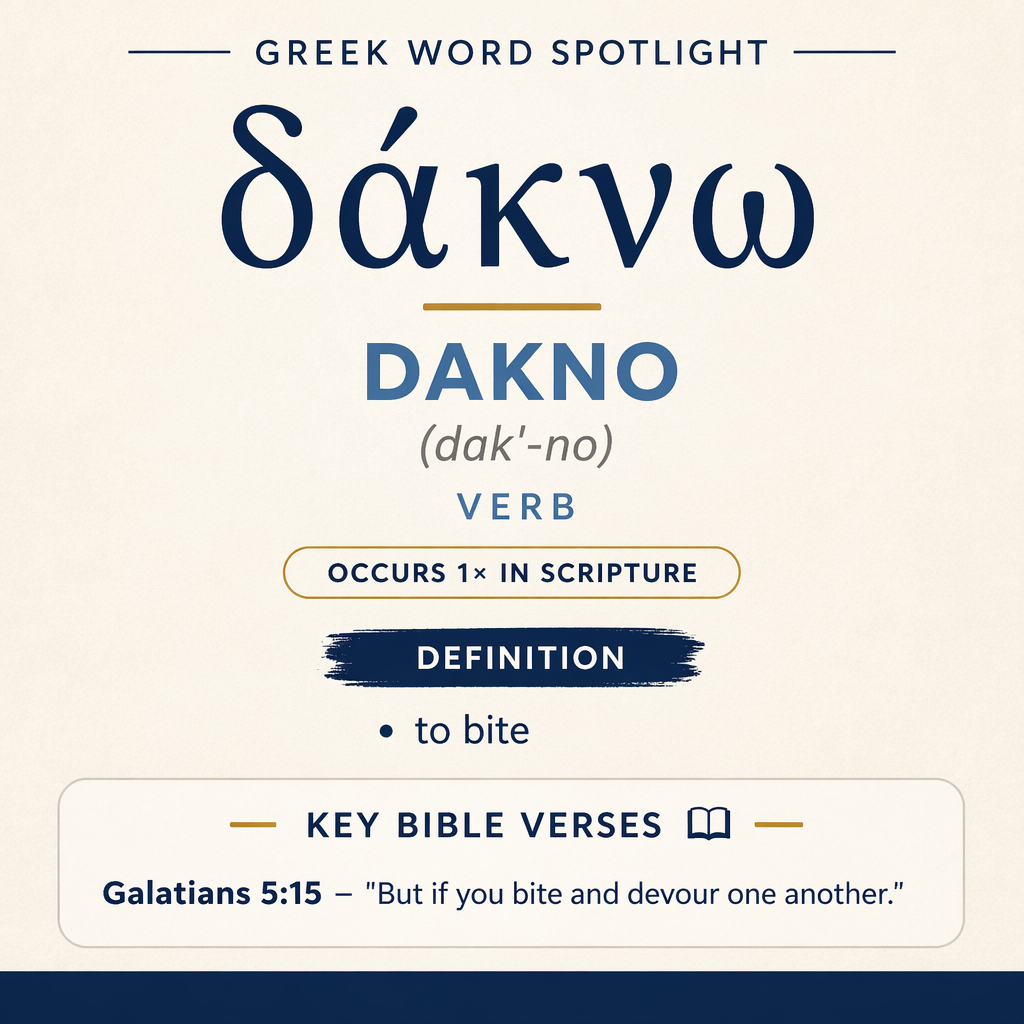
δάκνω means “to bite” and appears once in Scripture, in Galatians 5:15.
Scripture Occurrence
It occurs 1 time in Scripture. The occurrence is in Galatians 5:15.
Learn More →Verse Context
In Galatians 5:15 it appears in the warning, “if you bite and devour one another.”
Learn More →Dakno means “to bite.” It appears in a warning about destructive interpersonal behavior in Galatians 5:15, where the image of biting is paired with other consuming actions.
Occurrences
“But if you bite and devour one another, be careful that you don’t consume one another.” (Galatians 5:15)
Here dakno stands at the head of a tightly linked chain of hostile actions: “bite,” “devour,” and “consume.” Within the sentence, “bite” is not presented as an isolated incident but as the opening movement of a pattern of aggression (“bite and devour one another”) that threatens to end in mutual ruin (“be careful that you don’t consume one another”). The repeated phrase “one another” frames the action as reciprocal and community-wide: the biting is directed laterally within the group rather than outward toward an external enemy. The conditional “if” casts the biting as a recognizable behavior that may already be occurring or may arise, and the imperative warning (“be careful”) treats its consequences as real and urgent. In this setting, “bite” functions as vivid, bodily imagery for interpersonal conduct that injures and escalates; it is an action that invites retaliation and multiplies harm across relationships.

Sense and Usage
In its single New Testament appearance, dakno contributes the concrete, physical picture of biting to describe the way conflict operates among people. A bite is an act that breaks the surface and inflicts pain at close range; the verb therefore naturally evokes the immediacy and sharpness of a hostile exchange. In Galatians 5:15, the verb is coordinated with “devour” and followed by the warning against being “consume[d],” creating an intensifying sequence. Within that sequence, “bite” can be heard as the initial act of wounding—an early stage of aggression that, if unchecked, progresses toward more comprehensive harm.
The verse’s structure also shows how the action is understood socially. The object is not a singular target but “one another,” placing the biting inside the community’s own life. That reciprocal framing implies a cycle: biting provokes biting, and the group’s internal interactions become predatory. The command “be careful” marks the behavior as something that demands vigilance, suggesting that the community’s health can be undermined from within by the accumulation of such acts. The closing clause, “that you don’t consume one another,” sets a boundary around the metaphor: the concern is not merely that someone gets hurt in a moment of conflict, but that the group’s shared life is eaten away through continuing hostility.
Because dakno is used alongside stronger verbs of eating, its force here is not softened into a mild figure of speech. The phrase “bite and devour” keeps the imagery in the realm of bodily attack and appetite. The word therefore does more than label disagreement; it portrays conflict as a kind of mutual tearing that treats other members of the group as targets rather than partners. In this way, the verb’s plain meaning (“to bite”) becomes a pointed diagnosis of behavior that is injurious, escalating, and ultimately self-destructive when practiced “one another” in a closed circle.
Imagery
Galatians 5:15 uses the image of biting to make relational harm feel as concrete as physical injury. The progression from “bite” to “devour” to “consume” paints a picture of conflict that starts with sharp, localized damage and can grow into something that empties a community from the inside. The verse’s warning treats that progression as preventable only through careful attention before the first bite becomes a consuming pattern.
Sources: Lexical data from Strong’s Exhaustive Concordance and the Translators Brief Lexicon of Extended Strongs for Greek (STEPBible, CC BY). Occurrence data from the Translators Amalgamated Greek New Testament (STEPBible, CC BY). Scripture quotations from the World English Bible (public domain).