
Understanding the Biblical Meaning of Biazo in Greek
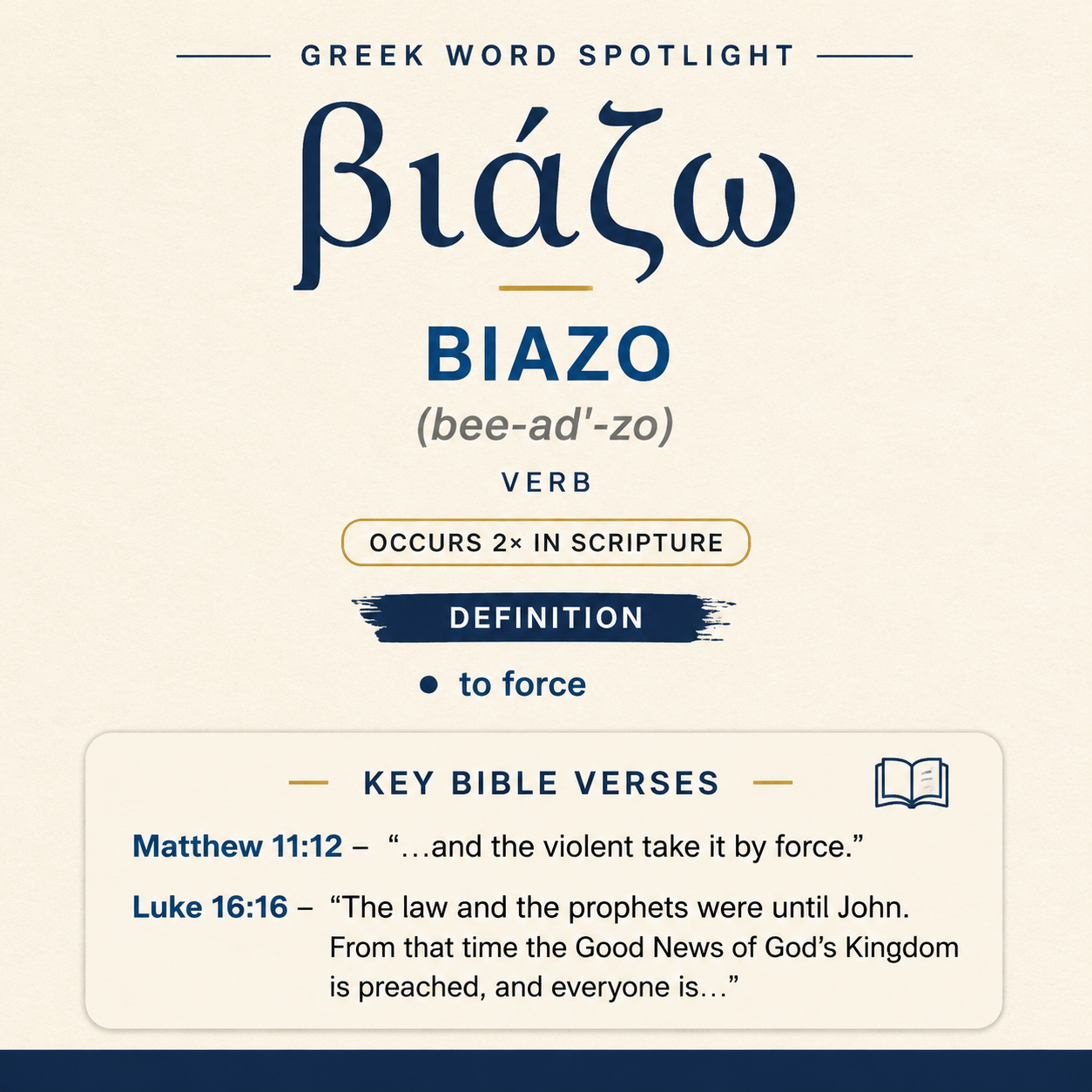
βιάζω means “to force” and occurs twice in Scripture, in Matthew 11:12 and Luke 16:16.
Luke Context
In Luke 16:16, God’s Kingdom is preached, and the verse uses βιάζω in that setting.
Learn More →βιάζω means “to force.” In the New Testament it appears in two sayings of Jesus that frame entry into the Kingdom of Heaven/Kingdom of God with the language of pressure, violence, and compelling force.
Root and Related Words
βιάζω is related to βίος (bios), “life” (Strong’s G979).

Occurrences
Matthew 11:12 — “From the days of John the Baptizer until now, the Kingdom of Heaven suffers violence, and the violent take it by force.”
Here βιάζω stands in a tightly packed description of conflict surrounding “the Kingdom of Heaven.” The time marker—“From the days of John the Baptizer until now”—sets the statement inside a particular season of intensified response to John and to the kingdom message associated with him. Within that period, the kingdom is pictured as a contested reality: it “suffers violence,” and those characterized as “the violent” are said to “take it by force.” The verb supplies the idea of compelled seizure rather than calm reception. In the sentence’s imagery, the kingdom is not described as passively arriving without resistance or as being entered without struggle; instead, it stands under violent pressure, and people described by their violence act upon it with forceful taking.
The structure also links two sides of the same scene. First, there is violence experienced by the kingdom (“suffers violence”), implying assault directed toward it. Second, there is violence enacted by certain people (“the violent take it by force”), implying aggressive action in relation to it. The word’s contribution is to depict the kingdom’s presence as provoking forceful human action—whether as hostile pressure against it, or as determined grasping at it—so that the whole saying feels like a report of a struggle rather than a quiet transition.
Luke 16:16 — “The law and the prophets were until John. From that time the Good News of God’s Kingdom is preached, and everyone is forcing his way into it.”
In Luke, βιάζω appears within a statement that contrasts two periods: “The law and the prophets were until John,” and “From that time” something new is happening—“the Good News of God’s Kingdom is preached.” Against that proclamation, Luke adds a striking description of response: “everyone is forcing his way into it.” The verb supplies the image of entry that happens by forceful pressing rather than by a gentle, unopposed opening of a door. The focus is not on violence being done to the kingdom as an object (as in Matthew’s “suffers violence”), but on people’s action toward it: a forceful pushing into the sphere of the kingdom as it is being announced.
The combination of “is preached” with “everyone is forcing his way into it” places proclamation and response side by side. The kingdom is not merely an idea being discussed; it is a reign announced as good news, drawing an urgent, forceful movement. The wording “forcing his way” also implies resistance or constraint along the path—an entrance that requires pressing through. Without specifying what the obstacles are, the saying portrays the kingdom as something people do not drift into, but something they press toward with compelling force once the message is proclaimed “from that time.”
Sense and Usage
Across these two passages, βιάζω carries the concrete sense of force applied in relation to the kingdom. The setting is not physical combat narrated in detail, but the word borrows the feel of violence and coercive strength to describe how people act when confronted with the kingdom’s announcement and presence. In Matthew the kingdom is placed in the middle of violence: it is a target that “suffers violence,” and it is an object that the violent “take…by force.” In Luke the emphasis falls on movement into the kingdom: “everyone is forcing his way into it,” describing entry as a forceful press.
These uses show how the same notion of forcing can be cast with different grammatical and imagistic angles. One angle depicts force exerted upon the kingdom (it “suffers violence”), highlighting opposition and assault language around it. Another depicts force exerted by people toward the kingdom (they “take it by force,” they are “forcing” their way in), highlighting a grasping or pressing motion. The common thread is that the kingdom is not presented as neutral territory; it is portrayed as a reality that draws out extremes of human action—pressure, violence, and compelling pursuit.
The references to John in both contexts are also part of the word’s framing. Matthew: “From the days of John the Baptizer until now.” Luke: “The law and the prophets were until John. From that time…” In both, John functions as a turning point that introduces a time when the kingdom is near and spoken of with new immediacy. βιάζω fits that turning point by portraying the era as one of intensified engagement: people are not merely listening; they are acting with force. Whether that force is oppositional (“suffers violence”) or acquisitive (“take it by force”) or pressing entry (“forcing his way into it”), the verb paints the response to the kingdom in strong, kinetic terms.
Because the two sayings do not unpack motives or moral evaluation inside the verb itself, βιάζω’s contribution remains the bare, vivid idea of forcing. Matthew’s pairing of “suffers violence” and “the violent take it by force” keeps the scene bristling with conflict. Luke’s pairing of “is preached” and “everyone is forcing his way into it” keeps the scene bristling with urgency. In both, the word pushes the reader to imagine the kingdom not as an abstract concept discussed at a distance, but as a reality encountered with pressure and force.
Imagery
The imagery attached to βιάζω in these verses is the imagery of a crowd at a boundary: a realm spoken of as “the Kingdom of Heaven” or “God’s Kingdom” that is simultaneously proclaimed and contested. Matthew pictures the kingdom under violent assault and being seized; Luke pictures people pressing in with force as the good news is announced. Together, these sayings give βιάζω a sharp, physical feel—forcing, pressing, taking—applied to the question of how the kingdom is met in the days that begin with John.
Sources: Lexical data from Strong’s Exhaustive Concordance and the Translators Brief Lexicon of Extended Strongs for Greek (STEPBible, CC BY). Occurrence data from the Translators Amalgamated Greek New Testament (STEPBible, CC BY). Scripture quotations from the World English Bible (public domain).




