
Exploring the Meaning of Achri in Greek
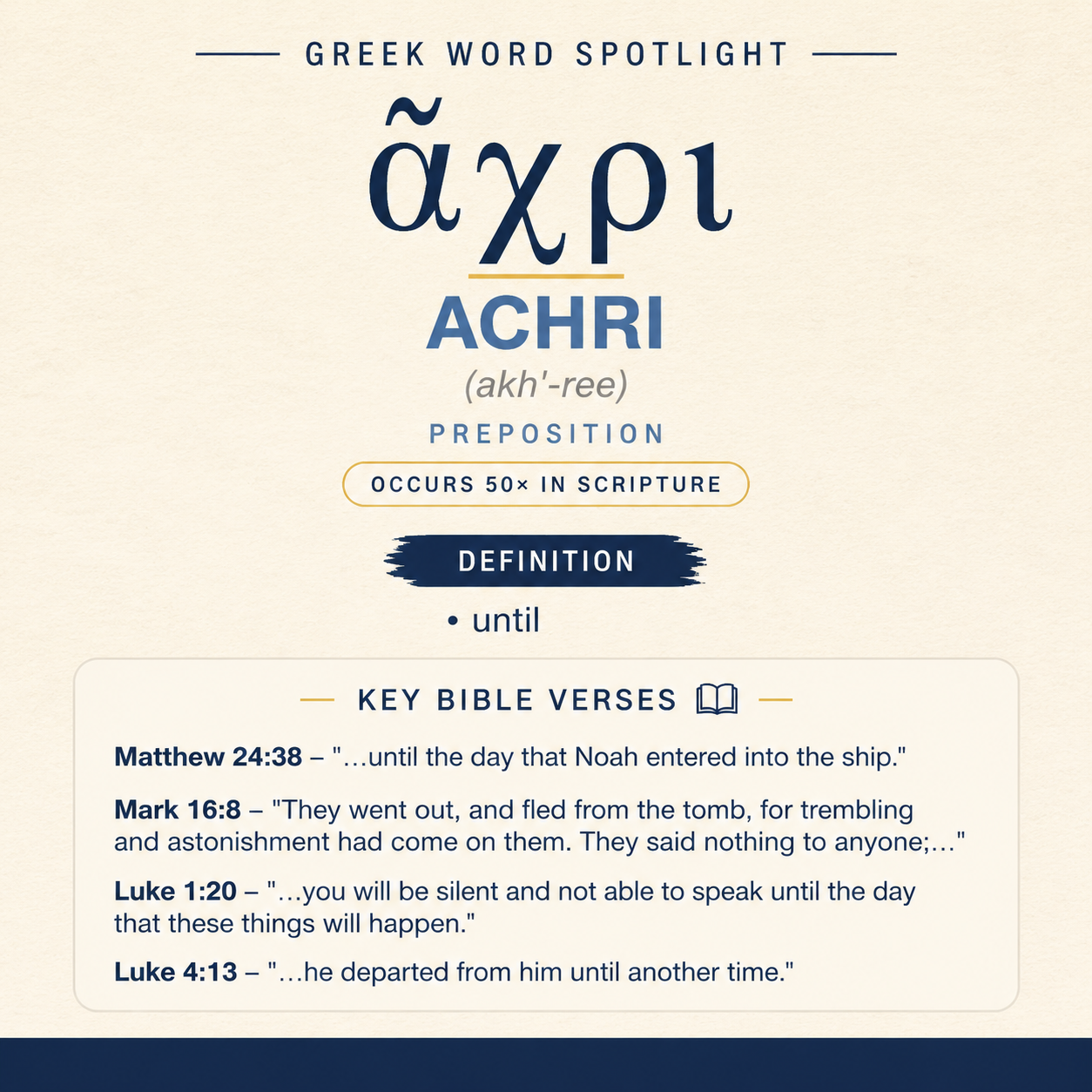
ἄχρι means “until” and occurs 50 times in Scripture, including Matthew 24:38, Mark 16:8, Luke, and Acts.
Sample Occurrences
Examples include Matthew 24:38 (“until”), Luke 1:20 (“until the day”), and Acts 1:2 (“until the day”).
Learn More →ἄχρι expresses a limit in time: it marks how long something continues, or the point at which a new stage begins. In the passages below it frames actions, restraints, temptations, judgments, and historical turns by setting an “up to that point” boundary.
Occurrences
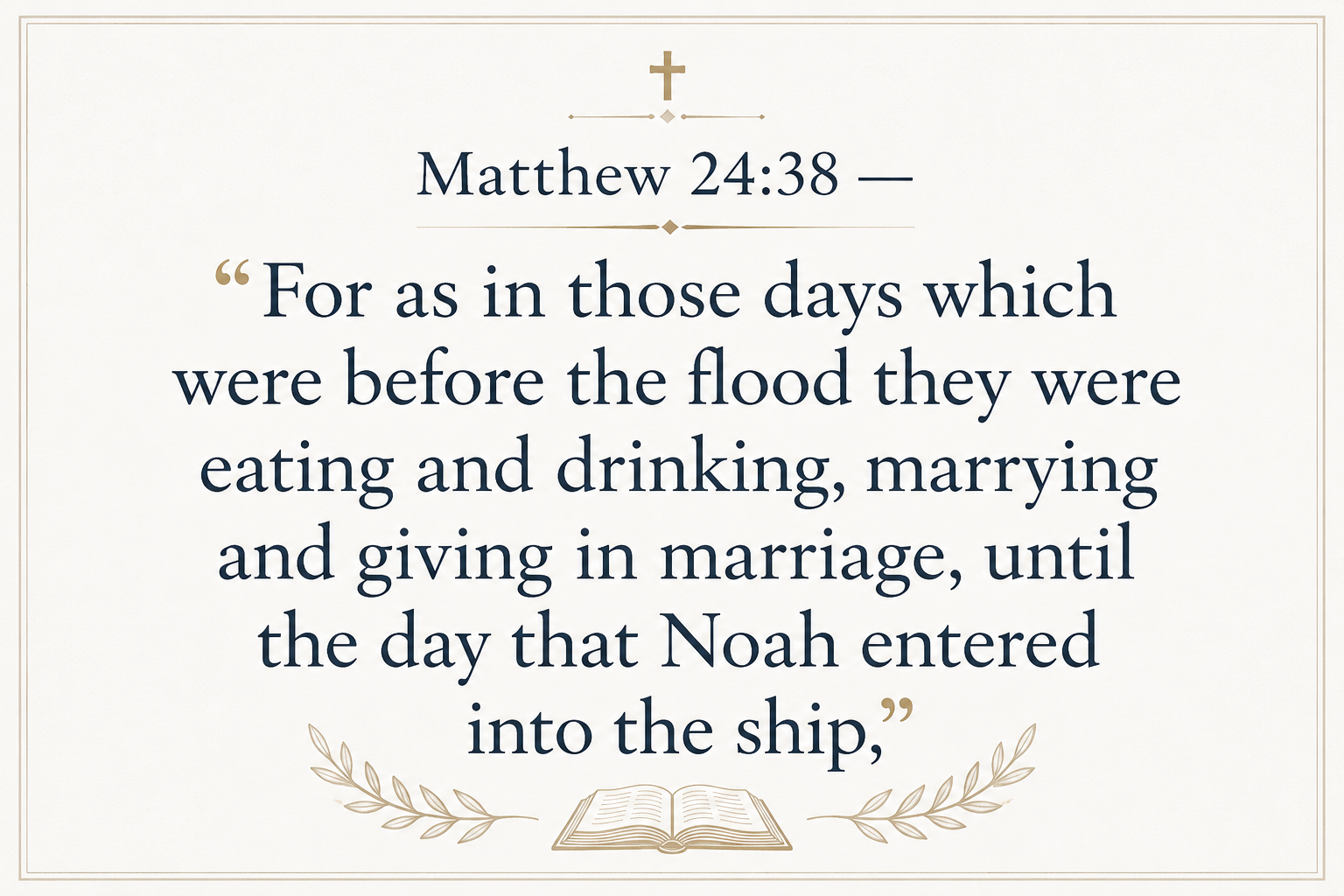
Matthew 24:38 — “For as in those days which were before the flood they were eating and drinking, marrying and giving in marriage, until the day that Noah entered into the ship,”
Here ἄχρι sets a terminal point for ordinary routines—“eating and drinking, marrying and giving in marriage.” The clause “until the day that Noah entered into the ship” draws a line across time: everything described continues right up to that day, and the entry into the ship stands as the decisive boundary after which the situation changes.
Mark 16:8 — “They went out, and fled from the tomb, for trembling and astonishment had come on them. They said nothing to anyone; for they were afraid.”
In this scene the narrative is driven by immediate reaction—flight, trembling, astonishment, and silence. Within the quoted wording, ἄχρι functions to orient the reader to the temporal edge implied by “They said nothing to anyone”; the moment is held at the boundary of speech, with fear constraining what follows from the women’s departure.
Luke 1:20 — “Behold, you will be silent and not able to speak until the day that these things will happen, because you didn’t believe my words, which will be fulfilled in their proper time.”
ἄχρι defines the duration of a restriction: silence lasts up to “the day that these things will happen.” The phrase ties the endpoint of the silence to the fulfillment of “my words,” so that the boundary is not arbitrary but coordinated with an appointed day and the arrival of predicted events.
Luke 4:13 — “When the devil had completed every temptation, he departed from him until another time.”
Here ἄχρι fixes the interval of withdrawal. The devil’s departure is real but bounded; “until another time” indicates a pause that lasts to a later point, after which the narrative expects renewed engagement. The word therefore turns “departed” into a temporary state, not a final resolution.
Luke 17:27 — “They ate, they drank, they married, and they were given in marriage until the day that Noah entered into the ship, and the flood came and destroyed them all.”
ἄχρι again places ordinary life—food, drink, marriage—against a sharply defined temporal limit: “the day that Noah entered into the ship.” The boundary created by ἄχρι heightens the contrast between ongoing normalcy and the sudden arrival of “the flood,” which follows and overwhelms what had continued up to that day.
Luke 21:24 — “They will fall by the edge of the sword, and will be led captive into all the nations. Jerusalem will be trampled down by the Gentiles, until the times of the Gentiles are fulfilled.”
In this prediction ἄχρι sets the endpoint of a prolonged condition: Jerusalem’s being “trampled down by the Gentiles.” The limit is expressed not as a date but as a completion—“until the times of the Gentiles are fulfilled”—so the boundary is tied to a larger timetable reaching its full measure.
Acts 1:2 — “until the day in which he was received up, after he had given commandment through the Holy Spirit to the apostles whom he had chosen.”
ἄχρι anchors the narrative to a culminating day: “the day in which he was received up.” The word connects what precedes—his activity of giving commands “through the Holy Spirit” to chosen apostles—to a fixed terminus, framing the period of instruction as extending up to that receiving-up.
Acts 2:29 — ““Brothers, I may tell you freely of the patriarch David, that he both died and was buried, and his tomb is with us to this day.”
Within this speech the emphasis falls on continuity from past to present: David “died and was buried,” and the proof is tangible—“his tomb is with us to this day.” In this setting ἄχρι functions to define the reach of the claim into the speaker’s present, drawing attention to the unbroken span leading up to “this day.”
Acts 3:21 — “whom heaven must receive until the times of restoration of all things, which God spoke long ago by the mouth of his holy prophets.”
ἄχρι marks how long “heaven must receive” him: the reception lasts up to “the times of restoration of all things.” The endpoint is again expressed as a divinely ordered period (“times”), and ἄχρι links that horizon with earlier divine speech “long ago” through prophets, giving the boundary a prophetic and teleological shape.
Acts 7:18 — “until there arose a different king, who didn’t know Joseph.”
Here ἄχρι introduces a historical turning point. Whatever state of affairs is in view continues up to the moment when “a different king” arises; that new ruler, characterized by not knowing Joseph, marks the boundary at which previous conditions no longer hold and a new phase begins.
Acts 11:5 — ““I was in the city of Joppa praying, and in a trance I saw a vision: a certain container descending, like it was a great sheet let down from heaven by four corners. It came as far as me.”
In the vision report, the motion of the descending object is traced to a limit: “It came as far as me.” ἄχρι here sets the spatial reach as a boundary described in personal terms—the object’s descent extends up to the narrator’s location, emphasizing closeness and immediacy in what is shown.
Acts 13:6 — “When they had gone through the island to Paphos, they found a certain sorcerer, a false prophet, a Jew, whose name was Bar Jesus,”
In this travel notice ἄχρι defines the extent of a journey: “gone through the island to Paphos.” The word establishes Paphos as the destination boundary of the movement, and reaching that limit provides the setting for the encounter with “a certain sorcerer” and “false prophet.”

Sense and Usage
Across these passages ἄχρι functions as a boundary-marker that organizes time (and, in one case, space) into a “before” that runs up to a limit and an “after” that begins at that limit. In narrative settings it frequently makes an ordinary or ongoing activity significant by placing it against an approaching edge: people keep eating, drinking, and arranging marriages up to a specific day (Matthew 24:38; Luke 17:27), and the stark change that follows is understood precisely because ἄχρι has already drawn the line.
In predictive or programmatic statements, ἄχρι often anchors an extended condition to an endpoint that is itself described as a “time” or “times” reaching fulfillment (Luke 21:24; Acts 3:21). The boundary is not merely a stopping point but a completion point—an interval lasts until a larger period is “fulfilled” or until restorative “times” arrive. This use gives duration a shape: it is measured toward an appointed terminus rather than left indefinite.
In personal experience and direct speech, ἄχρι defines the limits of constraint or withdrawal. Zechariah’s inability to speak lasts to a specified day when foretold events occur (Luke 1:20), and the devil’s departure is limited to “another time” (Luke 4:13), emphasizing that the present condition—silence, absence—has an expiration. Similarly, in Acts 1:2 the period of commands given to the apostles is framed as extending to the day of being “received up,” making the endpoint a hinge that closes one stretch of activity and sets up what follows.
Finally, ἄχρι can mark the reach of movement or presence. In Acts 11:5, it traces the descent of the visionary object to the narrator’s vicinity (“as far as me”), and in Acts 13:6 it marks travel “to Paphos,” identifying a destination as the boundary of the journey’s progress. Whether temporal or spatial, ἄχρι’s contribution is to make limits explicit, so that events are understood with clear edges and transitions.
Imagery
The imagery carried by ἄχρι in these texts is often that of a threshold: a day when Noah enters the ship, a moment when a different king arises, a period when trampling continues until times are fulfilled, and a point in a vision when the descending sheet comes as far as the observer. The word repeatedly places readers at the edge of a change, where what has been continuing is poised to meet its boundary.
Sources: Lexical data from Strong’s Exhaustive Concordance and the Translators Brief Lexicon of Extended Strongs for Greek (STEPBible, CC BY). Occurrence data from the Translators Amalgamated Greek New Testament (STEPBible, CC BY). Scripture quotations from the World English Bible (public domain).





