
Exploring the Meaning of Achreios in Greek
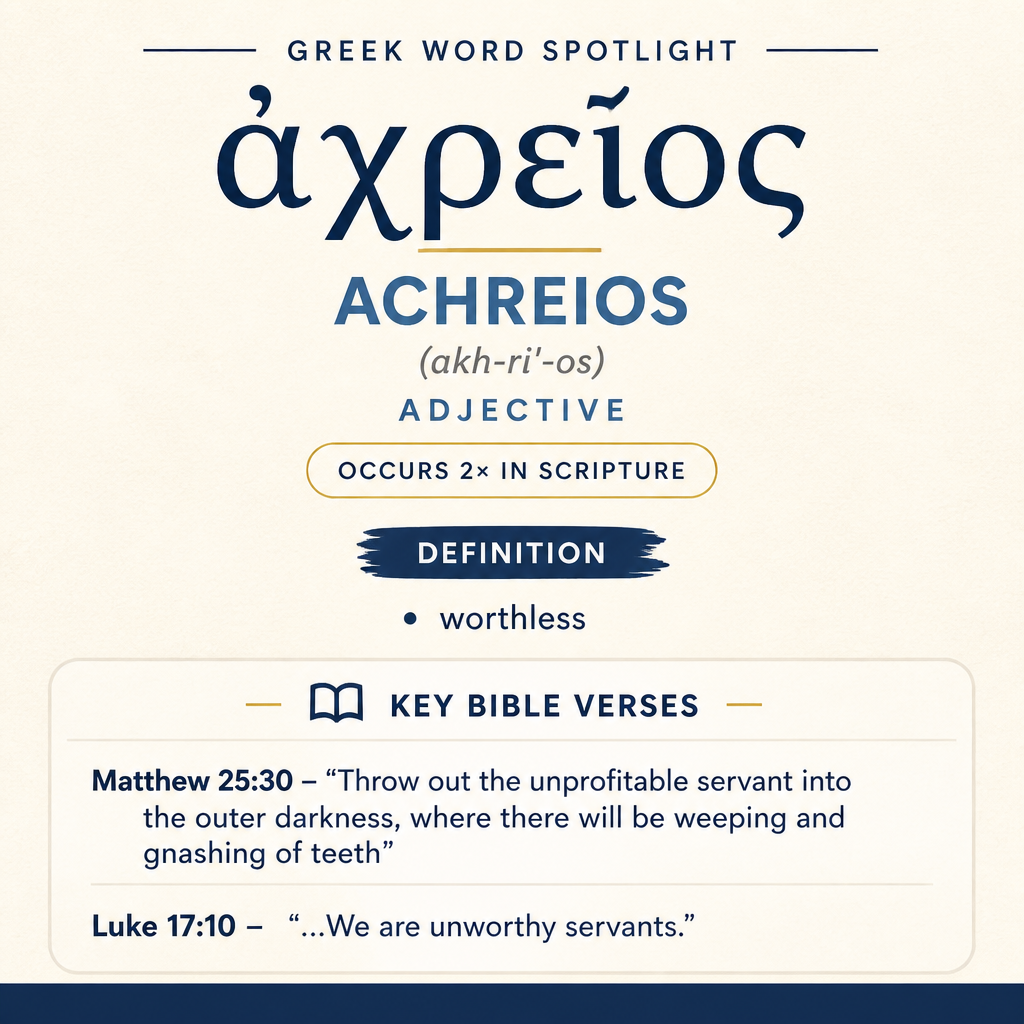
ἀχρεῖος means “worthless” and appears in Matthew 25:30 and Luke 17:10.
Verse Contexts
In Matthew 25:30 it describes an “unprofitable servant” cast into outer darkness. In Luke 17:10 servants call themselves “unworthy” after doing commanded duties.
Learn More →ἀχρεῖος means “worthless.” It appears in Jesus’ teaching in Matthew 25:30 and Luke 17:10, where it characterizes a “servant” in two different settings and serves two different rhetorical aims.
Root and Related Words
Strong’s connects ἀχρεῖος (Achreios) with χρεία (chreia), “need” (Strong’s G5532), and χρή (chre), “to ought/need” (Strong’s G5534), and also lists α (Alpha) (Strong’s G1) in the derivation line.

Occurrences
“Throw out the unprofitable servant into the outer darkness, where there will be weeping and gnashing of teeth.’” (Matthew 25:30)
Here ἀχρεῖος qualifies a “servant” whom the speaker orders to be “throw[n] out.” The adjective functions as the stated characterization that fits the judicial-sounding command: the servant is labeled “unprofitable,” and the sentence matches the severity of that evaluation—expulsion “into the outer darkness,” followed by the grim description “weeping and gnashing of teeth.” Within the line itself, the word helps the reader understand why this servant is treated as someone to be removed rather than retained in the household: the servant is described as having no worth in the master’s economy, and so is cast outside. The setting is not merely a private rebuke; it is depicted as a finalizing decision with a clear destination (“outer darkness”) and an accompanying outcome (“weeping and gnashing of teeth”). In this scene, ἀχρεῖος belongs to the vocabulary of assessment and consequence.
“Even so you also, when you have done all the things that are commanded you, say, ‘We are unworthy servants. We have done our duty.’ ” (Luke 17:10)
In Luke 17:10, ἀχρεῖος appears in the mouth of servants speaking about themselves: “We are unworthy servants.” The frame is strikingly different from Matthew 25:30. The servants are not being sentenced or expelled; instead, they are told what to say “when you have done all the things that are commanded you.” The word therefore shapes a posture of speech after full obedience: even after completing “all the things that are commanded,” the servants do not claim special standing. The sentence that follows—“We have done our duty”—anchors the adjective in the ordinary logic of service: the servants have met the obligations given to them, and their self-description resists turning duty into a basis for demanding praise or repayment. In this setting, ἀχρεῖος works as a corrective to self-congratulation; it frames obedience as the expected work of a servant rather than as an achievement that elevates the servant’s worth in a social exchange.
Sense and Usage
Across these two sayings, “worthless” is applied to “servant(s),” but the pragmatic force differs because the speakers and narrative situations differ. In Matthew 25:30, the label operates as a verdict pronounced about a servant and paired with exclusion and suffering imagery. The adjective is part of an evaluative declaration that justifies action against the servant (“Throw out…”). The worthlessness is not presented as a private feeling or a passing insult; it is presented as a settled classification with consequences described in stark sensory terms (“outer darkness,” “weeping,” “gnashing of teeth”). The word thus functions there as the hinge between identity (“the unprofitable servant”) and fate (being thrown out).
In Luke 17:10, by contrast, the adjective is used as a disciplined self-assessment within a community of obedience: “you also…say.” The servants’ statement does not negate that they have done what was required; it sits alongside the claim, “We have done our duty.” The point is not that duty was undone, but that duty fulfilled does not create a claim of increased worth. The adjective therefore helps maintain the boundary between commanded service and entitlement. Its placement after “when you have done all…” sharpens that boundary: even maximal compliance with commands does not produce a new status that demands acknowledgment as though the servant has become inherently worthy. The same word that can function as condemnation in one saying can function as humility-producing speech in another, because the surrounding discourse assigns it a different role—verdict versus posture.
Read together, the occurrences show that ἀχρεῖος can be deployed both externally (a master’s assessment of a servant) and internally (a servant’s assessment of self) without changing the basic evaluative direction of the term. In both cases, it sits within a master–servant framework and concerns what can be claimed on the basis of service. Matthew 25:30 ties worthlessness to being rejected from the master’s sphere; Luke 17:10 ties worthlessness to refusing to treat obedience as leverage for honor. The servant language in both passages keeps the adjective grounded in relational and functional categories rather than abstract theorizing: worth is being spoken about in relation to one’s role as “servant” and the expectations attached to that role (“commanded,” “duty”).
Imagery
Matthew 25:30 attaches ἀχρεῖος to vivid spatial and emotional imagery: a servant is “throw[n] out” into “the outer darkness,” and the result is “weeping and gnashing of teeth.” The word is thus colored by the picture of removal from light and from the master’s presence. Luke 17:10 offers a quieter image: servants who have completed their assigned work still speak as servants—“We have done our duty”—and the adjective marks the restraint of their claim. Together these passages let the word carry both the darkness of exclusion and the plain, unsentimental voice of completed obligation.
Sources: Lexical data from Strong’s Exhaustive Concordance and the Translators Brief Lexicon of Extended Strongs for Greek (STEPBible, CC BY). Occurrence data from the Translators Amalgamated Greek New Testament (STEPBible, CC BY). Scripture quotations from the World English Bible (public domain).





