
Exploring the Meaning of Asphalizo in Greek
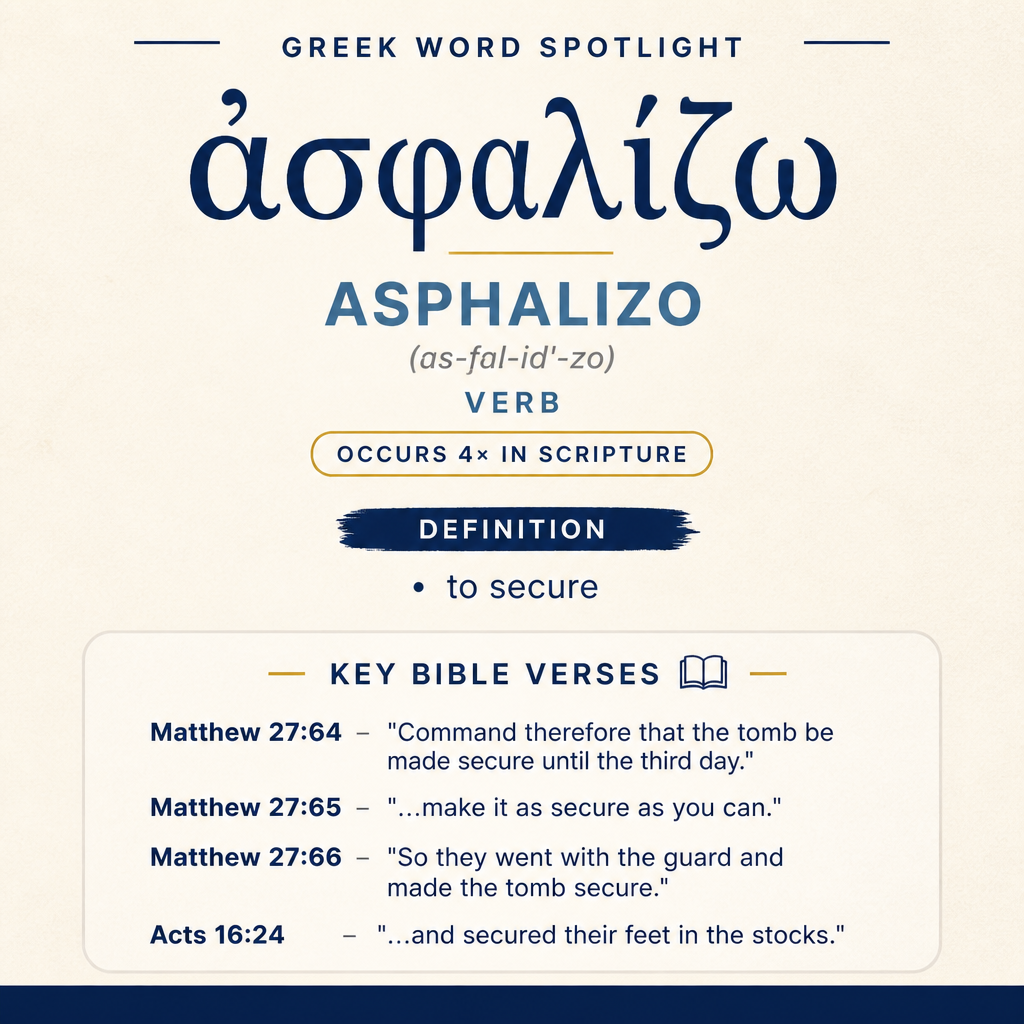
ἀσφαλίζω means “to secure” and occurs four times in Scripture: Matthew 27:64–66 and Acts 16:24.
Core Meaning
ἀσφαλίζω means “to secure.” It describes making something safe or firmly restrained.
Learn More →Tomb Secured
In Matthew 27:64–66, the word is used for making Jesus’ tomb secure until the third day. The tomb is made secure with a guard and by sealing the stone.
Learn More →Prison Secured
In Acts 16:24, it describes securing Paul and Silas’ feet in the stocks. This action takes place in the inner prison.
Learn More →ἀσφαλίζω means “to secure.” It appears in the burial-and-guarding of Jesus’ tomb in Matthew 27 and in the confinement of prisoners in Acts 16.
Root and Related Words
ἀσφαλίζω derives from the adjective asphalēs (ἀσφαλής), “secure” (Strong’s G804).

Occurrences
“Command therefore that the tomb be made secure until the third day, lest perhaps his disciples come at night and steal him away, and tell the people, ‘He is risen from the dead;’ and the last deception will be worse than the first.” (Matthew 27:64)
Here the verb is requested as a preventative measure: the speakers want the tomb to be “made secure” for a defined period (“until the third day”). The securing is not presented as an end in itself but as a means to block a feared chain of events: disciples might “come at night and steal him away,” then spread a report of resurrection. In this scene, “to secure” is tied to controlling access to a physical location (the tomb) in order to control what can be done with the body and, as a result, what can be said to “the people.” The stated motive shows how securing can be driven by concern over competing claims and public perception; the tomb becomes a contested point where actions could generate “deception,” so securing it is framed as managing that risk.
“Pilate said to them, “You have a guard. Go, make it as secure as you can.” (Matthew 27:65)
Pilate’s response turns the request into an authorized task with resources attached: “You have a guard.” The securing is now explicitly linked to personnel, suggesting that “to secure” can involve active watch and enforcement rather than merely passive barriers. The instruction “make it as secure as you can” highlights degree and effort: security is something that can be increased, pursued to a limit, and measured by capability (“as you can”). The verb thus carries the practical sense of arranging circumstances so that interference becomes difficult—an imperative that places responsibility on the hearers to do the securing with the means available.
“So they went with the guard and made the tomb secure, sealing the stone.” (Matthew 27:66)
This verse narrates the execution of the command: “they went with the guard” and “made the tomb secure.” The securing is concretely expressed by an accompanying action, “sealing the stone.” The seal is not described in detail, but in the sentence it functions as the visible, physical step that marks the tomb as secured—an additional layer placed upon the stone that closes the tomb. The scene shows securing as coordinated activity: a group acts “with the guard,” and the result is a tomb that has been put under controlled closure. The verb therefore fits an outcome-oriented action: the tomb moves from being merely closed to being secured, with the seal serving as the enacted means by which that outcome is achieved.
“who, having received such a command, threw them into the inner prison, and secured their feet in the stocks.” (Acts 16:24)
In Acts, ἀσφαλίζω is applied not to a place but to people’s bodies: the jailer “secured their feet in the stocks.” The securing follows a chain of tightening confinement—first “threw them into the inner prison,” then secured their feet—so the verb stands for a further step that limits movement. It is done “having received such a command,” so securing here is an act of obedience within a custodial setting: the jailer carries out an order by making escape or mobility harder. The object of the securing (“their feet”) and the instrument (“the stocks”) locate the verb in a tangible restraint; the action is not abstract, but a concrete fastening that fixes prisoners in a controlled posture within the prison.
Sense and Usage
Across these passages, “to secure” consistently involves imposing control over a vulnerable point—whether an entrance that might be accessed or a prisoner who might move. In Matthew, the focus is the tomb as a site that could be tampered with; the language of fear (“lest perhaps… steal him away”) frames security as preemptive, designed to prevent an undesired act and its consequences. The securing is pursued with available means: a guard is assigned, and the stone is sealed. The verb thus fits a scenario where authorities attempt to make a location resistant to interference through both oversight (the guard) and a physical measure (the seal on the stone).
In Acts, the same verb describes the intensification of custody. “Inner prison” already communicates depth of confinement, but securing the feet in stocks adds a targeted immobilization. The narrative sequence shows how securing can be layered: being placed in a restrictive environment is one level, and being fastened in a device is another. In both settings, ἀσφαλίζω is practical and action-driven: it marks the step where those in charge take deliberate measures to ensure that what they wish to keep contained—an entryway or a detainee—remains contained.
The four occurrences also show that “secure” can be applied to different objects with the same core idea. A tomb is “made secure” in the sense that access is controlled; feet are “secured” in the sense that movement is controlled. The verb therefore serves to describe measures that make a situation harder to alter by outsiders (Matthew) or by the restrained persons themselves (Acts). In both, the securing action is performed under authority: in Matthew by command and with official support, and in Acts by a jailer acting on instructions. This authority context helps explain why securing is described as something that can be ordered, carried out, and completed with observable means.
Imagery in Context
The Matthew passages attach ἀσφαλίζω to the imagery of a closed tomb guarded and sealed: security is pictured as a stone made firm against opening, backed by watchful force. Acts presents a darker, interior image: the inner prison and the stocks, where security is felt as the fixing of feet and the narrowing of possible movement. Together these texts portray securing as the tightening of boundaries—at a doorway of stone and at the body itself—through concrete acts meant to hold something in place.
Sources: Lexical data from Strong’s Exhaustive Concordance and the Translators Brief Lexicon of Extended Strongs for Greek (STEPBible, CC BY). Occurrence data from the Translators Amalgamated Greek New Testament (STEPBible, CC BY). Scripture quotations from the World English Bible (public domain).





