Exploring the Meaning of Asphaleia in Greek
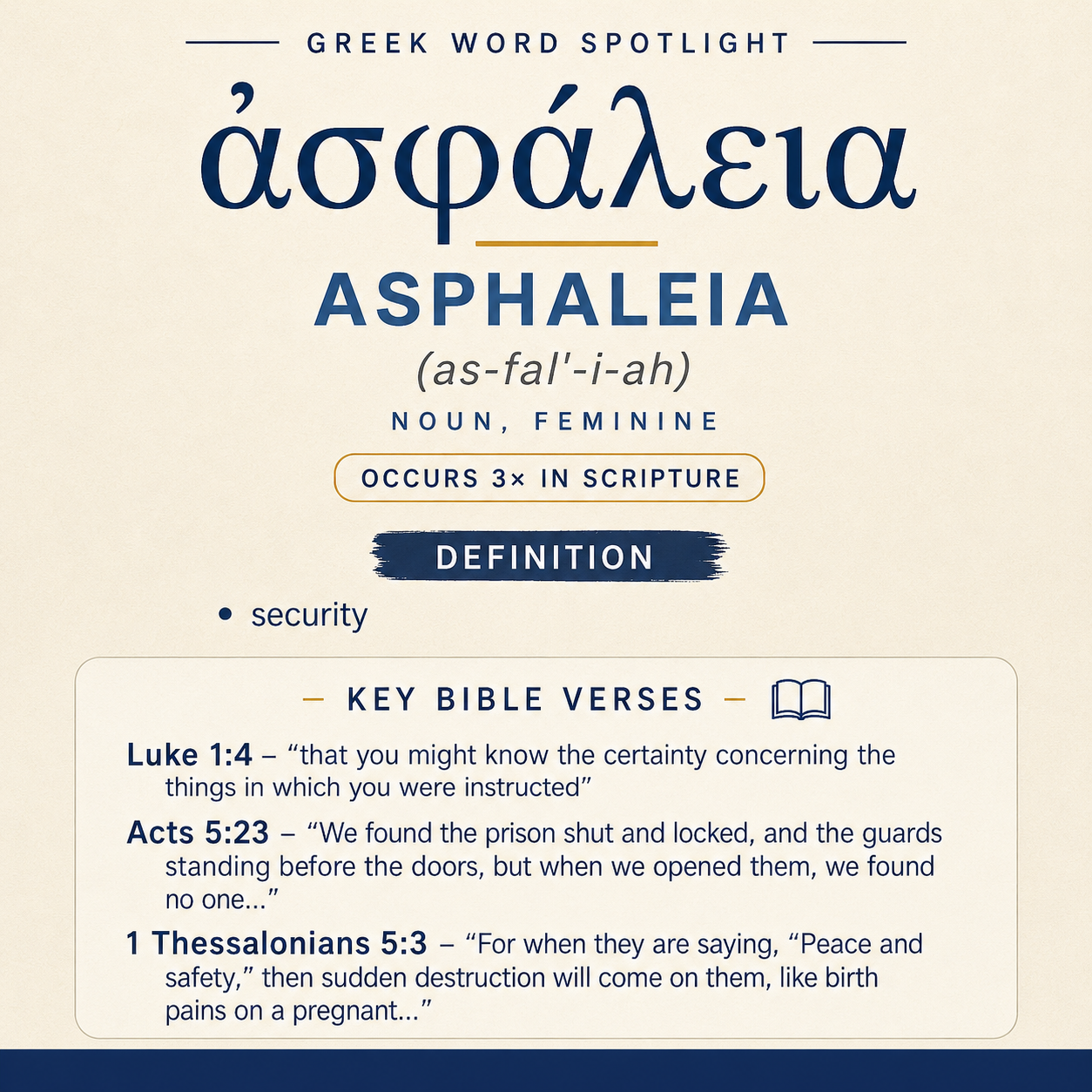
ἀσφάλεια means “security” and appears three times in Scripture: Luke 1:4, Acts 5:23, and 1 Thessalonians 5:3.
Core Meaning
ἀσφάλεια is defined as “security.” In Luke 1:4 it is rendered as “certainty” regarding instruction received.
Learn More →Acts Context
In Acts 5:23, it describes the prison found shut, locked, and guarded at the doors. Yet when opened, no one was found inside.
Learn More →Warning Usage
In 1 Thessalonians 5:3, the word appears in the claim “Peace and safety.” The verse warns that sudden destruction will come like birth pains.
Learn More →ἀσφάλεια expresses the idea of security, appearing in contexts that range from instructed confidence to physical confinement and to a public slogan of stability. Its three New Testament uses place it in settings where what is taken as secure is either established, tested, or exposed.
Root and Related Words
ἀσφάλεια is related to the adjective asphales (ἀσφαλής), “secure” (Strong’s G804).
Occurrences
“that you might know the certainty concerning the things in which you were instructed.” (Luke 1:4)
Here ἀσφάλεια characterizes what the recipient is meant to possess regarding prior instruction: a settled security of understanding. The line frames a purpose (“that you might know…”) and places security in the realm of what has been taught—“the things in which you were instructed.” In this scene, security is not pictured as a physical condition but as a stable grasp of the matters conveyed. The wording pushes the reader toward a state in which instruction is no longer tentative or merely heard, but held with firmness, so that what is known is secure rather than precarious.
“We found the prison shut and locked, and the guards standing before the doors, but when we opened them, we found no one inside!” (Acts 5:23)
In this report, ἀσφάλεια stands behind the description of a setting designed to be secure: a “prison shut and locked,” with “guards standing before the doors.” The statement highlights multiple layers that normally produce security—closed doors, locks, and posted guards—so that the audience feels the strength of the containment. The surprise comes in the contrast introduced by “but”: despite everything that should guarantee security, “when we opened them, we found no one inside!” The word’s contribution in this scene is to sharpen the irony of an environment that appears fully secured, yet proves unable to hold the intended occupants. Security is presented as something observable and verifiable by human measures (locks, guards, doors), and then overturned by the unexpected emptiness within.
“For when they are saying, “Peace and safety,” then sudden destruction will come on them, like birth pains on a pregnant woman. Then they will in no way escape.” (1 Thessalonians 5:3)
In this warning, ἀσφάλεια belongs to a spoken assurance—“Peace and safety”—and functions as the second part of a confident claim about the state of affairs. The verse does not merely mention security as a desirable condition; it depicts people actively declaring it (“when they are saying…”). That verbalized security is immediately countered by the arrival of “sudden destruction,” compared to “birth pains on a pregnant woman.” The comparison underscores the abruptness and inevitability of what follows the confident slogan. The closing line, “Then they will in no way escape,” places security and escape side by side: what is proclaimed as safety is shown to be incapable of preventing what comes. In this scene, security is exposed as a brittle human conclusion—something people can announce—set against an outcome that renders that announcement empty.
Sense and Usage
Across these passages, ἀσφάλεια operates as a term for security that can attach to different domains: understanding, institutions, and public expectation. In Luke 1:4, it describes a security of knowledge connected to instruction; the concern is that what has been taught should be held with confidence rather than uncertainty. In Acts 5:23, it is the assumed security of a controlled space—security constructed by barriers and personnel—presented through concrete details that would normally certify confinement. In 1 Thessalonians 5:3, it is the security people claim for their situation, paired with “Peace,” and shown to be a fragile assessment when confronted with sudden catastrophe.
These uses share a common thread: ἀσφάλεια is recognizable as a condition people want and expect, but its reliability is tested by context. The word can mark what is intended to be firm (instruction meant to yield certainty; a prison meant to hold; social confidence meant to reassure), yet the passages differ in whether that security stands or collapses. Luke presents security as the desired outcome of careful communication—security that rests in what is known. Acts places security in the visible apparatus of restraint and then shows that the appearance of being secured does not guarantee the result. Thessalonians places security in a confident slogan and portrays it as the calm before an unavoidable crisis. Together, these scenes keep the reader alert to the difference between security as a stable possession and security as a claim or construction that may fail under pressure.
Imagery
The imagery surrounding ἀσφάλεια moves from the quiet interior stability of “certainty” to the hard, external signs of being “shut and locked,” and then to the public sound of voices saying “Peace and safety.” In Acts 5:23, security is almost tactile: doors, locks, guards, and an interior space meant to be controlled. In 1 Thessalonians 5:3, security is heard as a declaration, and its collapse is pictured through the sudden onset of “birth pains,” ending with the stark finality, “Then they will in no way escape.”
Sources: Lexical data from Strong’s Exhaustive Concordance and the Translators Brief Lexicon of Extended Strongs for Greek (STEPBible, CC BY). Occurrence data from the Translators Amalgamated Greek New Testament (STEPBible, CC BY). Scripture quotations from the World English Bible (public domain).