
Exploring the Significance of Aspasmos in Greek
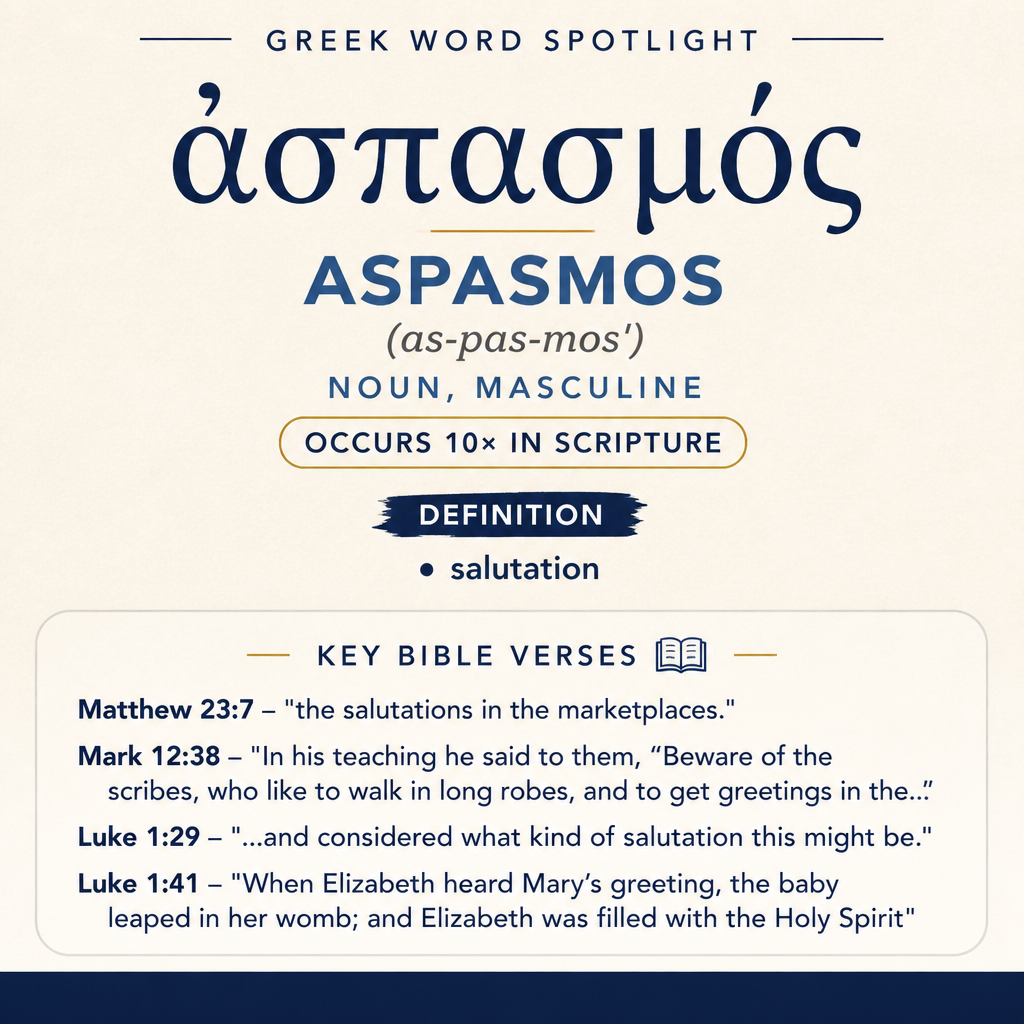
ἀσπασμός means “salutation” and appears 10 times in Scripture, including in the Gospels and 1 Corinthians.
Core Meaning
ἀσπασμός is defined as “salutation.” It refers to a greeting addressed to someone.
Learn More →Gospel Occurrences
It appears in scenes of public greetings in marketplaces (Matthew 23:7; Mark 12:38; Luke 11:43; Luke 20:46). It also describes Mary’s greeting (Luke 1:29, 41, 44).
Learn More →Pauline Example
In 1 Corinthians 16:21, Paul writes, “This greeting is by me, Paul, with my own hand.” This occurrence uses ἀσπασμός for a written greeting.
Learn More →ἀσπασμός denotes a salutation, the spoken or written act of greeting. It appears in Gospel scenes where public greetings are sought as marks of honor, and in letters where the writer points to a greeting written in his own hand.
Occurrences
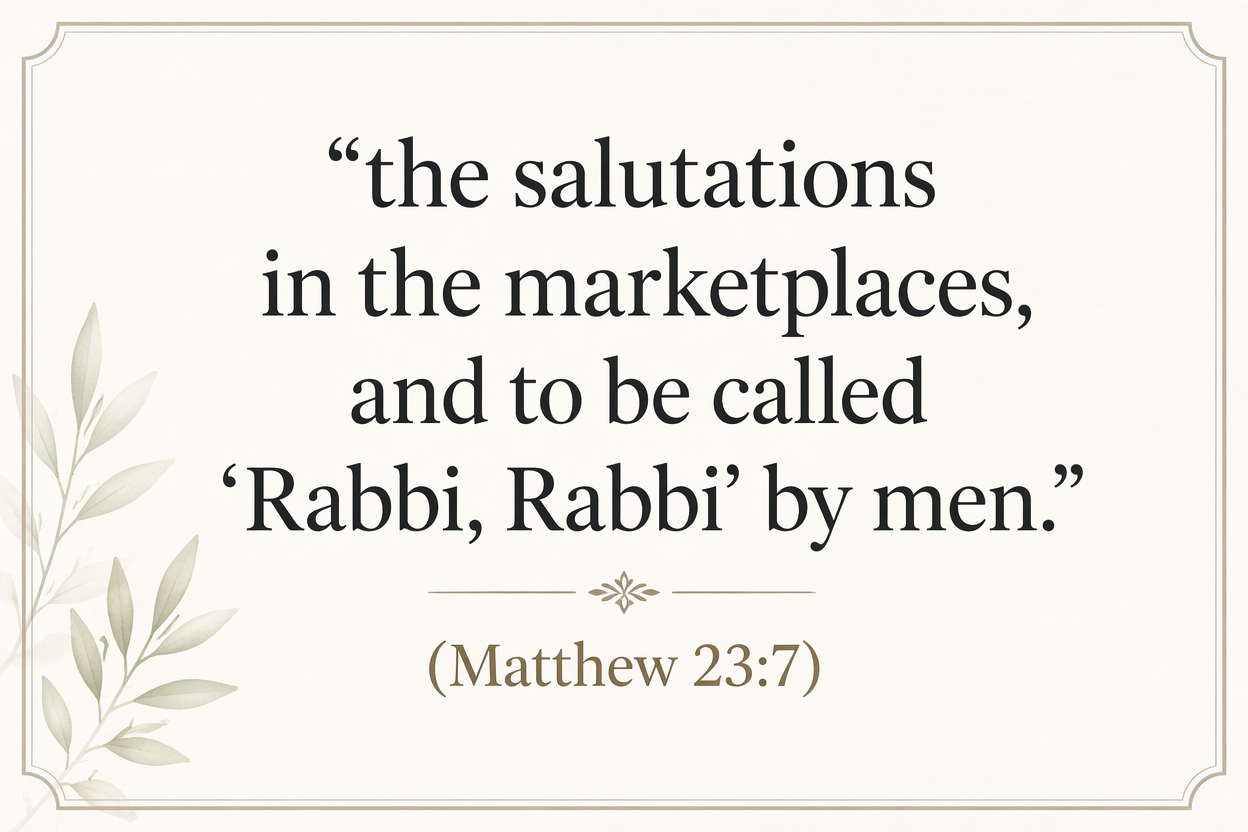
“the salutations in the marketplaces, and to be called ‘Rabbi, Rabbi’ by men.” (Matthew 23:7)
Here ἀσπασμός stands for the public salutation given “in the marketplaces.” In the same breath the verse links these salutations with being addressed by an honorific title, so the greeting functions as a social signal of status: it is not merely contact between people but a public performance of recognition.
“In his teaching he said to them, “Beware of the scribes, who like to walk in long robes, and to get greetings in the marketplaces,” (Mark 12:38)
In Mark the word is framed by the warning “Beware,” and it is embedded in a list of what the scribes “like” to do. The salutation is something they “get” in a public place; it becomes a sought-after response from others, part of the image of a carefully maintained public reputation.
“But when she saw him, she was greatly troubled at the saying, and considered what kind of salutation this might be.” (Luke 1:29)
Luke places ἀσπασμός inside a private encounter that produces inner reaction rather than public recognition. Mary is “greatly troubled” and reflects on “what kind of salutation this might be,” so the greeting is presented as meaningful speech whose character must be weighed—its “kind” matters, not just the fact that it is a greeting.
“When Elizabeth heard Mary’s greeting, the baby leaped in her womb; and Elizabeth was filled with the Holy Spirit.” (Luke 1:41)
In this scene the salutation is something Elizabeth “heard,” and it triggers bodily and spiritual response: the baby “leaped,” and Elizabeth “was filled with the Holy Spirit.” The greeting is thus portrayed as an utterance with immediate effect in the moment of arrival and recognition between the two women.
“For behold, when the voice of your greeting came into my ears, the baby leaped in my womb for joy!” (Luke 1:44)
Elizabeth repeats and sharpens the description by focusing on “the voice of your greeting.” ἀσπασμός is not abstract politeness here; it is a voiced salutation that “came into my ears,” tied to the physicality of sound and the concrete reaction “for joy.”
“Woe to you Pharisees! For you love the best seats in the synagogues, and the greetings in the marketplaces.” (Luke 11:43)
Again ἀσπασμός is paired with honor, set beside “the best seats in the synagogues.” The verse makes the salutations an object of love—desired not for relationship but for what they represent when received publicly “in the marketplaces.”
““Beware of those scribes who like to walk in long robes, and love greetings in the marketplaces, the best seats in the synagogues, and the best places at feasts;” (Luke 20:46)
Luke reiterates the same social setting and adds further markers of prestige: “the best places at feasts.” ἀσπασμός belongs to this cluster of sought-after distinctions. The greeting is something “loved,” indicating that the salutation can function as a token of rank when exchanged in public view.
“This greeting is by me, Paul, with my own hand.” (1 Corinthians 16:21)
In the letter closing, ἀσπασμός refers to a greeting that Paul marks out as written “with my own hand.” The salutation becomes a personal touch at the end of a communication, distinguishing the author’s direct participation from whatever else has been conveyed in the letter.
“The salutation of me, Paul, with my own hand: remember my bonds. Grace be with you. Amen.” (Colossians 4:18)
Here the greeting is again specified as Paul’s own handwriting, and it sits alongside two brief, weighty lines: “remember my bonds” and “Grace be with you.” The salutation frames a personal presence in the letter’s final lines, where the writer’s identity and situation are brought close to the recipients.
“The greeting of me, Paul, with my own hand, which is the sign in every letter: this is how I write.” (2 Thessalonians 3:17)
This occurrence explicitly connects ἀσπασμός with authentication: it is “the sign in every letter.” The greeting is not only cordial closure; it functions as a recognizable mark of authorship—“this is how I write”—anchoring the letter to the writer through a characteristic handwritten salutation.

Sense and Usage
Across these passages, ἀσπασμός consistently names the act of greeting, yet the scenes show that salutations can carry different social weight depending on setting and motive. In the marketplaces of Matthew, Mark, and Luke, salutations are treated as public acknowledgments that confer honor. The repeated pairing with “long robes,” “best seats,” and “best places at feasts” places the greeting in the sphere of visible status: a salutation becomes a socially legible act by which others affirm someone’s importance in a shared space.
Luke’s infancy narrative uses the same word for a salutation whose force lies not in social rank but in its content and impact. Mary considers “what kind of salutation” she has received, emphasizing that a greeting can be evaluated for its character. When Mary greets Elizabeth, the narrative repeatedly ties the salutation to sound—“heard,” “voice,” “came into my ears”—and to immediate reaction. This does not change the basic notion of greeting; it shows that a salutation may be portrayed as an event that happens through speech, received by hearing, and capable of provoking response.
In the Pauline letter closings, ἀσπασμός shifts from spoken exchange to written form. A greeting can be embodied in handwriting, and in two places it is explicitly “with my own hand.” In 2 Thessalonians the salutation is further described as “the sign in every letter,” making the greeting a functional marker: it is both personal and identificatory. These uses highlight that a salutation can be more than a courteous formula; it can also serve as a deliberate, recognizable act of address that stamps a document with the sender’s presence.
Imagery
The word’s imagery moves between crowded public places and intimate, voice-centered moments. In the marketplaces, salutations are pictured as exchanges sought and “loved,” closely tied to visibility and reputation. In Luke 1, the greeting is heard as a “voice,” entering the ears and coinciding with joy and spiritual filling. In the letters, the salutation is pictured in the hand of the writer, a tangible closing gesture that both greets and signs.
Sources: Lexical data from Strong’s Exhaustive Concordance and the Translators Brief Lexicon of Extended Strongs for Greek (STEPBible, CC BY). Occurrence data from the Translators Amalgamated Greek New Testament (STEPBible, CC BY). Scripture quotations from the World English Bible (public domain).





