Understanding the Meaning of Apostasion in Greek
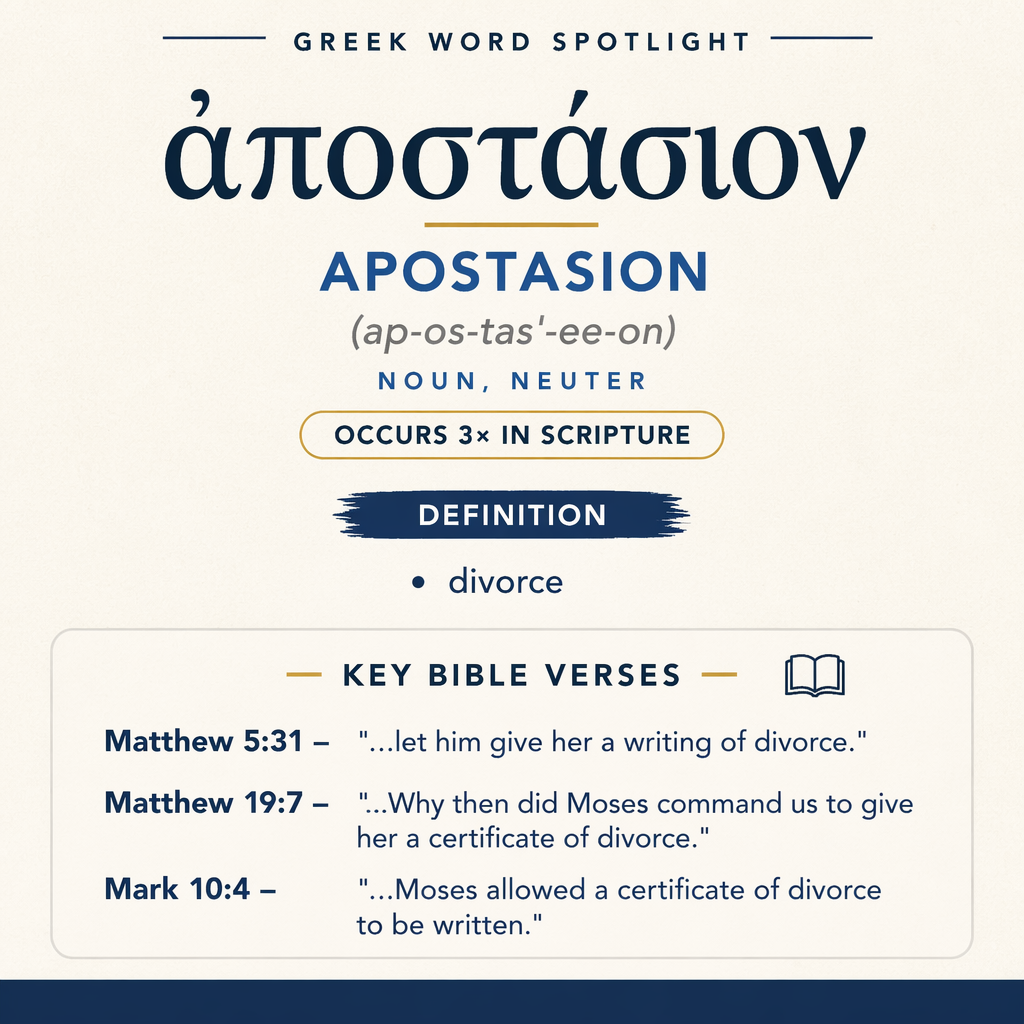
ἀποστάσιον means “divorce” and occurs three times in Scripture: Matthew 5:31, Matthew 19:7, and Mark 10:4.
Core Meaning
ἀποστάσιον is defined as “divorce.” In the cited passages, it appears in language about a formal writing or certificate of divorce.
Learn More →Gospel Occurrences
This noun occurs three times in Scripture. All occurrences are in Matthew 5:31, Matthew 19:7, and Mark 10:4.
Learn More →Quoted Context
Matthew 5:31 mentions giving “a writing of divorce.” Matthew 19:7 and Mark 10:4 refer to “a certificate of divorce” and divorcing.
Learn More →ἀποστάσιον refers to “divorce” in contexts where separation is framed through formal documentation. It appears in three Gospel discussions that speak of a written instrument connected with ending a marriage.
Root and Related Words
ἀποστάσιον is connected (per Strong’s) with the verb
aphistēmi (ἀφίστημι)
meaning “to leave” (Strong’s G868).

Occurrences
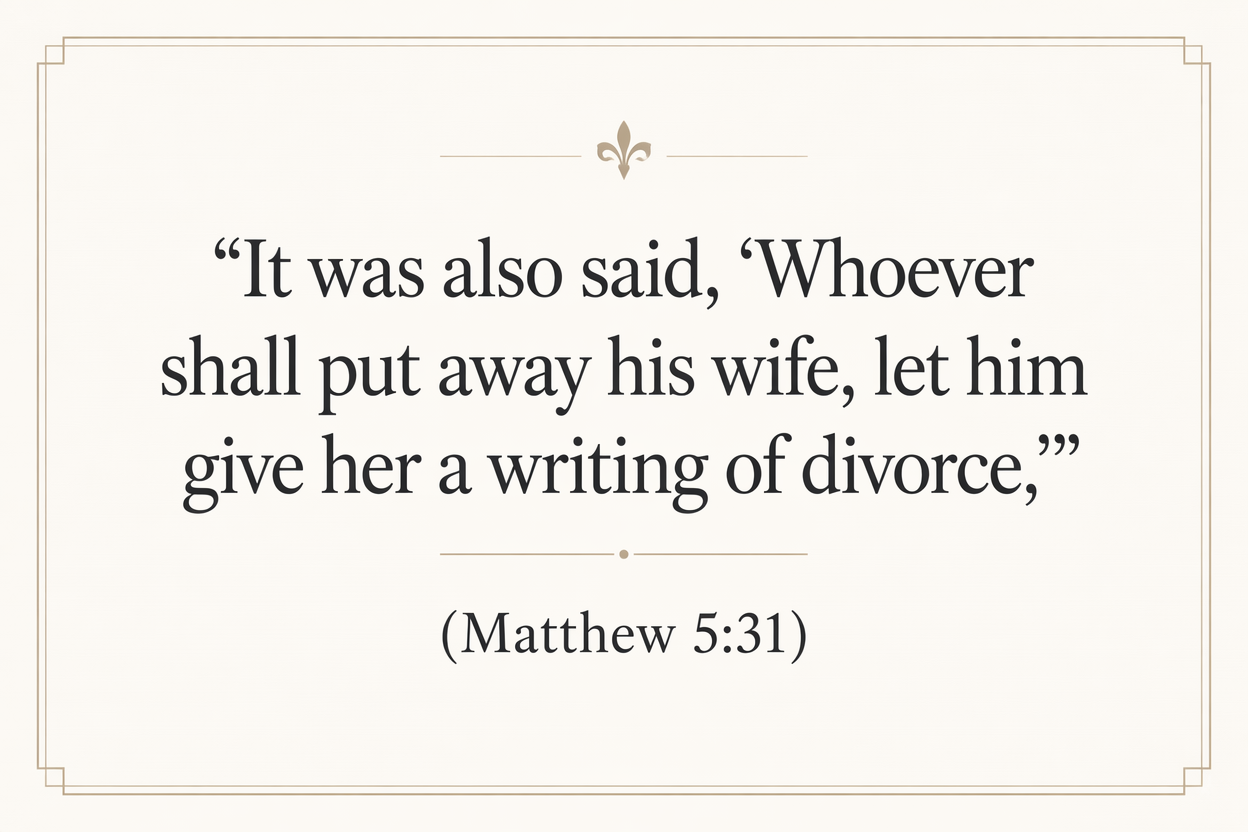
“It was also said, ‘Whoever shall put away his wife, let him give her a writing of divorce,’” (Matthew 5:31)
Here ἀποστάσιον is embedded in a fixed-sounding formula: a husband “put[s] away his wife” and is to “give her a writing of divorce.” The word belongs to the phrase “a writing of divorce,” so its immediate force is documentary and procedural. Divorce is not presented merely as an intention or a private decision; it is represented as something that can be expressed and conveyed in writing. The quoted line also ties divorce to the act of giving: the husband “give[s] her” the writing. Within the sentence’s logic, the written item functions as the outward, transferable piece that corresponds to the act of dismissal (“put away”). Thus ἀποστάσιον contributes the idea of divorce as a formalized status communicated through an instrument.
They asked him, “Why then did Moses command us to give her a certificate of divorce, and divorce her?” (Matthew 19:7)
In this question, ἀποστάσιον appears in the phrase “a certificate of divorce,” and it is paired with a further action: “and divorce her?” The question places emphasis on what is “command[ed]”: “to give her” the certificate, and then to carry out the divorce. The wording distinguishes between the document and the act. The certificate is something handed to the woman—again a tangible, deliverable object—while the divorce is the relational termination the questioners have in mind. By including ἀποστάσιον within “certificate of divorce,” the sentence casts divorce as something that is expected to be accounted for in an official or at least recognizable form, rather than being left ambiguous. The question’s structure also suggests that the certificate stands as a procedural requirement that accompanies, and perhaps regulates, the dissolution being discussed.
They said, “Moses allowed a certificate of divorce to be written, and to divorce her.” (Mark 10:4)
This wording likewise joins ἀποστάσιον to “certificate,” but it adds a specific verbal detail: “to be written.” That addition highlights the production of the document. Divorce is still spoken of as an action (“and to divorce her”), but the certificate is not only given; it is written. In this framing, ἀποστάσιον is the defining content or character of the certificate: what is written is a “certificate of divorce,” a written statement that bears divorce as its subject. The appeal is to permission: “Moses allowed” this to happen. So the word sits within an argument about what was permitted and how it was structured—divorce as something handled by a written instrument and an ensuing separation, rather than an unrecorded dismissal.
Sense and Usage
Across these three occurrences, ἀποστάσιον consistently appears as the key term in a documented form of divorce. Two phrases describe the document: “a writing of divorce” (Matthew 5:31) and “a certificate of divorce” (Matthew 19:7; Mark 10:4). The variation in English phrasing still points to the same communicative function: divorce is treated as something that can be inscribed and certified. The repeated collocation with “give her” underscores that the document is directed to the woman; it is the piece transferred in the process. In these settings, divorce is not described in isolation from legal or quasi-legal procedure; rather, it is bound to the existence of an identifiable written artifact.
The scenes also show how discussion of divorce can pivot on obligation or permission. Matthew 5:31 frames the formula as a remembered saying: the requirement is expressed as “let him give her a writing of divorce.” Matthew 19:7 and Mark 10:4 place the same sort of document into a debate about Mosaic instruction: one speaker group asks why Moses “command[ed]” it, while the other reports that Moses “allowed” it. Even within the quoted lines alone, ἀποστάσιον is tied to social regulation: divorce is not merely an outcome but a process shaped by commands, allowances, and written certification. The term therefore functions as a pivot between personal action (“put away,” “divorce her”) and formal attestation (“writing,” “certificate,” “to be written”).
The connection noted with aphistēmi (“to leave”) fits the relational direction implied by these quotations: divorce is treated as a structured leaving or separation that is made explicit by a document. Yet the Gospel occurrences do not present ἀποστάσιον as an abstract concept detached from action; they keep it closely attached to the making and giving of a written certificate. In these contexts, the term’s semantic weight lies in divorce as an established outcome that is handled in a way that can be recorded, handed over, and appealed to in argument.
Imagery
The repeated picture is of a written certificate changing hands. Whether described as “a writing of divorce” or “a certificate of divorce,” the imagery attached to ἀποστάσιον in these passages is concrete: divorce is envisioned as something put into writing—“to be written” (Mark 10:4)—and then “give[n] her” (Matthew 5:31; Matthew 19:7). The word therefore carries, in these scenes, the feel of inked lines on a tangible document that marks the end of a marriage in a way others can recognize.
Sources: Lexical data from Strong’s Exhaustive Concordance and the Translators Brief Lexicon of Extended Strongs for Greek (STEPBible, CC BY). Occurrence data from the Translators Amalgamated Greek New Testament (STEPBible, CC BY). Scripture quotations from the World English Bible (public domain).