
Understanding the Significance of Apostrepho in Greek
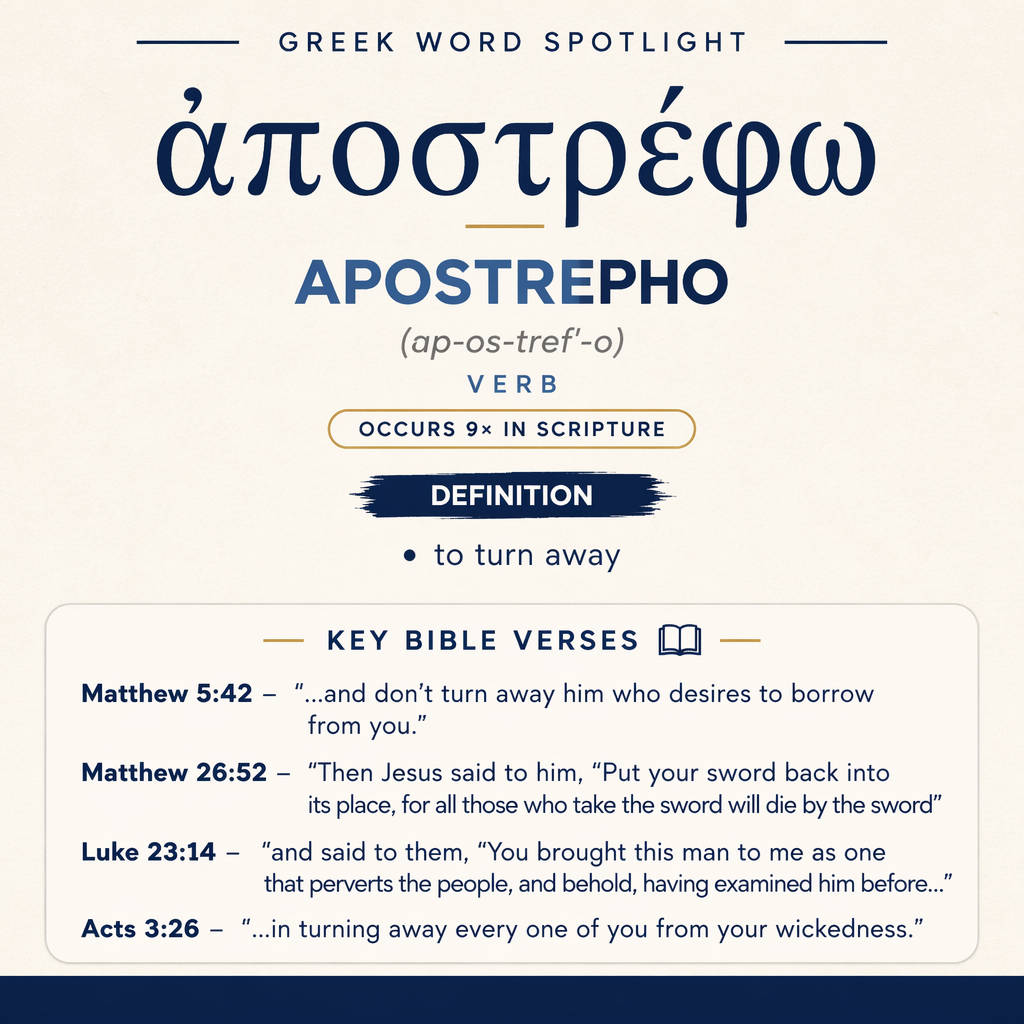
ἀποστρέφω means “to turn away” and occurs 9 times in Scripture, including Matthew, Luke, Acts, Romans, 2 Timothy, and Titus.
Core Meaning
ἀποστρέφω means “to turn away.” In Matthew 5:42 it is used in the instruction not to turn away someone who wants to borrow.
Learn More →Narrative Contexts
It appears in varied settings, including Jesus’ words in Matthew 26:52 and events surrounding Jesus’ trial in Luke 23:14. Acts 3:26 uses it for God’s blessing in turning people away from their iniquities.
Learn More →Truth and Turning
Several occurrences describe turning away in relation to truth: ears turned away from the truth to fables (2 Timothy 4:4), and commands of men who turn away from the truth (Titus 1:14). Romans 11:26 speaks of the Deliverer turning away ungodliness from Jacob.
Learn More →ἀποστρέφω expresses the act of turning away. In the passages where it appears, the verb marks refusal, withdrawal, redirection, or moral change, depending on the scene.
Occurrences
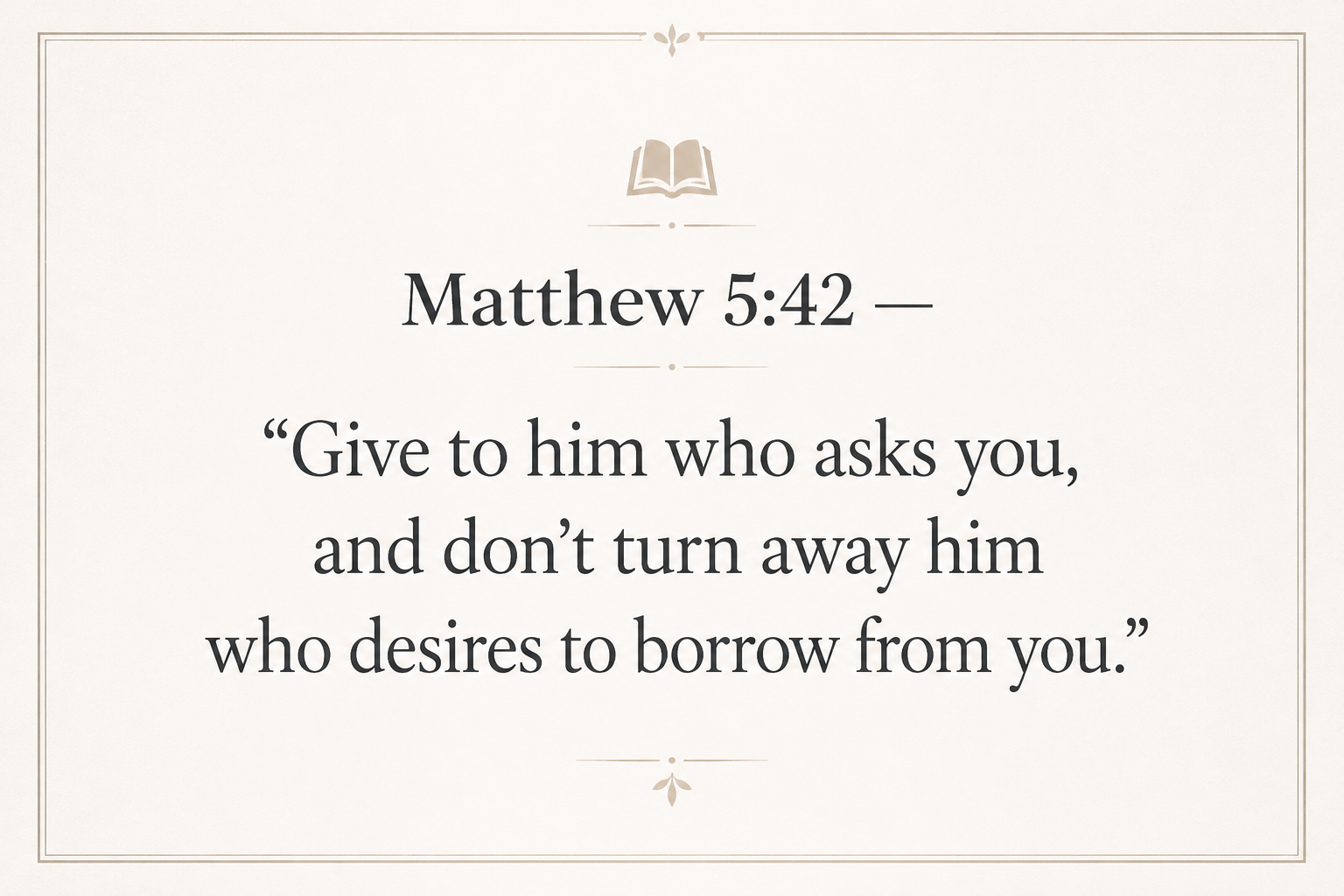
Matthew 5:42 — “Give to him who asks you, and don’t turn away him who desires to borrow from you.”
Here the verb belongs to a direct imperative: the hearer is commanded not to “turn away” a person who wants to borrow. The turning away is interpersonal and practical—an action taken toward “him who desires to borrow.” In the sentence structure, “don’t turn away” stands alongside “Give,” so refusal (turning away) is contrasted with active generosity.
Matthew 26:52 — “Then Jesus said to him, “Put your sword back into its place, for all those who take the sword will die by the sword.”
In this saying, the scene is one of immediate restraint: a sword is to be returned “back into its place.” Within the quoted command, the motion described is a reversal from readiness to strike to being put away. As the broader moment is framed by warning—“all those who take the sword will die by the sword”—the turning back of the weapon functions as a decisive turning away from violent action.
Luke 23:14 — “and said to them, “You brought this man to me as one that perverts the people, and behold, having examined him before you, I found no basis for a charge against this man concerning those things of which you accuse him.”
The setting is judicial examination. The language centers on allegations that Jesus “perverts the people,” and on the speaker’s conclusion that there is “no basis for a charge.” In this courtroom-like evaluation, turning away would naturally align with the idea of being diverted from an intended course; the verse’s emphasis on the lack of evidence sets a context where claims of perversion or diversion are weighed and rejected.
Acts 3:26 — “God, having raised up his servant Jesus, sent him to you first to bless you, in turning away every one of you from your wickedness.”
Turning away is presented as the form blessing takes: the blessing is “in turning away every one of you from your wickedness.” The verb’s direction is explicit: it is a turn away from “wickedness.” The scope is individual (“every one of you”) yet comprehensive, portraying moral change not as an abstract ideal but as a concrete reorientation away from a defined course of behavior.
Romans 11:26 — “and so all Israel will be saved. Even as it is written, “There will come out of Zion the Deliverer, and he will turn away ungodliness from Jacob.”
Here the verb describes what “the Deliverer” does: “he will turn away ungodliness from Jacob.” The turning away is not framed as Jacob’s self-initiated action but as an act performed on Jacob’s behalf, removing or redirecting “ungodliness” away from the people. The object “ungodliness” is treated as something that can be turned away, emphasizing effective intervention rather than mere instruction.
2 Timothy 1:15 — “This you know, that all who are in Asia turned away from me, of whom are Phygelus and Hermogenes.”
In this personal report, turning away is relational and painful: “all who are in Asia turned away from me.” The verb indicates withdrawal of loyalty or support, with named examples (“Phygelus and Hermogenes”) sharpening the sense of a concrete, recognizable defection. The turning away is not from an idea but from a person, marking a break in association.
2 Timothy 4:4 — “and will turn away their ears from the truth, and turn away to fables.”
This verse uses turning away in a striking paired construction. First there is a turn “their ears from the truth”—a metaphor for listening and receptivity being redirected. Then the sentence adds a second movement: “turn away to fables.” The double phrasing depicts a twofold reorientation: away from one object (“the truth”) and toward another (“fables”), as if hearing itself can be aimed.
Titus 1:14 — “not paying attention to Jewish fables and commandments of men who turn away from the truth.”
The verb characterizes a certain kind of people: those “who turn away from the truth.” The surrounding language connects such turning away with “fables” and “commandments of men,” setting the turn away as a defining posture that shapes what is attended to and obeyed. The phrase functions adjectivally to identify a class of teachers or influencers by their directional stance toward “the truth.”
Hebrews 12:25 — “See that you don’t refuse him who speaks. For if they didn’t escape when they refused him who warned on the earth, how much more will we not escape who turn away from him who warns from heaven,”
In this warning, turning away is cast as a grave response to divine speech: “don’t refuse him who speaks,” and “how much more will we not escape who turn away from him who warns from heaven.” The verb belongs to a contrast between heeding and refusing, and the difference in location (“on the earth” / “from heaven”) intensifies the seriousness. Turning away here is not merely inattentiveness; it is a decisive refusal directed at “him who warns.”

Sense and Usage
Across these passages, “turning away” appears as a deliberate directional act that can operate in several relational frames. In Matthew 5:42, it is refusal of a neighbor’s request; the command forbids a posture that closes off help. In 2 Timothy 1:15, it is abandonment of a person, where “turned away from me” narrates the severing of companionship or support. Hebrews 12:25 likewise makes turning away fundamentally relational—directed “from him who warns from heaven”—but intensifies it by placing the act under the category of refusing a speaking, warning authority.
The verb also addresses the sphere of moral and spiritual change. Acts 3:26 presents turning away as beneficent action that moves people away from “wickedness”; the wording frames the turn as part of God’s blessing. Romans 11:26 applies the same directional logic to “ungodliness,” describing it as turned away from Jacob by the Deliverer. In these two texts, turning away is restorative and protective: it redirects what harms or stains, whether conceived as behavior (“wickedness”) or a broader impiety (“ungodliness”).
A third cluster emphasizes the realm of reception and teaching. 2 Timothy 4:4 locates turning away in “ears,” implying that listening can be oriented. The verse’s parallel phrasing depicts a patterned movement: a turn away from one target and a turn toward another. Titus 1:14 similarly defines certain people by their stance toward “the truth,” linking their turn away with attraction to “fables” and “commandments of men.” In both, turning away is not presented as a momentary lapse but as a settled direction of attention and allegiance.
Finally, the imagery of turning away can be expressed through a concrete action even when the object is not explicitly named as a person or doctrine. Matthew 26:52 contains a command to put a sword “back into its place,” a physical reversal that functions as a practical turning away from a course of action warned against in the same breath. Luke 23:14, in a legal context concerned with whether someone “perverts the people,” supplies a setting where the idea of being turned aside is at issue; the speaker’s finding of “no basis for a charge” sets a counterpoint to claims that the people are being redirected in a harmful way.
Imagery
The passages use “turning away” in vivid directions: a borrower at the door who must not be dismissed (Matthew 5:42), a weapon physically returned to its place (Matthew 26:52), ears pivoting from “the truth” toward “fables” (2 Timothy 4:4), and a community warned not to turn away from a heavenly voice (Hebrews 12:25). Alongside these images stands a hopeful use: blessing described as being turned away from “wickedness” (Acts 3:26) and ungodliness being turned away from Jacob (Romans 11:26). Together they show turning away as an action that can either reject what should be received or reject what should be left behind.
Sources: Lexical data from Strong’s Exhaustive Concordance and the Translators Brief Lexicon of Extended Strongs for Greek (STEPBible, CC BY). Occurrence data from the Translators Amalgamated Greek New Testament (STEPBible, CC BY). Scripture quotations from the World English Bible (public domain).





