
Understanding the Meaning of Apokruphos in Greek
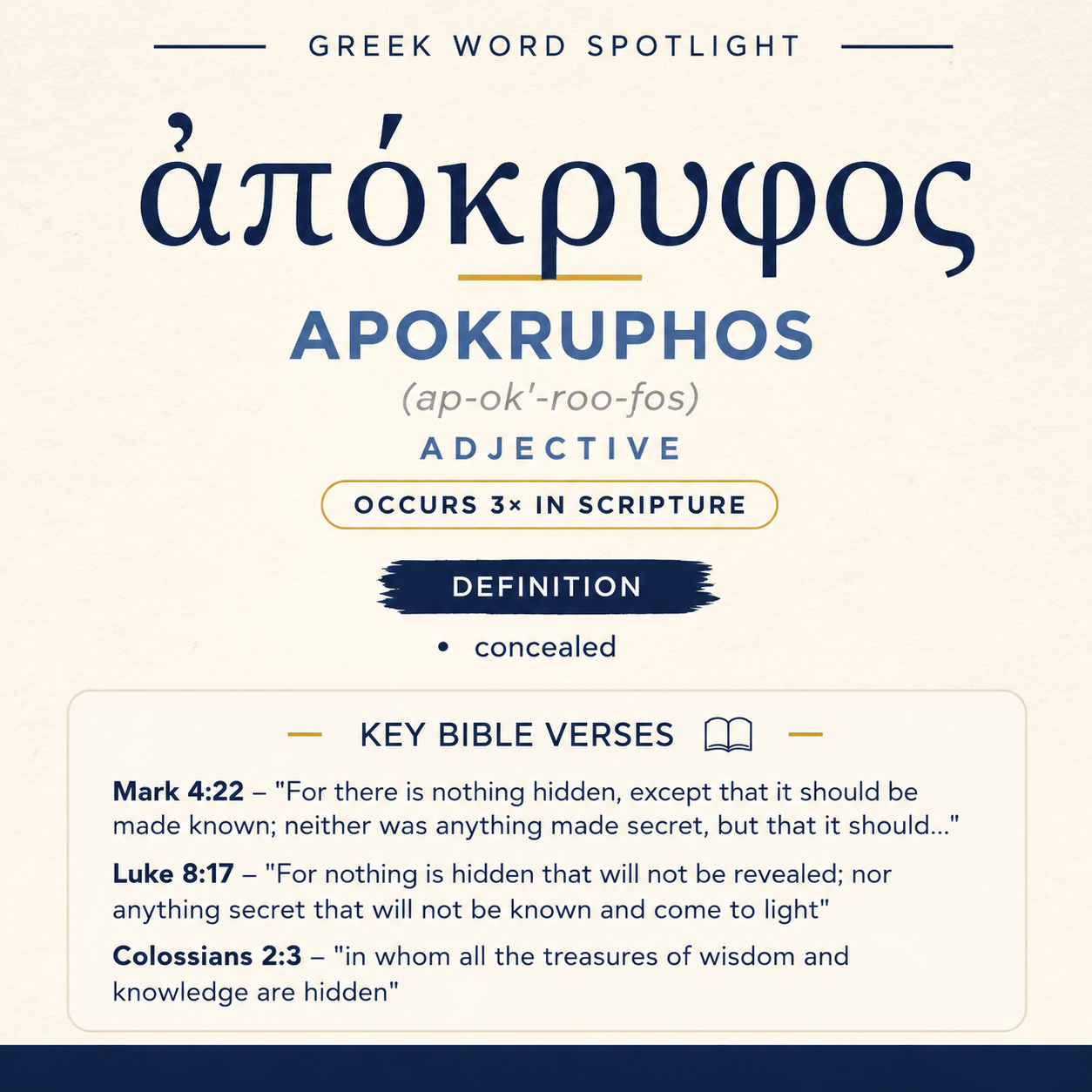
ἀπόκρυφος means “concealed” and occurs three times in Scripture: Mark 4:22, Luke 8:17, and Colossians 2:3.
Gospel Contexts
In Mark 4:22 and Luke 8:17, it appears in sayings about what is hidden being revealed and brought to light.
Learn More →Colossians Context
In Colossians 2:3, it describes treasures of wisdom and knowledge as hidden in him.
Learn More →ἀπόκρυφος describes something as concealed, appearing in two sayings about what is hidden and in one statement about treasures of wisdom and knowledge. Across its uses, it frames concealment in relation to disclosure (“come to light”) and to where something valuable is kept.
Root and Related Words
ἀπόκρυφος is related to the verb apokryptō (ἀποκρύπτω), “to conceal” (Strong’s G613). The adjective expresses the state or characterization that corresponds to that action: what is spoken of is presented as belonging in the category of the concealed.

Occurrences
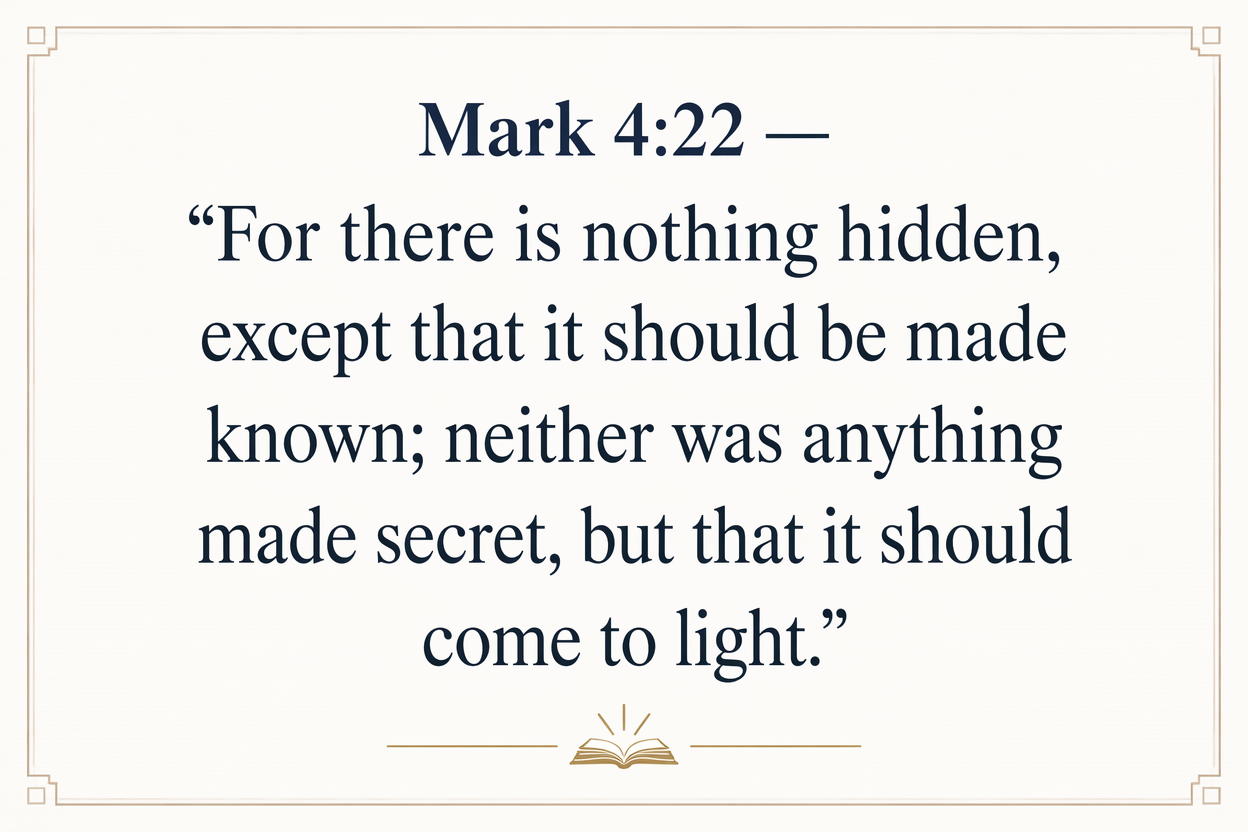
Mark 4:22 — “For there is nothing hidden, except that it should be made known; neither was anything made secret, but that it should come to light.”
Here ἀπόκρυφος belongs to a tightly balanced pair of clauses. First, something is described as “hidden,” but the clause immediately points beyond concealment to an aim: “that it should be made known.” Second, the saying restates the same thought with fresh wording: something can be “made secret,” yet the intent is “that it should come to light.” Within this parallelism, ἀπόκρυφος helps portray concealment as a condition that stands in tension with disclosure; the concealed item is not treated as permanently inaccessible but as headed toward visibility. The movement of the sentence is from concealment (hidden/secret) to public accessibility (made known/come to light), so the adjective contributes the starting point from which the disclosure is measured.
Luke 8:17 — “For nothing is hidden that will not be revealed; nor anything secret that will not be known and come to light.”
This saying echoes the same conceptual pairing of “hidden” and “secret,” and again drives toward exposure. ἀπόκρυφος functions within an absolute-sounding claim: “nothing” in the concealed category escapes the future actions described—“revealed,” “known,” and “come to light.” The verse uses a set of three disclosure expressions that intensify the outcome. “Revealed” speaks of unveiling; “known” speaks of recognition; “come to light” speaks of visibility. In this setting, the adjective does not merely label an object as concealed; it defines the kind of thing being discussed—whatever is now concealed—so that the statement can deny concealment the last word. The force of the proverb depends on the contrast: concealment is real (“hidden… secret”), yet it is not final (“will not be revealed… will not be known and come to light”).
Colossians 2:3 — “in whom all the treasures of wisdom and knowledge are hidden.”
In this line, ἀπόκρυφος modifies “the treasures of wisdom and knowledge.” Concealment here is applied not to an embarrassing fact or an undisclosed action, but to “treasures,” a term that naturally carries the idea of something valuable and deliberately kept. The phrase “in whom” provides the location or sphere in which the concealment holds: the treasures are concealed “in whom,” and the sentence gathers them comprehensively as “all the treasures of wisdom and knowledge.” The adjective thus contributes the picture of value that is present yet not on the surface—present in a person (“in whom”), yet not immediately accessible as an obvious display. The concealment is not described as accidental loss; it is a feature of where the treasures are situated, and it gives the reader a way to think about wisdom and knowledge as rich and real while still being hidden.
Sense and Usage
Across these three occurrences, ἀπόκρυφος consistently marks a thing as concealed, but the surrounding language shows different emphases. In Mark 4:22 and Luke 8:17, concealment is set within a verbal sequence that points toward disclosure. The concealed thing is discussed as “hidden” or “secret,” and then the sayings pivot to what will happen to it: it will be “made known,” “revealed,” “known,” and it will “come to light.” In these sayings, concealment is significant precisely because it is contrasted with the strong expectation of exposure. The adjective helps establish the category (“hidden/secret”) so that the hearer feels the weight of the reversal: what is concealed is destined for the open.
Colossians 2:3 uses the same basic idea of concealment but places it in a different frame. The concealed items are “treasures,” and the sentence does not contrast concealment with an immediate unveiling; instead it asserts where the treasures are found—“in whom”—and characterizes their manner of presence there as hidden. Concealment here is compatible with abundance (“all the treasures”) and with value (treasures), and it works with the relational phrasing (“in whom”) to suggest that what is concealed is not absent but located. In that way, ἀπόκρυφος can describe concealment that invites seeking rather than concealment that merely frustrates observation.
Put together, the passages show that concealment can be spoken of in at least two complementary ways without changing the basic sense of the adjective. First, concealment can be treated as a temporary status that will yield to disclosure (Mark 4:22; Luke 8:17). Second, concealment can be treated as the manner in which valuable realities are present within a given locus (“in whom”), concealed yet real and comprehensive (Colossians 2:3). In both patterns, the adjective keeps its plain contribution: it places what is being discussed on the concealed side of the hidden/known contrast, whether the emphasis falls on the coming disclosure or on the hidden location of what is valuable.
Imagery
The word’s imagery is shaped by the paired verbs and metaphors that accompany it. In Mark 4:22 and Luke 8:17, concealment is pictured as something that can be overcome by illumination—what is secret is described in terms of what will “come to light.” In Colossians 2:3, concealment is pictured more like stored wealth: “treasures” that are truly present but kept hidden “in whom.” The same adjective can therefore evoke both the dark-to-light movement of disclosure and the guarded-in-place character of a treasure kept from plain view.
Sources: Lexical data from Strong’s Exhaustive Concordance and the Translators Brief Lexicon of Extended Strongs for Greek (STEPBible, CC BY). Occurrence data from the Translators Amalgamated Greek New Testament (STEPBible, CC BY). Scripture quotations from the World English Bible (public domain).




