
Understanding the Meaning of Apokrima in Greek
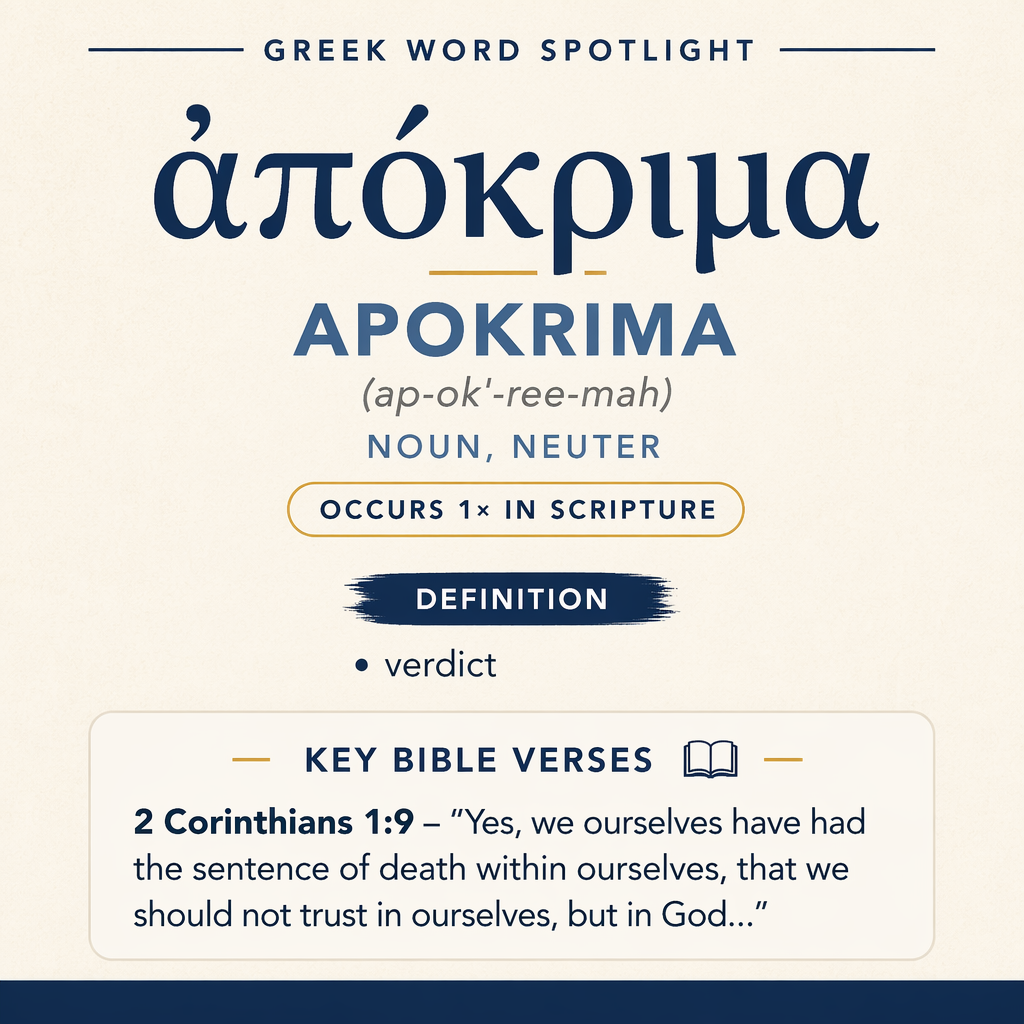
ἀπόκριμα means “verdict” and appears once in Scripture, in 2 Corinthians 1:9.
Scripture Occurrence
It occurs 1 time in Scripture. The occurrence is in 2 Corinthians 1:9.
Learn More →Verse Context
In 2 Corinthians 1:9, it is rendered “sentence of death within ourselves.”
Learn More →Apokrima means “verdict.” It appears once, in Paul’s description of an inner “sentence of death” that pressed him away from self-reliance and toward the God who raises the dead.
Root and Related Words
Apokrima is connected with the verb apokrinomai (ἀποκρίνω), “to answer” (Strong’s G611). In form and feel it belongs to the same word-family that speaks of an answer given in response, now expressed as a settled response rather than a spoken reply.

Occurrences
“Yes, we ourselves have had the sentence of death within ourselves, that we should not trust in ourselves, but in God who raises the dead,” (2 Corinthians 1:9)
Here apokrima is rendered “sentence,” and it is paired directly with “of death,” making the content of the verdict explicit. The phrase locates this verdict “within ourselves,” presenting it as an inwardly borne conclusion that Paul and his companions carried, not merely a distant report. The statement is not left as a bare description of suffering; it is framed with a purpose clause: “that we should not trust in ourselves, but in God who raises the dead.” In this setting, the verdict functions as a decisive internal assessment that shuts the door on self-confidence. It acts like a final ruling that renders self-trust unreasonable and forces a different posture—reliance on God—precisely because the God in view is characterized as one “who raises the dead.” The severity of the verdict (“death”) sharpens the contrast: if the settled outcome is death, then the only adequate object of trust is the One whose power reaches beyond that outcome.
Sense and Usage
The single use of apokrima shows “verdict” operating as a firm, concluded judgment rather than a tentative fear. It is the kind of determination that feels already decided—so decided that it can be spoken of as something “had” and carried “within ourselves.” The wording also indicates that the verdict is experiential and existential: it is not presented as an abstract principle but as a felt and internalized sentence. The verse’s logic makes the verdict’s function clear. Because the verdict is “of death,” it exposes the limits of self as a source of security; self-trust cannot answer the finality implied by death. The verdict therefore serves as a pivot point, turning confidence away from the self and toward God, identified by an action that directly meets the verdict’s content: raising the dead.
Even in this lone occurrence, the word’s placement within a tight argument gives it weight. The verdict is not the last word in the sentence; it is the pressure that produces a reorientation of trust. The noun’s concreteness helps: a “verdict” is not merely a feeling but a concluded outcome, a fixed decision. Paul’s phrasing makes that fixity part of the spiritual effect. The sense is not that the verdict is enjoyed or sought, but that, once embraced as real, it becomes the means by which self-reliance is unlearned and God-reliance is learned. The verse does not soften the verdict’s content; instead, it sets the verdict beside God’s life-giving power, so that the verdict becomes the dark backdrop against which God’s identity as life-giver is confessed.
Imagery
The imagery carried by apokrima in 2 Corinthians 1:9 is judicial and final: a “sentence of death.” Yet it is pictured as residing “within ourselves,” as though the courtroom has moved into the conscience and the judgment is carried internally. Against that inner finality stands the simple, stark counter-image: “God who raises the dead.” The verse sets a humanly inescapable ruling beside a divine act that reaches past the ruling, so that the verdict becomes the occasion for a transfer of trust.
Sources: Lexical data from Strong’s Exhaustive Concordance and the Translators Brief Lexicon of Extended Strongs for Greek (STEPBible, CC BY). Occurrence data from the Translators Amalgamated Greek New Testament (STEPBible, CC BY). Scripture quotations from the World English Bible (public domain).




