Understanding the Significance of Apeimi in Greek
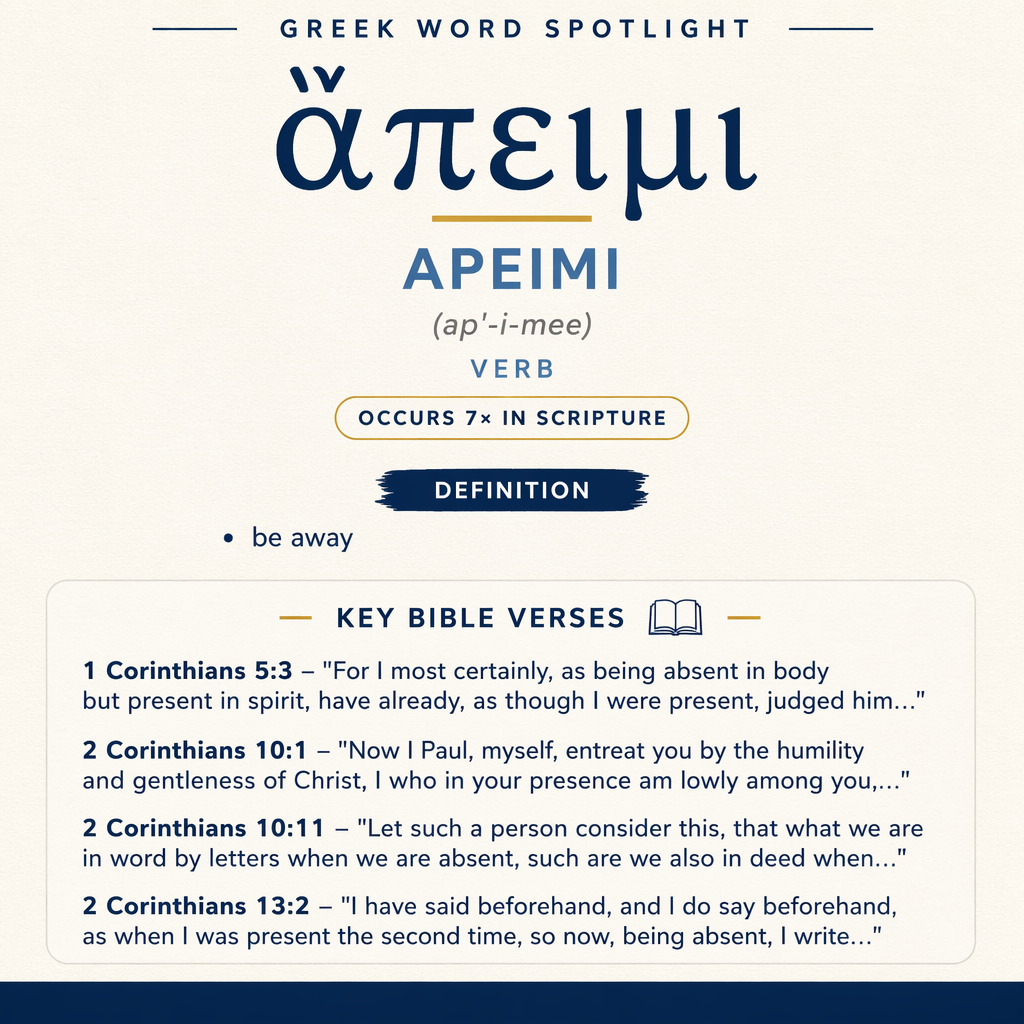
ἄπειμι means “be away” and occurs 7 times in Scripture (1 Corinthians 5:3; 2 Corinthians 10:1, 10:11, 13:2, 13:10; Philippians 1:27; Colossians 2:5).
Core Meaning
ἄπειμι means “be away.” In its occurrences, it describes being absent in contrast to being present.
Learn More →Paul’s Letters
All seven occurrences are in Pauline epistles: 1 Corinthians, 2 Corinthians, Philippians, and Colossians. Several contexts pair absence “in body/flesh” with presence “in spirit.”
Learn More →Contrasts of Presence
The word appears alongside explicit contrasts between being absent and being present (e.g., “absent in body… present in spirit”). It also frames communication “by letters when we are absent” versus deeds when present.
Learn More →ἄπειμι expresses the state of being away, and in the New Testament it is heard in a cluster of Pauline contexts where distance is contrasted with presence. Across its occurrences it helps frame how someone speaks, writes, judges, or rejoices when not physically there.
Root and Related Words
ἄπειμι is linked with two components: the verb eimi (εἰμί), “to be” (Strong’s G1510), and the preposition apo (ἀπό), “away from” (Strong’s G575). The combination fits the idea of a person’s condition being characterized by separation from a place or people.

Occurrences
“For I most certainly, as being absent in body but present in spirit, have already, as though I were present, judged him who has done this thing.” (1 Corinthians 5:3)
Here ἄπειμι marks Paul’s bodily distance from the Corinthian situation, yet the sentence immediately sets that distance alongside another kind of presence: “present in spirit.” The word strengthens the contrast between physical location (“in body”) and Paul’s active engagement (“have already… judged”), so that his decisive action is framed as taking place even while he is away.

“Now I Paul, myself, entreat you by the humility and gentleness of Christ, I who in your presence am lowly among you, but being absent am bold toward you.” (2 Corinthians 10:1)
In this appeal, ἄπειμι helps articulate a perceived shift in posture: “in your presence” Paul is “lowly,” but “being absent” he is “bold.” The term functions as the hinge between two relational settings. It is not merely travel information; it sets the stage for how his manner is interpreted depending on whether he is with them or away from them.
“Let such a person consider this, that what we are in word by letters when we are absent, such are we also in deed when we are present.” (2 Corinthians 10:11)
In this warning, ἄπειμι is paired with communication “by letters.” The distance (“when we are absent”) becomes the setting for written speech, and Paul insists on continuity: what is true in “word” at a distance is matched by “deed” in person. The word thus helps distinguish two modes of interaction—letter and presence—while denying that the distance changes the substance of his conduct.
“I have said beforehand, and I do say beforehand, as when I was present the second time, so now, being absent, I write to those who have sinned before now, and to all the rest, that, if I come again, I will not spare;” (2 Corinthians 13:2)
Here ἄπειμι frames the timing and seriousness of a written admonition. Paul places his current act (“being absent, I write”) between past presence (“when I was present the second time”) and a possible future visit (“if I come again”). The term helps emphasize that the warning is not postponed until he arrives; it is issued while he is away, with the stated possibility of strict action when he returns.
“For this cause I write these things while absent, that I may not deal sharply when present, according to the authority which the Lord gave me for building up, and not for tearing down.” (2 Corinthians 13:10)
In this explanation of purpose, ἄπειμι locates Paul at a distance precisely so that his writing may shape what happens later “when present.” The word contributes to a careful pastoral strategy: admonition while away is meant to reduce the need to “deal sharply” face-to-face. The contrast also highlights the different effects he seeks in each setting—correction mediated by a letter during absence, and constructive use of “authority” during presence.
“Only let your way of life be worthy of the Good News of Christ, that whether I come and see you or am absent, I may hear of your state, that you stand firm in one spirit, with one soul striving for the faith of the Good News;” (Philippians 1:27)
In Philippians, ἄπειμι is set within an either/or scenario: Paul may “come and see” them, or he may “be absent.” The word helps make the ethical exhortation independent of his location. Their “way of life” is to be consistent such that, whether by direct observation or by report (“I may hear of your state”), Paul receives the same testimony: firmness “in one spirit” and shared striving “with one soul.”
“For though I am absent in the flesh, yet I am with you in the spirit, rejoicing and seeing your order, and the steadfastness of your faith in Christ.” (Colossians 2:5)
Here ἄπειμι again marks physical separation (“absent in the flesh”), and it is balanced by a claim of spiritual solidarity (“with you in the spirit”). Within that relationship, Paul depicts himself as rejoicing and as “seeing” their “order” and “steadfastness.” The word provides the spatial contrast that makes the sentence’s interpersonal closeness more vivid: physical distance does not cancel his attentive, celebratory alignment with them.
Sense and Usage
Across these passages, ἄπειμι consistently names the condition of being away as a meaningful relational setting rather than a bare detail of geography. The word is frequently paired with an explicit counterpoint—“present”—so that absence and presence become two frames for the same ongoing relationship. In 1 Corinthians 5:3 and Colossians 2:5, absence is sharpened by the body/flesh versus spirit contrast (“absent in body… present in spirit”; “absent in the flesh… with you in the spirit”), allowing Paul to speak of engagement that persists despite distance.
In 2 Corinthians, ἄπειμι especially serves the rhetoric of accountability. It marks the distance from which Paul writes and speaks (“in word by letters when we are absent”; “being absent, I write”), but the repeated contrast with presence underscores that the distance does not lessen the seriousness of what he communicates. The term helps organize a sequence: admonition at a distance, followed by consistency in action when present, and even the stated intent to avoid harshness later by writing now.
In Philippians 1:27, ἄπειμι broadens from Paul’s personal posture to the community’s stability. Whether his relationship with them is maintained by visit or by news, their conduct is to stand as a steady reality. Thus ἄπειμι can function as a test case for integrity: what is true of a community should not depend on whether a respected figure is physically there.
Imagery
In these letters, ἄπειμι carries the repeated picture of two modes of nearness: bodily presence and the kind of connection maintained through spirit, reports, and letters. The word often stands at the point where an unseen relationship must prove itself—where admonition is issued from afar, where boldness is assessed without face-to-face contact, and where joy and confidence are expressed despite physical separation.
Sources: Lexical data from Strong’s Exhaustive Concordance and the Translators Brief Lexicon of Extended Strongs for Greek (STEPBible, CC BY). Occurrence data from the Translators Amalgamated Greek New Testament (STEPBible, CC BY). Scripture quotations from the World English Bible (public domain).