
Understanding the Meaning of Apeithes in Greek
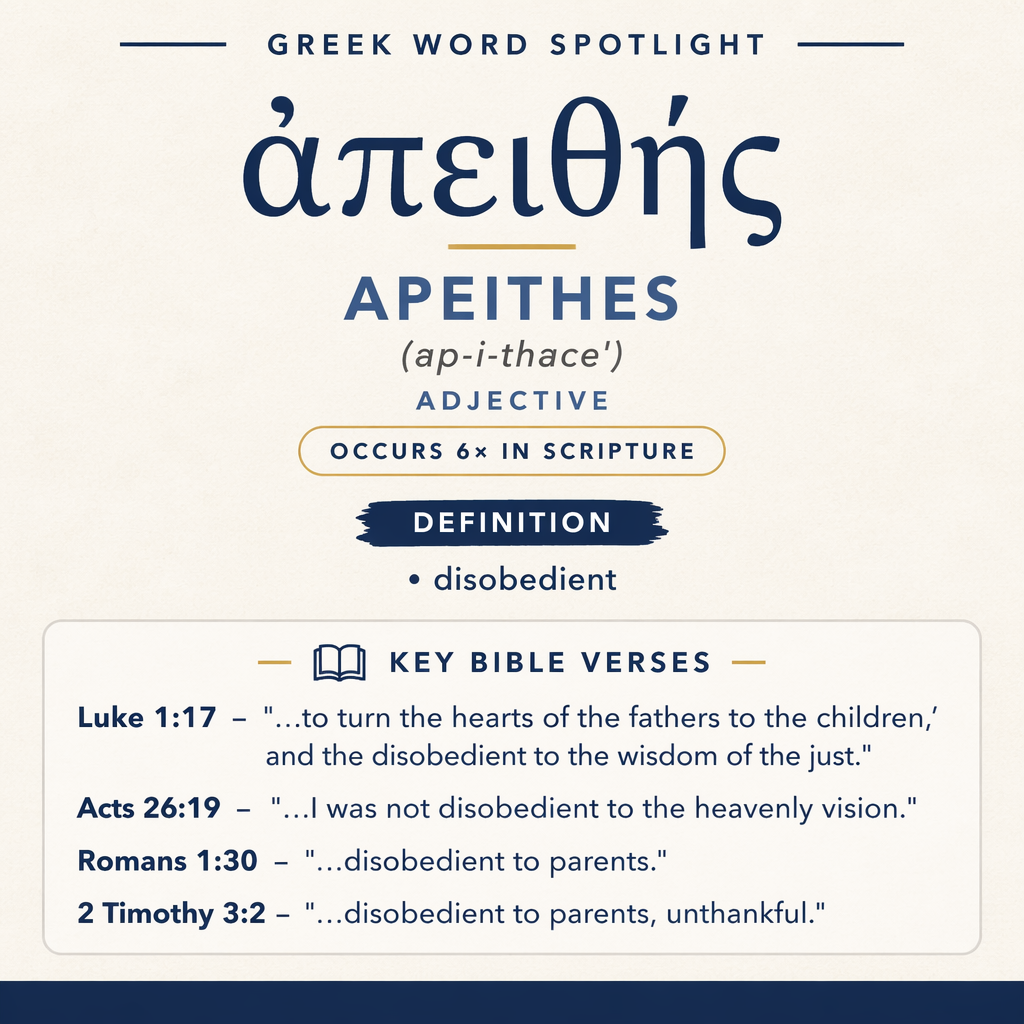
ἀπειθής (Apeithes) means “disobedient” and occurs 6 times in Scripture: Luke 1:17; Acts 26:19; Romans 1:30; 2 Timothy 3:2; Titus 1:16; Titus 3:3.
Core Meaning
ἀπειθής means “disobedient.” It describes people characterized by refusal to obey.
Learn More →Where It Appears
ἀπειθής occurs 6 times in Scripture. It appears in Luke 1:17; Acts 26:19; Romans 1:30; 2 Timothy 3:2; Titus 1:16; Titus 3:3.
Learn More →Usage Examples
Acts 26:19 uses it negatively (“not disobedient to the heavenly vision”). Romans 1:30 and 2 Timothy 3:2 apply it to being “disobedient to parents.”
Learn More →ἀπειθής means “disobedient.” In the New Testament it appears in settings that range from prophetic preparation and apostolic testimony to moral catalogs and pastoral evaluation of a community’s character.
Root and Related Words
ἀπειθής is derived from the verb πείθω (peithō), “to persuade,” with the prefix α (alpha), a form used to negate.

Occurrences
Luke 1:17 — “He will go before him in the spirit and power of Elijah, ‘to turn the hearts of the fathers to the children,’ and the disobedient to the wisdom of the just; to prepare a people prepared for the Lord.”
Here the word marks a group defined by their stance toward what is wise and right: “the disobedient” stand in contrast to “the wisdom of the just.” The line sets the turning of such people as part of a broader work of preparation, alongside the restoration of family bonds (“the hearts of the fathers to the children”). Within this prophetic description, disobedience is not treated as a minor flaw but as a condition needing redirection toward the pattern of life characterized by the “just.”
Acts 26:19 — “Therefore, King Agrippa, I was not disobedient to the heavenly vision,”
In Paul’s defense before “King Agrippa,” the adjective functions as a self-description framed negatively: “not disobedient.” The word emphasizes the moral posture of response to what Paul calls “the heavenly vision.” The statement is brief and forceful, portraying obedience as the appropriate counterpart to a vision understood to be from above; in this courtroom-like context, “not disobedient” supports the credibility and coherence of Paul’s actions flowing from that encounter.
Romans 1:30 — “backbiters, hateful to God, insolent, arrogant, boastful, inventors of evil things, disobedient to parents,”
In this list, ἀπειθής appears as one element among many, but it is sharpened by its object: “to parents.” The phrase places disobedience in the realm of family order and everyday authority, not merely in public crimes. The catalog’s piling up of terms (“insolent, arrogant, boastful…”) makes “disobedient to parents” part of a portrait of social breakdown where basic bonds and obligations are violated.
2 Timothy 3:2 — “For men will be lovers of self, lovers of money, boastful, arrogant, blasphemers, disobedient to parents, unthankful, unholy,”
Again the word is set within a chain of character traits, and again it is specified as “disobedient to parents.” The immediate neighbors in the sentence—“lovers of self,” “lovers of money,” “boastful,” and “arrogant”—frame disobedience as part of a larger self-centered orientation. In this warning, “disobedient to parents” is not isolated as a youthful indiscretion; it sits alongside attitudes and actions that depict a serious moral climate (“blasphemers… unthankful, unholy”).
Titus 1:16 — “They profess that they know God, but by their deeds they deny him, being abominable, disobedient, and unfit for any good work.”
Here ἀπειθής describes people whose stated confession (“They profess that they know God”) is contradicted by conduct (“by their deeds they deny him”). The adjective stands between “abominable” and the practical result, “unfit for any good work,” forming a tight moral diagnosis: disobedience is part of what makes their lives inconsistent and unproductive in the sphere of “good work.” In this setting the word highlights not merely a failure to comply, but a settled posture that manifests in deeds and leads to inability rather than usefulness.
Titus 3:3 — “For we were also once foolish, disobedient, deceived, serving various lusts and pleasures, living in malice and envy, hateful, and hating one another.”
This occurrence places ἀπειθής within a shared recollection: “we were also once” like this. Disobedience is paired with being “deceived” and with a pattern of servitude (“serving various lusts and pleasures”), and it belongs to a way of life characterized by corrosive relationships (“living in malice and envy, hateful, and hating one another”). The word thus contributes to a before-and-after moral portrait: disobedience is remembered as part of an old existence, not as a neutral trait but as intertwined with deception, misdirected service, and hostility.
Sense and Usage
Across these passages, “disobedient” functions as a descriptor of persons rather than an isolated act. Luke 1:17 speaks of “the disobedient” as a recognizable type, one that must be “turn[ed]… to the wisdom of the just,” placing disobedience in relation to the direction of a life and the need for reorientation. Acts 26:19 shows the same adjective in a personal claim of integrity—Paul’s “not disobedient” stance—where the word draws attention to responsiveness as a defining feature of his story in front of a ruler.
In Romans 1:30 and 2 Timothy 3:2, the adjective is attached to the household: “disobedient to parents.” In both lists, this feature is grouped with arrogance, boastfulness, and other dispositions that fracture community life. The recurrence of the same phrase in two different catalogs underlines how disobedience can be treated as emblematic of wider moral disorder: refusing parental authority becomes one sign among many of a character bent away from proper relational boundaries.
Titus uses the word twice in close proximity but with different rhetorical aims. Titus 1:16 applies it to those whose outward religious profession is contradicted by their behavior; disobedience stands as part of what makes them “unfit for any good work,” linking the term to practical fruitlessness. Titus 3:3, by contrast, places it in a confessional memory (“we were also once”), embedding disobedience among a cluster of enslaving desires and hostile attitudes; the word helps name the former condition from which the community has moved. Taken together, these uses show ἀπειθής as a strong moral label, capable of describing both a social posture (especially within the family) and a spiritual-ethical posture revealed through deeds.
Imagery and Contrast
The passages often sharpen ἀπειθής by contrast. Luke 1:17 sets “the disobedient” over against “the wisdom of the just,” making the word evoke a path that must be redirected. Acts 26:19 frames the term against faithfulness to “the heavenly vision,” casting disobedience as the opposite of a responsive life. In Titus 1:16 the contrast is between profession and deeds, where disobedience belongs to the side that denies in practice what is confessed in speech. The word’s imagery in these texts is therefore relational and directional: it depicts people defined by resistance, and it invites the reader to see how such resistance shapes families, communities, and the integrity of one’s stated allegiance.
Sources: Lexical data from Strong’s Exhaustive Concordance and the Translators Brief Lexicon of Extended Strongs for Greek (STEPBible, CC BY). Occurrence data from the Translators Amalgamated Greek New Testament (STEPBible, CC BY). Scripture quotations from the World English Bible (public domain).





