
Exploring the Meaning of Apeitheia in Greek
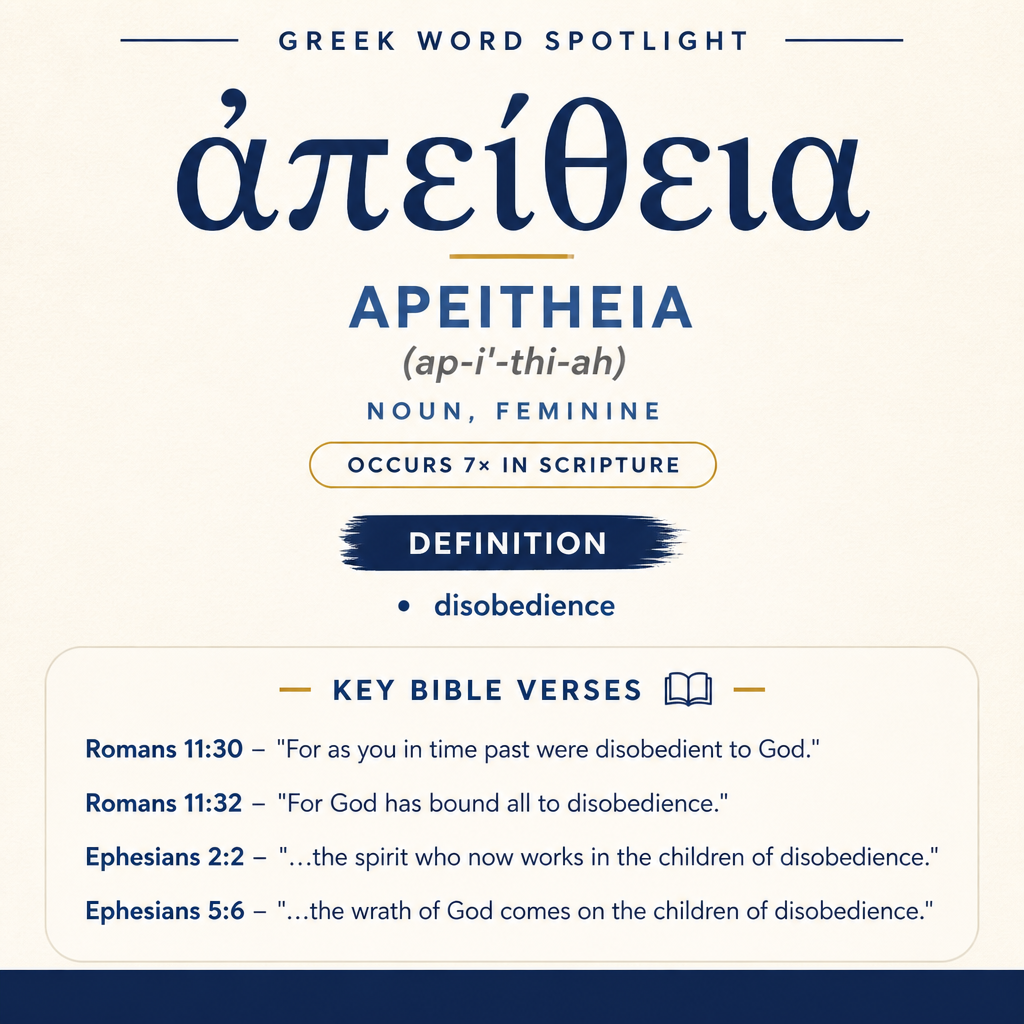
ἀπείθεια (Apeitheia) means “disobedience” and occurs 7 times in Scripture, including Romans 11, Ephesians 2 and 5, Colossians 3, and Hebrews 4.
Core Meaning
ἀπείθεια is defined as “disobedience.” It is used as a noun in the cited passages.
Learn More →Where It Appears
It occurs in Romans 11:30, 11:32; Ephesians 2:2, 5:6; Colossians 3:6; Hebrews 4:6, 4:11. These references account for all 7 occurrences listed.
Learn More →In Context
Romans 11 connects disobedience with God’s mercy (11:30, 11:32). Ephesians 5:6 and Colossians 3:6 speak of “children of disobedience,” and Hebrews 4 warns against an “example of disobedience” (4:11).
Learn More →ἀπείθεια names “disobedience” in a set of passages that cluster in Romans, Ephesians, Colossians, and Hebrews. In these contexts it functions as a decisive explanation: it characterizes people (“children of disobedience”), describes a past condition, and accounts for exclusion from a promised “rest.”
Occurrences
“For as you in time past were disobedient to God, but now have obtained mercy by their disobedience,” (Romans 11:30)
Here ἀπείθεια appears twice to frame a reversal in experience. The first instance locates the readers’ earlier stance as “disobedient to God,” setting a before-and-after contrast with “but now have obtained mercy.” The second instance (“by their disobedience”) treats disobedience as the occasion through which mercy has come to the formerly disobedient group; the term is thus not merely descriptive but part of the logic by which Paul explains the present situation of mercy.
“For God has bound all to disobedience, that he might have mercy on all.” (Romans 11:32)
In this compressed statement ἀπείθεια functions as a condition that encompasses “all.” The verb “has bound” presents disobedience as a constraining state, not simply a momentary act, and the purpose clause (“that he might have mercy on all”) places disobedience within a larger contrast between a universal plight and a universal intent of mercy. The word supplies the name of the plight.
“in which you once walked according to the course of this world, according to the prince of the power of the air, the spirit who now works in the children of disobedience.” (Ephesians 2:2)
Here ἀπείθεια is embedded in the expression “children of disobedience,” and it helps mark identity and belonging. The verse portrays a former manner of life (“you once walked”) governed by outside influences (“according to the course of this world,” “according to the prince of the power of the air”). Disobedience is not isolated from that environment: the same “spirit” is said to be “now” active “in the children of disobedience,” so the term points to a group defined by disobedience as the sphere in which this activity takes place.
“Let no one deceive you with empty words. For because of these things, the wrath of God comes on the children of disobedience.” (Ephesians 5:6)
In this warning, ἀπείθεια again shapes the label “children of disobedience,” but now with an explicit consequence: “the wrath of God comes.” The verse begins with a prohibition against being misled (“Let no one deceive you with empty words”), and then grounds that warning “because of these things.” Disobedience is presented as the defining trait of those who are the object of coming wrath; the word therefore supports the moral seriousness of the warning by naming the kind of people on whom wrath arrives.
“For these things’ sake the wrath of God comes on the children of disobedience.” (Colossians 3:6)
This sentence parallels the Ephesians warning in form and force. ἀπείθεια appears in the same group-designation (“children of disobedience”), and the consequence is again stated as the coming of divine wrath. Within this tight phrasing, the term functions as a concise categorization: it locates the recipients of wrath not by ethnicity or status but by their defining posture of disobedience.
“Seeing therefore it remains that some should enter into it, and they to whom the good news was preached before failed to enter in because of disobedience,” (Hebrews 4:6)
In Hebrews, ἀπείθεια is tied to an outcome: failure to enter. The verse contrasts two groups—“some” who yet “should enter into it” and those who previously heard “the good news” but “failed to enter in.” Disobedience supplies the stated reason (“because of disobedience”), so the term here carries explanatory weight: it identifies the cause of exclusion from what the passage calls entry “into it,” in a context focused on the remaining opportunity to enter.
“Let’s therefore give diligence to enter into that rest, lest anyone fall after the same example of disobedience.” (Hebrews 4:11)
Here ἀπείθεια is cast as an “example” that can be followed, with the peril that “anyone” might “fall.” The exhortation “give diligence” is aimed at “enter[ing] into that rest,” and the warning sets disobedience as the pattern that leads to falling. The term thus functions pedagogically: it names the negative model whose repetition the community must avoid while striving toward “that rest.”
Sense and Usage
Across these passages ἀπείθεια consistently denotes disobedience, but it is used with different kinds of grammatical and rhetorical force. In Romans 11 it is contrasted with mercy and woven into a storyline of “time past” and “now,” so that disobedience becomes a marker of an earlier relation to God and also a factor in how mercy is presently experienced. Romans 11:32 intensifies this by speaking of being “bound” to disobedience, treating it as a comprehensive condition under which “all” are placed—language that makes disobedience sound like an enclosing status rather than a single choice.
In Ephesians and Colossians the term is most visible in the compound description “children of disobedience.” This phrasing gives disobedience an almost familial or generational coloring: it is not merely something done but something that characterizes a set of people as a class. Ephesians 2:2 links that identity to a broader pattern of life (“walked according to the course of this world”) and to a present spiritual activity (“the spirit who now works”), so disobedience is the context in which that “spirit” is active. Ephesians 5:6 and Colossians 3:6 then attach a clear consequence: “the wrath of God comes.” In those warnings, ἀπείθεια helps draw a boundary by identifying the group on whom wrath comes, supporting the call not to be “deceive[d] with empty words.”
Hebrews 4 uses ἀπείθεια in a different argumentative setting: entry into “that rest.” Disobedience there is not primarily a label for a social group but a reason for a past failure and a template for a potential future failure. The word is connected to preaching (“the good news was preached before”) and to the outcome of not entering, so it frames disobedience as the decisive explanation of why hearing good news did not result in participation. When Hebrews 4:11 speaks of “the same example of disobedience,” it treats disobedience as a reproducible pattern with an observable end—falling short of the rest that remains to be entered.
Taken together, these uses show ἀπείθεια functioning at three levels within the quoted texts: (1) a past stance toward God contrasted with mercy (Romans 11:30), (2) an all-encompassing condition contrasted with mercy’s purpose (Romans 11:32), and (3) an identity-marker and warning category associated with wrath (Ephesians 2:2; 5:6; Colossians 3:6) alongside (4) a causal explanation and cautionary pattern associated with failing to enter rest (Hebrews 4:6, 11). In every case, the word’s contribution is to name disobedience as something that shapes outcomes—mercy explained, wrath coming, entry missed, diligence required.
Imagery in Context
The passages attach ἀπείθεια to vivid motions and results: being “bound” (Romans 11:32), “walk[ing]” along a world-shaped course (Ephesians 2:2), wrath that “comes” (Ephesians 5:6; Colossians 3:6), and the contrast between entering and failing to enter “that rest” (Hebrews 4:6, 11). Without redefining the term, these scenes make disobedience tangible as a condition that constrains, a path people travel, and a pattern whose end is either mercy’s display or the tragedy of falling short of rest.
Sources: Lexical data from Strong’s Exhaustive Concordance and the Translators Brief Lexicon of Extended Strongs for Greek (STEPBible, CC BY). Occurrence data from the Translators Amalgamated Greek New Testament (STEPBible, CC BY). Scripture quotations from the World English Bible (public domain).





