
Exploring the Meaning of Antapodosis in Greek
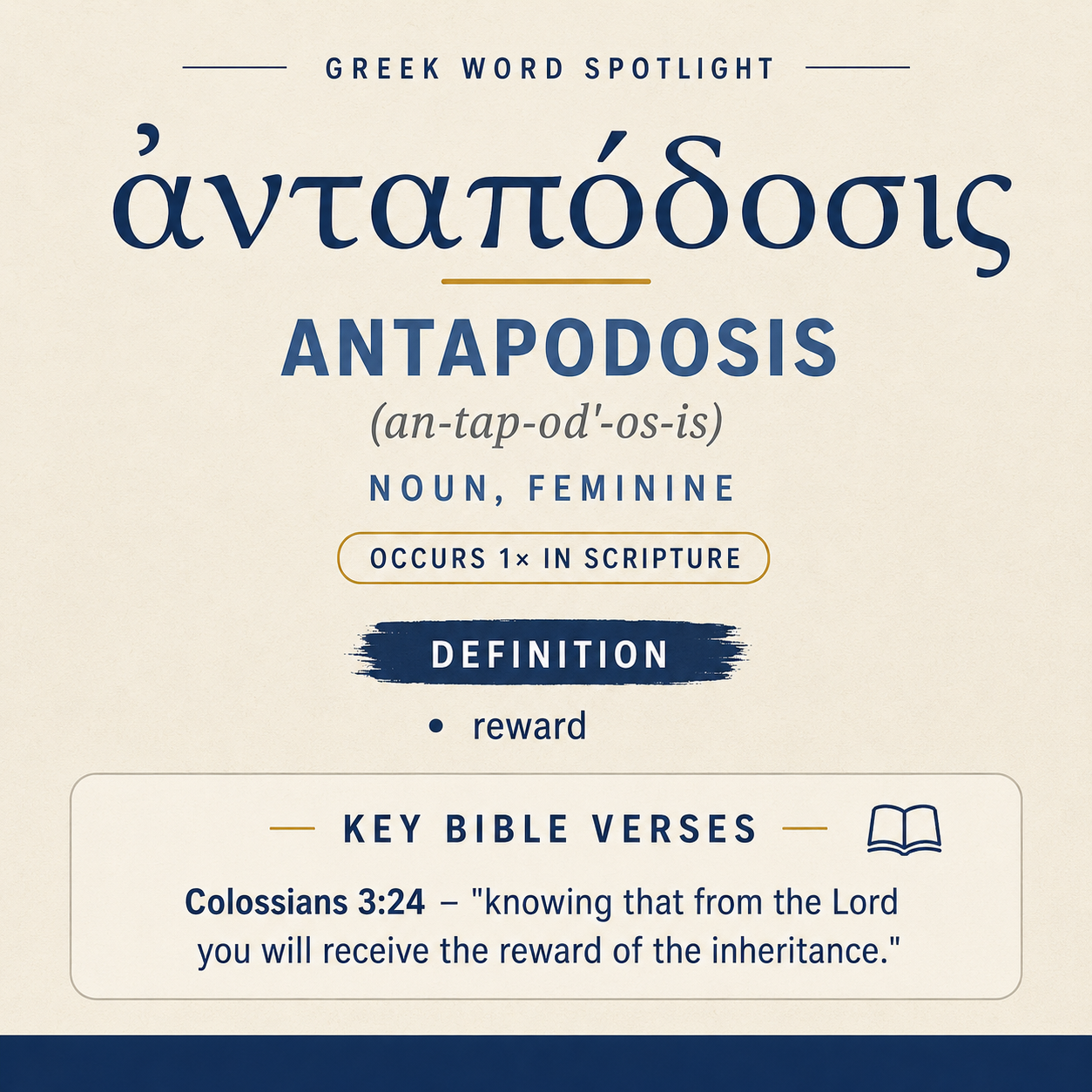
ἀνταπόδοσις means “reward” and appears once in Scripture, in Colossians 3:24.
Scripture Occurrence
It occurs 1 time in Scripture. The occurrence is in Colossians 3:24.
Learn More →Context in Colossians
Colossians 3:24 says believers will receive “the reward of the inheritance” from the Lord. The verse adds, “for you serve the Lord Christ.”
Learn More →ἀνταπόδοσις refers to a “reward” and is used once in the New Testament, in Paul’s instruction to believers about their service to Christ. In its lone occurrence, it names what the Lord will give in connection with an “inheritance.”
Root and Related Words
ἀνταπόδοσις is related to the verb antapodidōmi (ἀνταποδίδωμι), meaning “to repay” (Strong’s G467). The noun expresses the outcome or product associated with that verb’s action: what is given back as recompense.

Occurrences
“knowing that from the Lord you will receive the reward of the inheritance; for you serve the Lord Christ.” (Colossians 3:24)
Here ἀνταπόδοσις appears in a clause of assurance: “you will receive the reward.” The giver is explicitly identified—“from the Lord”—and the receiving is future (“you will receive”), so the term functions as a promised bestowal rather than a present wage. The wording also tightens the idea of reward by linking it to a defined good: “the inheritance.” In this sentence, the “reward” is not left as an unspecified benefit; it is framed as “the reward of the inheritance,” a reward characterized by, or bound up with, what is called “the inheritance.”

The second half of the verse grounds this expectation in the believer’s present allegiance: “for you serve the Lord Christ.” Within this immediate scene, ἀνταπόδοσις supports the logic that service rendered is not aimless or unseen. Paul’s statement does not describe the mechanisms of how the reward is calculated; instead, it anchors the certainty of reception (“you will receive”) in the identity of the Master served (“the Lord Christ”) and the source from whom it comes (“from the Lord”). As a result, the noun contributes a stabilizing point in the exhortation: faithful service is matched by a definite, Lord-given reward tied to the inheritance.
Sense and Usage
The sense of ἀνταπόδοσις as “reward” is presented with several features that shape its force in Colossians 3:24.
First, the reward is personal and relational in its direction: it comes “from the Lord.” The verse places the Lord as the active giver, making the reward an expression of his granting rather than something extracted from human systems. The noun, therefore, does not stand alone as an abstract concept; it is set within a giver–receiver relationship where the Lord is the one who ensures the outcome.
Second, the reward is future-oriented: “you will receive.” The term speaks into the time horizon of Christian obedience. Its role in this sentence is to make present service intelligible in light of a coming reception. The verse uses the certainty of that future reception as a motive and consolation for those currently “serve[ing] the Lord Christ.”
Third, the reward is defined by its association with “the inheritance.” Grammatically, the phrase “the reward of the inheritance” draws the reader to consider the reward in close connection with what is inherited. That linkage affects how the reward is heard: it is not depicted as a stray bonus detached from the believer’s standing, but as something belonging to the category of inheritance. In other words, the verse presents the reward as something that coheres with the idea of receiving what is allotted or granted as an inheritance.
Fourth, the reward language works to align motivation with the true Master. The verse contrasts nothing explicitly, but it does set emphasis: the believer’s service is to “the Lord Christ,” and the reward is “from the Lord.” In that tight framing, ἀνταπόδοσις helps locate the center of accountability and hope in the Lord himself. The reward is not portrayed as self-generated satisfaction; it is something received from a person of authority who sees and grants.
Finally, the relation to antapodidōmi (ἀνταποδίδωμι), “to repay,” supplies a conceptual shading without adding a new gloss: the noun fits the logic of recompense. Colossians 3:24 does not spell out a ledger of merits; yet by calling what is received a “reward,” the verse places the Lord’s giving in a framework where faithful service is answered with fitting return. The word therefore carries a moral coherence in the sentence: service and reward correspond, because the same Lord who is served is the Lord who grants the reward.
Imagery
In Colossians 3:24, ἀνταπόδοσις evokes the picture of a gift conferred by a master upon a servant: “from the Lord you will receive.” The imagery is not of grasping or taking, but of receiving, and the reward is portrayed as something already framed—“the inheritance”—waiting to be granted by the Lord to those who “serve the Lord Christ.”
Sources: Lexical data from Strong’s Exhaustive Concordance and the Translators Brief Lexicon of Extended Strongs for Greek (STEPBible, CC BY). Occurrence data from the Translators Amalgamated Greek New Testament (STEPBible, CC BY). Scripture quotations from the World English Bible (public domain).





