
The Significance of Amphipolis in Greek Culture
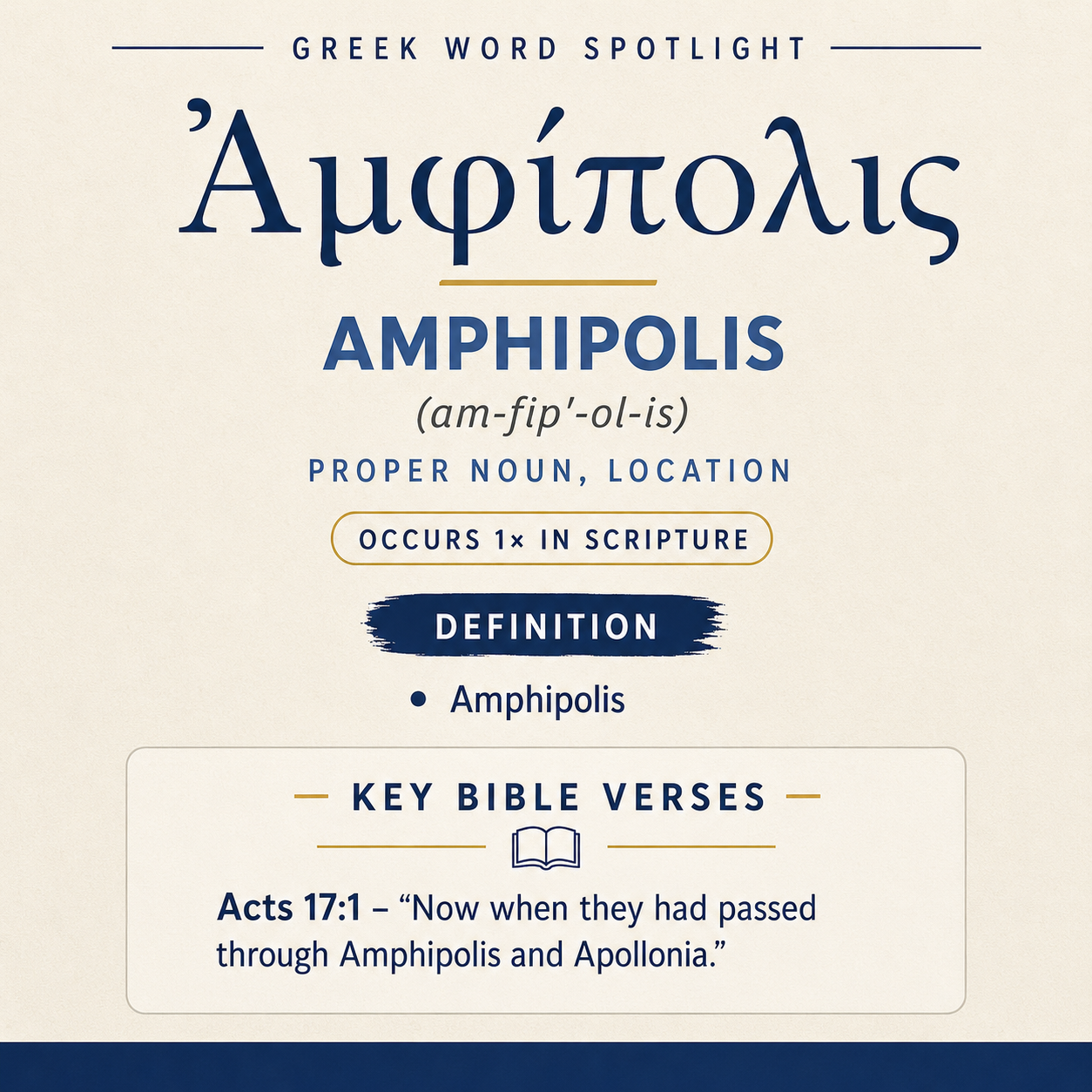
Ἀμφίπολις (Amphipolis) refers to Amphipolis and appears in Acts 17:1.
Acts Narrative
In Acts 17:1, Paul and his companions passed through Amphipolis and Apollonia on the way to Thessalonica.
Learn More →Amphipolis is a place-name that appears in the narrative of Paul’s travel in Acts. It functions as a named waypoint in a sequence of towns passed through on the way to Thessalonica.
Root and Related Words
The name Amphipolis is connected with the Greek adjective amphoteros (ἀμφότερος), “both” (Strong’s G297), and the noun polis (πόλις), “city” (Strong’s G4172). In the form used in Acts, the word behaves like a single, established toponym rather than a descriptive phrase, serving primarily to identify a specific location in the travel itinerary.
Occurrences
“Now when they had passed through Amphipolis and Apollonia, they came to Thessalonica, where there was a Jewish synagogue.” (Acts 17:1)
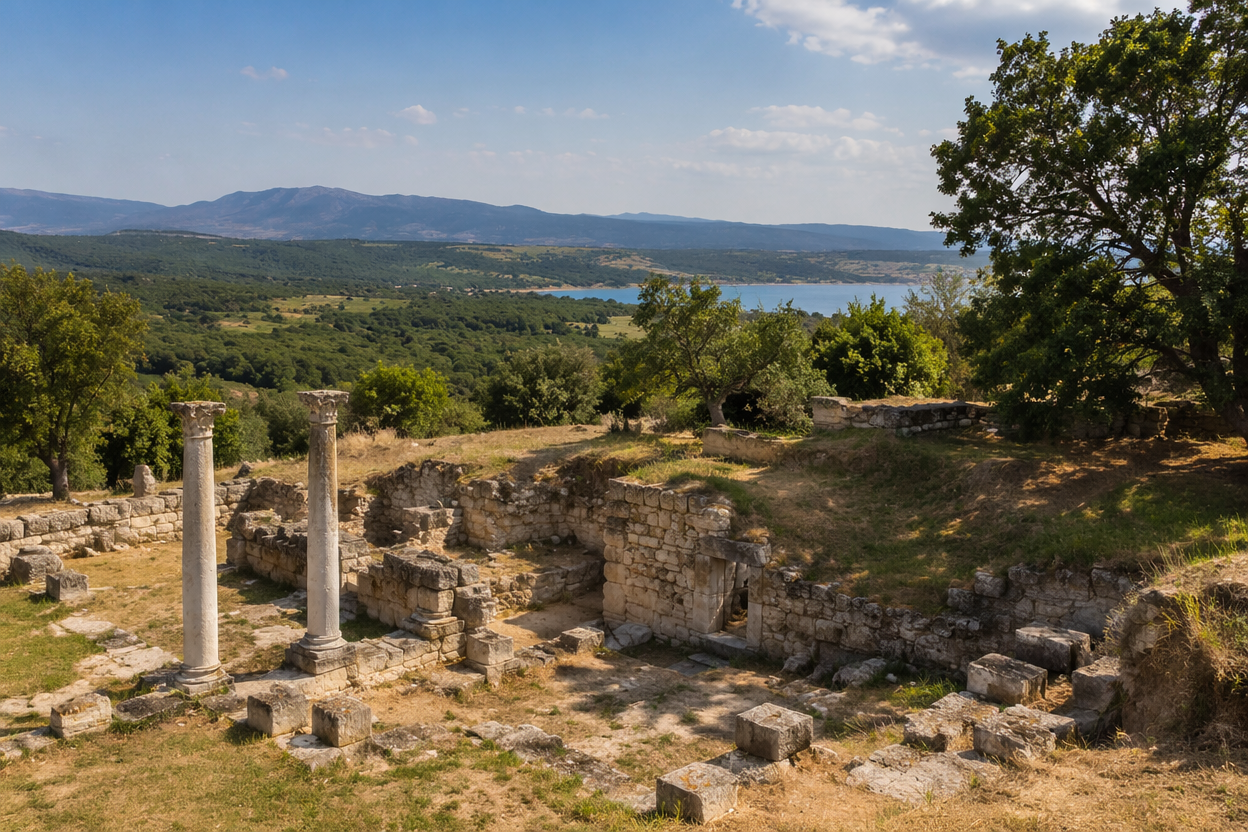
Here Amphipolis appears in a chain of place-names that marks movement from one location to another. The clause “passed through Amphipolis and Apollonia” presents these locations as stages along the road, and the naming of Amphipolis helps the sentence do two things at once: it gives geographic specificity to the journey, and it paces the narrative by indicating that travel involved more than a direct, single-step arrival at Thessalonica.
Within the verse’s structure, Amphipolis is not the destination where the narrated action pauses; the action culminates with “they came to Thessalonica,” and the reason Thessalonica matters for what follows is immediately supplied: “where there was a Jewish synagogue.” By contrast, Amphipolis functions as a transitional marker. It contributes to the reader’s sense of progression—an ordered passage through identifiable towns—while remaining itself a passing point rather than the location of an explicit encounter, speech, or event in the verse.
Amphipolis also participates in a coordinated pair: “Amphipolis and Apollonia.” The coupling emphasizes that more than one town lay between the prior context and Thessalonica, and the verb “passed through” positions both as traversed spaces. That phrasing frames Amphipolis as part of the landscape of travel: a real place with a name, included because the journey is being narrated in concrete terms.
Sense and Usage
As a proper place-name, Amphipolis operates chiefly as an identifier. In Acts 17:1 it does not carry a described quality or a stated role other than being one of the locations through which “they” traveled. The effect is documentary and directional: the narrative is anchored in a route, and the reader is given a sequence of towns that situates the arrival at Thessalonica within a larger movement.
The immediate context shows a contrast between places that are merely traversed and the place where the narrative is poised to focus. Amphipolis belongs to the former category in this verse. It is mentioned without commentary, which is itself a meaningful narrative choice: the name is included to trace the path, not to introduce a new setting for dialogue or conflict. In that way, Amphipolis contributes to the story’s sense of continuity—events in Thessalonica are connected to a journey that passed through other named localities.
The verse also shows how a toponym can carry weight without additional description. Because the text does not pause at Amphipolis, its role is to keep the narrative moving while maintaining specificity. The reader is not left with a vague impression of travel; instead, the travel is mapped by names. Amphipolis, then, is used as a coordinate in the flow of the account: it helps define the “from…through…to” pattern that culminates in a place where subsequent action is expected (“where there was a Jewish synagogue”).
The pairing with another town (“Amphipolis and Apollonia”) underscores that the journey involved successive legs. In this sentence, Amphipolis is one of the steps that leads to the stated objective of the verse, arrival at Thessalonica. Its inclusion supports the narrative logic: traveling missionaries moved through multiple locations, and their appearance in Thessalonica is presented as the result of a real itinerary rather than an abrupt scene change.
Imagery
Although Amphipolis is a bare place-name here, it evokes the concrete imagery of travel: roads that pass through towns, stopping points along a route, and the steady forward motion of a group headed toward a city with a synagogue. In Acts 17:1, Amphipolis belongs to that travel-imagery—named on the way, part of the path by which the travelers “came to Thessalonica.”
Sources: Lexical data from Strong’s Exhaustive Concordance and the Translators Brief Lexicon of Extended Strongs for Greek (STEPBible, CC BY). Occurrence data from the Translators Amalgamated Greek New Testament (STEPBible, CC BY). Scripture quotations from the World English Bible (public domain).





