
Understanding the Significance of Amphiblestron in Greek
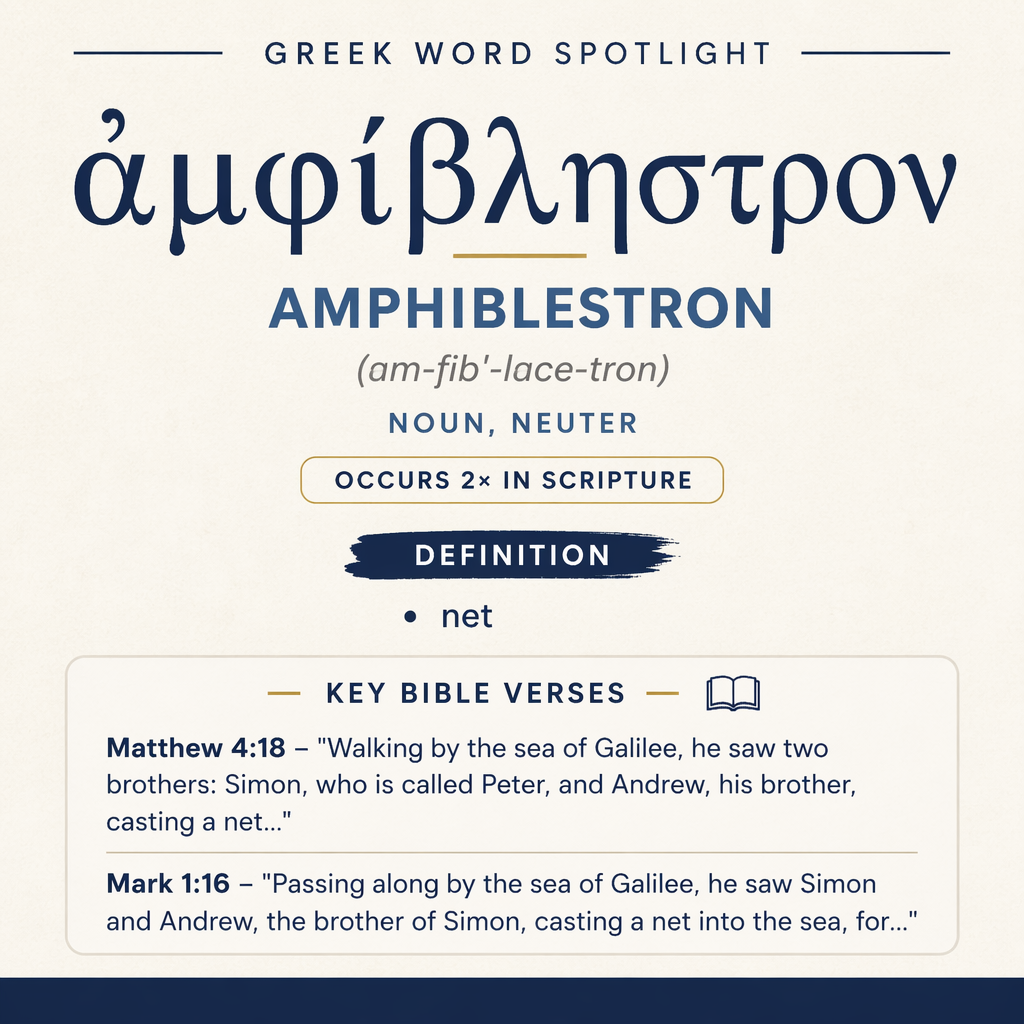
ἀμφίβληστρον means “net” and appears in Matthew 4:18 and Mark 1:16.
Scene Context
In both verses, Simon and Andrew are casting a net into the sea of Galilee.
Learn More →ἀμφίβληστρον means “net” and appears in two parallel scenes at the Sea of Galilee, in Matthew and Mark. In both passages it belongs to the everyday work of Simon and Andrew as fishermen casting into the water.
Root and Related Words
ἀμφίβληστρον is connected with ἀμφότερος (amphoteros), “both” (Strong’s G297), and βάλλω (ballō), “to throw” (Strong’s G906). Together these related terms situate the word within the action of throwing and the idea of “both,” aligning well with a net that is cast out in a spreading motion.

Occurrences
“Walking by the sea of Galilee, he saw two brothers: Simon, who is called Peter, and Andrew, his brother, casting a net into the sea; for they were fishermen.” (Matthew 4:18)
Here ἀμφίβληστρον is the immediate object of the brothers’ labor: they are “casting a net into the sea.” The sentence gives the setting (“by the sea of Galilee”), the observers’ perspective (“he saw”), and the workers’ identity (“two brothers… fishermen”), but the net is what makes the activity specifically fishing rather than simply standing by the shore. The word anchors the scene in a concrete tool that is actively handled—something extended outward from the hands into the water. It also helps the verse move from naming Simon and Andrew to explaining their occupation: the net is the visible evidence that “they were fishermen.”
The net is not described in its size, shape, or material; instead, the verse highlights its use. The verb “casting” places the emphasis on motion and direction: it goes “into the sea.” ἀμφίβληστρον therefore contributes a tactile realism to the moment—this is not an abstract label for their trade but an item in motion as the scene unfolds.
“Passing along by the sea of Galilee, he saw Simon and Andrew, the brother of Simon, casting a net into the sea, for they were fishermen.” (Mark 1:16)
Mark presents the same essential activity with slightly different framing. The subject is “Passing along,” which makes the sighting feel like an encounter along a route, and ἀμφίβληστρον again appears as the tool that defines what is happening: “casting a net into the sea.” The explanatory clause “for they were fishermen” again interprets the action for the reader, and the net is the centerpiece of that interpretation. Without the net, the statement “they were fishermen” would be a bare assertion; with the net, the occupation is inferred from what is seen.
The repetition of the same action in a second Gospel also gives the word a stable narrative profile: it belongs to shoreline work, to the sea itself, and to a specific pair of brothers identified by name. In both accounts, the net is the point where the setting (sea), the people (fishermen), and the action (casting) meet.
Sense and Usage
Across Matthew 4:18 and Mark 1:16, ἀμφίβληστρον functions as a straightforward term for a fisherman’s net within a brief observational report: someone walking by sees fishermen at their work. The word is not used metaphorically in these verses; its force comes from its concreteness and from the way it ties identity to activity. The brothers are known in the scene not by speech or by a description of character but by what they are doing with this implement.
Both passages place the net “into the sea,” so its use is inseparable from the body of water that defines the locale: “the sea of Galilee.” That prepositional detail matters for how the word is experienced in the sentence. The net is not simply held or carried; it is thrown outward into a particular environment. In this way ἀμφίβληστρον is presented as an instrument that bridges land and water—handled on the shore, directed into the sea—so that the work of fishing can occur.
The explanatory clause “for they were fishermen” appears in both accounts and draws a line from tool to trade. The net is the emblem of their occupation precisely because it is the means by which fishing happens in the moment: it is what they cast. The word thus participates in a compact scene-setting technique: a single concrete object, linked with a single visible action, communicates a whole way of life (“they were fishermen”) without extended description.
The related terms also illuminate the action implied in the context. The connection with βάλλω (ballō), “to throw,” corresponds to the verb “casting” that governs the net in both verses; ἀμφίβληστρον belongs to an action-oriented vocabulary where the tool is defined by what is done with it. The association with ἀμφότερος (amphoteros), “both,” points in the direction of a net’s spreading or encompassing motion as it is cast, which fits the repeated portrayal of the net not as a static possession but as something actively extended into the water.
Imagery
In these two passages, ἀμφίβληστρον carries the imagery of ordinary work at the water’s edge: two brothers, the sea beside them, and a net moving from hand to water. The word evokes a scene defined by motion (“casting”), place (“by the sea of Galilee”), and purpose (“for they were fishermen”), where a simple tool makes visible the trade and rhythm of life on the shore.
Sources: Lexical data from Strong’s Exhaustive Concordance and the Translators Brief Lexicon of Extended Strongs for Greek (STEPBible, CC BY). Occurrence data from the Translators Amalgamated Greek New Testament (STEPBible, CC BY). Scripture quotations from the World English Bible (public domain).




