
Understanding the Significance of Akon in Greek
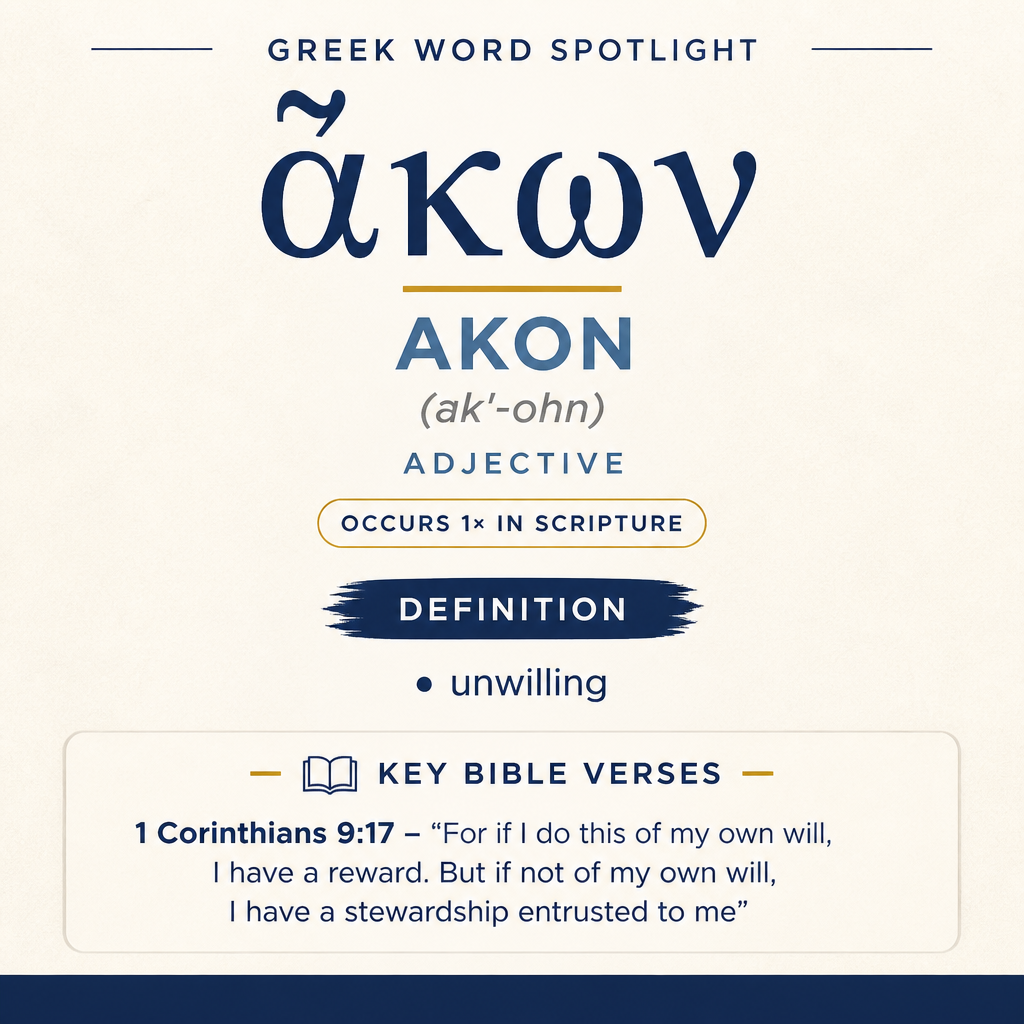
ἄκων means “unwilling” and appears once in Scripture, in 1 Corinthians 9:17.
Scripture Occurrence
ἄκων occurs 1 time in Scripture. Its single occurrence is in 1 Corinthians 9:17.
Learn More →Verse Context
In 1 Corinthians 9:17, the verse contrasts doing something “of my own will” with “not of my own will.”
Learn More →ἄκων expresses the stance of acting “unwilling,” marking a deed as not arising from one’s own desire. It appears once, in Paul’s discussion of motive and obligation in 1 Corinthians 9:17.
Root and Related Words
ἄκων (Akon) is related to ἑκών (hekon), “voluntarily” (Strong’s G1635). It is also connected in Strong’s to Α (alpha), “Alpha” (Strong’s G1).

Occurrences
“For if I do this of my own will, I have a reward. But if not of my own will, I have a stewardship entrusted to me.” (1 Corinthians 9:17)
In this sentence Paul places two modes of doing the same work side by side: acting “of my own will” and acting “not of my own will.” ἄκων belongs to the second mode, specifying that the action is carried out unwillingly—without the inward consent or preference conveyed by “of my own will.” The contrast is not between doing and not doing, but between doing voluntarily and doing under a different kind of necessity. That necessity is named explicitly in the second clause: “I have a stewardship entrusted to me.” ἄκων, then, helps Paul frame his labor as something that can be performed either as a self-chosen undertaking with “a reward,” or as a charge laid upon him, where the defining feature is obligation rather than eagerness.

The wording of the verse sets up a tight logic. The first clause links willing action to the prospect of “a reward.” The second clause links unwilling action to the fact of being entrusted with “a stewardship.” By marking the second clause with unwillingness, ἄκων sharpens the distinction: it is possible to carry out a task faithfully even when it is not one’s own preference, because the task stands as an entrusted responsibility. In this way the word serves Paul’s argument about motive—he speaks not only of what he does (“I do this”) but of the internal posture in which it is done.
Sense and Usage
As used in 1 Corinthians 9:17, “unwilling” functions as a qualifier of agency: it describes the manner in which an action is undertaken rather than the external form of the action. Paul’s language shows that unwillingness here does not mean inactivity; the deed still occurs (“I do this”). Instead, ἄκων characterizes the deed as not proceeding from personal choice (“not of my own will”), and the verse supplies a reason why such action nevertheless takes place: the actor has been entrusted with “a stewardship.”
The immediate contrast with the idea of acting “of my own will” draws attention to the difference between voluntary initiative and compelled responsibility. The verse does not portray unwillingness as mere emotional reluctance for its own sake; it is tied to a framework of accountability. The entrusted “stewardship” places the action under obligation, so that the work is done whether or not it is welcomed as a chosen project. Within the verse’s logic, ἄκων highlights a kind of service where the determining factor is not self-directed desire but a charge received from another.
This single occurrence also shows how “unwilling” can be rhetorically useful in moral reasoning. By stating the unwilling alternative explicitly, Paul makes room for a scenario in which the same labor is performed without the personal satisfaction or self-determination implied by “of my own will.” The word therefore helps distinguish two grounds for action—one connected with reward, the other connected with trust. Even without expanding beyond the verse, the placement of ἄκων indicates that unwillingness is not treated as an excuse for abandoning the task; the stewardship remains “entrusted,” and the work remains something he does.
Imagery and Framing
The imagery of 1 Corinthians 9:17 is administrative rather than visual: “reward” on one side and an “entrusted… stewardship” on the other. ἄκων colors that stewardship with the realism that a person may carry a trust without inner willingness, yet still be bound to discharge it as a responsibility laid upon him.
Sources: Lexical data from Strong’s Exhaustive Concordance and the Translators Brief Lexicon of Extended Strongs for Greek (STEPBible, CC BY). Occurrence data from the Translators Amalgamated Greek New Testament (STEPBible, CC BY). Scripture quotations from the World English Bible (public domain).




